


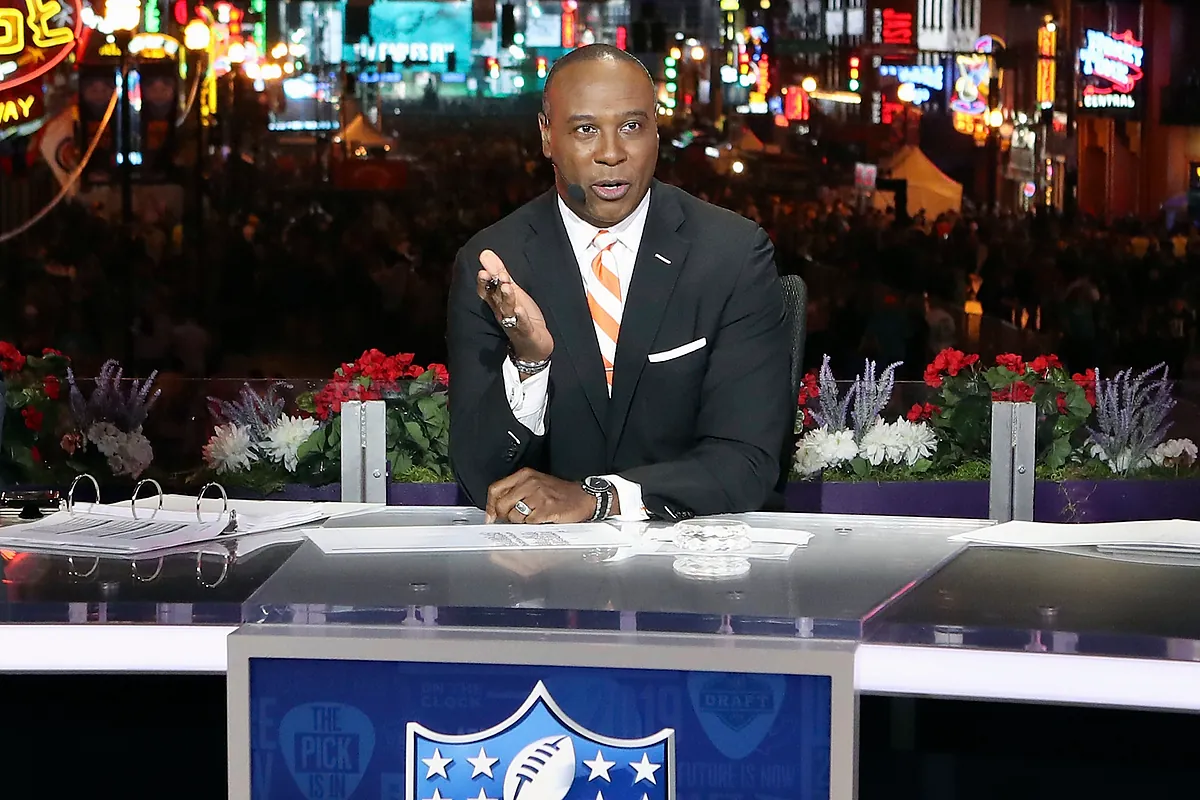
The NFL Draft is already looming on the calendar as one of those dates that alters the pulse of the league even before the first ball flies in September. Between Thursday, April 23 and Saturday, April 25, Pittsburgh will host a new edition of an event that each year mixes excitement, strategy, business, debate and future. In this prelude, Charles Davis, one of the NFL’s leading analysts and a draft specialist, left several interesting reflections in a virtual press conference in which he reviewed proper names, college football trends and the real impact that this event has on the construction of a franchise.
Davis started with an idea that sums up the magnitude of the moment. The draft, he said, remains the NFL‘s great renewal mechanism. “I’m very excited, obviously, every time we look at how we’re going to renew and nurture the NFL.” It’s not a minor phrase. In a league obsessed with competitiveness and balance, the draft is not just a televised ceremony or a showcase of promises: it is the tool that defines projects, corrects mistakes, fills gaps and sometimes changes the destiny of a locker room.
It is not surprising, therefore, that Davis also praised the chosen venue. “There couldn’t be a better NFL city than Pittsburgh. They love their Steelers.” The choice of Pennsylvania fits with the symbolism of the event. Few cities better represent football culture than a place where the bond between team, stands and local identity is part of the emotional landscape of American sports.
The event is also attracting increasing interest from outside the United States. In the UK, it will be broadcast live and free of charge on DAZN and NFL Game Pass, further evidence of the league’s international push. The NFL itself, aware of this growth, continues to widen its reach with programs such as the International Pathway Program, something Davis was keen to stress when talking about the increasingly diverse background of players coming into the competition.
“It all starts with the new players coming into the league,” he explained. And he immediately linked this idea to the global dimension of today’s football: “We are reaching out worldwide with the International Pathways program and players are coming from everywhere.” In his review, he mentioned names that already serve as examples for the expansion of the sport, such as Scotsman Jamie Gillan or Australian Jordan Mailata, who became an All-Pro after a career as improbable as it was revealing. He also cited Moritz Böhringer, the German who was drafted in the fifth round and who, although he did not end up consolidating, symbolized in his day that novelty that so seduces the NFL: the possibility of finding talent where before almost no one looked.
Among the proper names in this edition, one stood out above the rest: Fernando Mendoza. The quarterback was one of the main topics of the press conference and Davis made it clear that the league is closely following his evolution after his time at Cal and his subsequent explosion at Indiana. “He’s an excellent player and we’re very excited about what he brings,” he said. He then wanted to play down the temptation of grandiose labels, so common at this time of year. “We believe he will be a great player in the NFL. Whether he is generational or not, like Tom Brady, whose team he is going to reinforce, remains to be seen”.
The nuance is not accidental. Around the draft, there is always a need to anticipate legends, to label each quarterback as the next phenomenon, the heir to someone, the new savior of a franchise. Davis preferred to take refuge in caution, although he did not skimp on praise: “What I do know is that he is a great person, a great player, and the league is delighted that he is going to be part of it.” It’s an elegant way of saying that the talent is there, but that the NFL, as it almost always does, will end up dictating its verdict on the field.
In one of the most interesting responses of the talk, Davis also entered into a debate that marks the present of college football: the new ecosystem created by NIL and the current ease of changing schools. The system of financial compensation for college players and the flexibility to move between programs has completely transformed the map prior to the professional leap. However, the draft remains virtually unchanged in its structure.
Therein lies one of the great tensions of modern football: the freedom of the player before reaching the NFL versus the competitive straitjacket imposed by the professional league. Davis summed it up clearly. “It’s a very difficult balance because the pathway into the NFL since the 1930s has been through the draft,” he said. From the player’s perspective, he acknowledged, it would ideally be possible to choose a destination from the outset. But that’s not how the NFL works. The logic of competition dictates that the worst teams have priority in choosing, and that forces many emerging stars to land in unfavorable contexts.
Even so, Davis recalled that the system also offers immediate rewards. “In the NFL it’s not the same, but it also has advantages: immediate salary, bonuses, etc. It’s a difficult balance, but players are willing to take it,” he said. It is, at heart, a fairly accurate picture of the business: less initial freedom in exchange for getting into the most powerful economic and competitive machinery in football as soon as possible.
Another underlying issue was the effect of NIL on players’ staying in college. For Davis, the phenomenon has a positive reading. “Now players can make money and don’t need to go to the NFL early.” This, in his opinion, means that many players are more mature when they reach the professional ranks, although they are also older, a nuance that in the NFL always generates discussion because of the importance of physical development and the potential length of careers.
The conversation also turned to Spain. Asked what Spanish players lack to make it to the draft after well-known cases such as Alejandro Villanueva or JJ Arcega-Whiteside, Davis went straight to the heart of the matter. “I don’t think talent is the problem. It’s growing up with the sport.” His analysis pointed less to athletic ability than to a lack of tradition. “It’s not athletic ability, it’s having grown up with the sport.” It is a logical reflection in a country where soccer occupies the cultural and media center, while American football continues to advance, yes, but still far from the exposure and formative base it has in the United States.
In the same vein of international expansion, Davis was optimistic about the growing Latin and Hispanic interest in the NFL. He highlighted names such as KC Concepcion, Diego Pavia, Joey Aguilar and Enrique Cruz Jr. and linked this focus with the league’s global outreach and the holding of international games, including Spain within the championship’s strategic horizon.
When the conversation turned to the concrete value of this draft for the franchises, the response was as short as it was forceful. To Nacho Labarga’s question, Davis left no room for doubt: “It’s always important. This draft has very good players, although fewer superstars. It serves to make the competitive leap.” There is probably one of the keys to this edition. There may not be such an exuberant collection of star names as in other years, but there is enough depth for many franchises to find pieces capable of raising the level of their squad from day one.
In a league where the margin between competing and falling behind is so small, this type of draft can be even more decisive. It’s not always about choosing the player who will sell the most jerseys or make the most headlines. Sometimes the difference is made by an underrated linebacker, a smart safety or a reliable piece for the offensive line. And it is precisely in this area, that of less flashy but very useful profiles, that Davis left several clues.
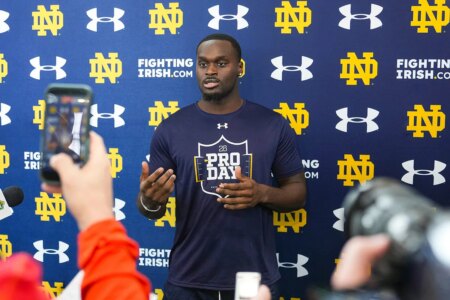
In addition to Mendoza, he cited Notre Dame running back Jeremiyah Love, BYU linebacker Jack Kelly, Utah offensive lineman Spencer Fano and Oregon safety Dillon Thienemann. It is a list that, rather than seeking the impact of the big name, seems to draw the obsessions of any serious scouting department: talent, projection, context and market value.
Davis closed his speech with a very revealing reflection on the draft process itself. He believes it could be improved, yes, perhaps by shortening it a bit. But at the same time he understands perfectly why the NFL does not touch too much a machinery that generates conversation throughout the year. “This process already lasts 12 months a year. We talk about the draft even when it’s not happening.” And he concluded with a phrase that explains why this product has become a phenomenon in itself: “There are more people who want to talk about the draft than about the games themselves.”
It is a very NFL paradox. A show that has not yet begun to be played already dominates talk shows, forecasts, simulations and debates. It is the realm of expectation, of the board, of calculation and hope. Pittsburgh is already preparing for three days of noise, spotlights and decisions that can change careers and rebuild franchises. And Charles Davis, with the serenity of someone who has been reading this theater of promises for years, made it clear: maybe this draft will not bring so many superstars, but it can change many things. In the NFL, almost always, that is already a lot.
Read the full article here