

An eerie silence descended over the stadium. Sure, Randy Moss had fumbled away the football. But the void seemed too big — too hushed — for something as surmountable as a mere turnover.
New England Patriots backup quarterback Matt Cassel then looked back at the line of scrimmage. And he understood instantly.
“I see Tom [Brady] sitting there holding his knee,” Cassel told me.
He saw the trainers doing the ACL test, moving the knee in the direction where the ligament should stop it. Brady got up and hobbled straight into the locker room.
“Cassel, get your helmet. Warm up. You’re going in,” Bill Belichick said.
The legendary coach’s delivery was matter-of-fact, trying to make something immense feel simple. No big deal, right? Just another day at work: replacing Tom Brady.
Tom Brady heads off the field after the knee injury that cost him his 2008 season with the Patriots. (Photo by Damian Strohmeyer /Sports Illustrated via Getty Images)
That was Sept. 7, 2008, in New England’s opener against the Kansas City Chiefs. Brady was fresh off a season during which he cemented himself as the best quarterback of his generation, kickstarting a campaign to become the greatest of all time. The Patriots went undefeated in the 2007 regular season, only to lose the Super Bowl — which left some pretty important unfinished business. Everyone in New England expected the team to run it back in 2008, and to finish the job this time.
That suddenly became Cassel’s charge. This is the life of an NFL backup QB: finding ways to make something immense look and feel simple.
“It’s psychological warfare,” Cassel said.
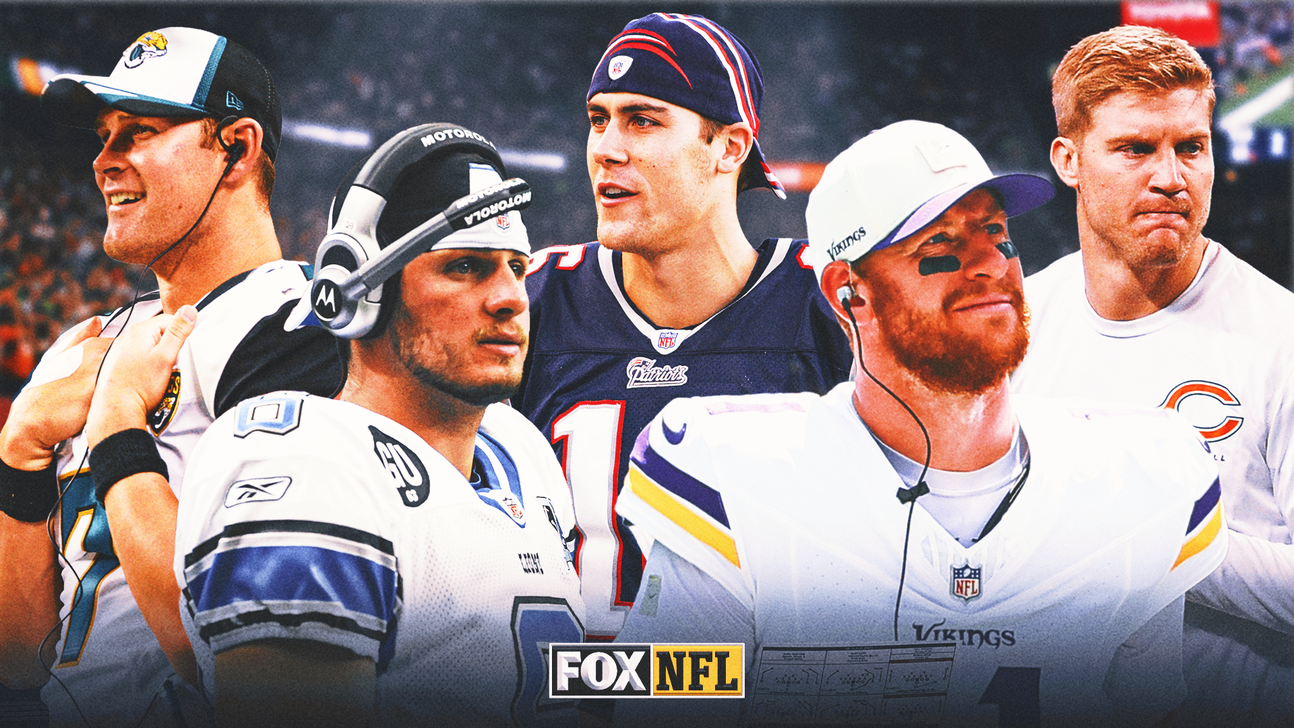
Most fans watch on Sundays and see the backup quarterback on the sideline wearing a clean jersey, a ball cap and a headset. Maybe he’s holding a clipboard or a tablet. He’s going to make a fortune just standing there, without being subjected to the violence that makes football, football.
Matt Cassel was pressed into service for the Patriots on opening day in 2008, having to replace a legend in the making on a team with unbridled expectations. (Photo by David Eulitt/Kansas City Star/Tribune News Service via Getty Images)
It’s only natural to think: Wouldn’t that be a nice job? Well, think again. Ask any backup what it feels like being a backup.
“I don’t think anybody ever wants to be in that backup role,” said Chad Henne, once a Miami Dolphins starter who finished his career as backup to Patrick Mahomes in Kansas City.
“For three hours every Sunday, you’re on the edge of your seat. Your heart’s in your chest,” Josh McCown, who was a backup for most of his 16 years in the NFL, told me.
“There’s this level of stress that you just can’t control,” Vikings veteran Carson Wentz told me during training camp.
Wentz is one of several backup QBs who’ve already had to jump into the starting lineup this season. We’ve also seen Seahawks quarterback Drew Lock replace Sam Darnold, and Jameis Winston replace Giants starter Jaxson Dart. This week, Jack Strand, a QB4, took over for Cooper Rush, a QB3, because the Atlanta Falcons’ top two options — Tua Tagovailoa and Michael Penix Jr. — were sidelined by injury. And Bears backup Tyson Bagent subbed in for Caleb Williams, who suffered a hamstring injury against the Vikings in Week 2.
Every year, we see backups get thrown into action. They often haven’t taken a single rep with the first-team — maybe going back as far as training camp, if they were lucky enough to be with the team at that point. And often, they get judged as if they were always the starter.
I wanted to know what that’s like. So I asked around. These are the war stories from the moments when backups ascended to the QB1 spot and how they coped with that psychological warfare.
When Brady went down, Cassel had not played a competitive snap of football since high school. He was a four-year backup for Heisman Trophy winners Carson Palmer and Matt Leinart at USC before serving as a four-year backup for the Patriots.
“My heart’s beating through my chest, probably close to damn near hyperventilating,” Cassel said. “I can hear my heartbeat in my ears. … This is my first real opportunity to go into a meaningful game. You’ve been waiting for this opportunity, but you don’t know until you know, right?”
Playing behind two Heisman winners, Cassel threw a total of 33 passes in four years at USC and never started a game. (Photo by Jeff Gross/Getty Images)
When Cassel entered the game on the ensuing drive, the Patriots were on their own 1-yard line. Perhaps to show confidence in his backup QB, offensive coordinator Josh McDaniels called a play-action pass.
“Jab 126 D pop X prick — I still remember the play,” Cassel said.
He faked a handoff and turned to look downfield. Obviously, he wanted Moss, but the future Hall of Fame receiver was not where he was supposed to be. He was freelancing.
“I’m blind to the pass pattern at this point [because of the play-action],” Cassel said. “I come off the fake, and all I see is Randy running downfield on a go-route. That wasn’t even the route called. I just instinctually threw it up. And he caught the thing and went for 51 down the sideline.”
The Patriots won 17-10, even if they’d lost Brady for the season. Cassel’s transition into New England’s QB1 started immediately after the game when the PR team ushered him up to the postgame podium. Cassel didn’t think about what he was wearing. He hadn’t brought any nice clothes. He just went in front of the cameras with what he had on.
Right after that session, he found a letter in his locker: a fine for $10,000.
The offense? He’d worn a Nike hat to the press conference. The NFL was a partner with Reebok.
“I was like, ‘Are you f—ing kidding?’” Cassel remembered.
Josh McCown’s last game was — to his recollection — the most intense of his journeyman career as a backup with nine NFL teams (and one United Football League team). McCown was the archetypal backup QB, a third-round draft pick who simply wouldn’t quit.
Until after a wild-card game against the Seahawks in January 2020, when the then-40-year-old quarterback served as the backup to Eagles starter Wentz, the No. 2 overall pick of the 2016 draft. (McCown now serves as Wentz’s quarterbacks coach in Minnesota.) Wentz went into concussion protocol in the first quarter and McCown replaced him with Philadelphia’s season on the line.
This is all pretty normal for a backup quarterback. Intense? Sure. But what makes it a war story is …
“At some point in the first half, I tear my hamstring off the bone,” McCown casually told me.
Yeah, OK, that’s bad.
“I go into halftime, and I see everybody around Carson — like the doctors. Everybody is around Carson. I’m like, ‘Oh, this is great, he must be coming out of the protocol. He must be cleared. He’s gonna come back and play,’” McCown said. “My leg’s kind of hurting, and I’m like, ‘He’s going back in there?’ And they say, ‘Oh no. No, no. He’s in the protocol. He’s out.’ I was like, ‘Well, can I get some help over here? Cause,” he paused, “my leg.”
McCown added: “The focus is never off the No. 1 guy no matter what you do.”
He finished that game, completing 18 of 24 passes for 174 yards with no touchdowns, no turnovers — and only one intact hamstring. The Eagles lost 17-9. It was McCown’s only playoff appearance in 16 (largely) thankless years, moving from quarterback room to quarterback room — Arizona to Miami to San Francisco to Chicago to New York and almost everywhere in between.
During this playoff game against the Seahawks in January 2020, Eagles backup Josh McCown tore his hamstring in the first half but finished the game. (Photo by Steven Ryan/Getty Images)
This was apparently the last straw for McCown. But somehow, it’s hardly a unique story.
It was Week 17 in 2011, and backup quarterback Dan Orlovsky was trying to help the 2-13 Colts get a win to end their season. Of course, it was a little more complicated than that because the franchise and the fan base wanted Stanford QB Andrew Luck in the upcoming draft.
“It was the whole ‘Suck for Luck’ saga,” Orlovsky told me.
The Colts had a shot at beating the Jaguars, and so before halftime, Indy drew up a Hail Mary in hopes of sneaking in some points in the 30th minute. The ball fell harmlessly incomplete. The play, however, was anything but harmless.
“Right when I threw it, I just got folded in half on the Hail Mary. … I tore my ankle up,” Orlovsky said. “And I just remember going into the locker room, and you fake it as much as you can.”
He pulled aside the trainer, quietly.
“This is in shambles,” he said, pointing to his ankle. “You have to do everything you can to tape this as hard as you can.”
When Orlovsky returned to the field in the second half, he said he felt like he was wearing a “space boot.”
“There was no way that I was coming out. I’ll finish the game on one leg,” he said.
“When you get on the field, it brings you back to the most fun days of your life — playing the game as a kid. And the last thing you want is to go off the field again, because you know you just don’t have that many opportunities.”
Colts backup QB Dan Orlovsky tore ligaments in his ankle in this game against the Jaguars in January 2012 but stayed in the game. (Photo by Joe Robbins/Getty Images)
He threw two second-half interceptions. The Colts lost 19-13, finished the season 2-14 and did, in fact, select Luck No. 1 overall in the 2012 NFL Draft.
Orlovsky went home to his wife, who had given birth to triplets just five days before the season finale. Shortly after, he was in the hospital to help take care of her and their three babies.
“My wife was hunched over in the hospital. I’m walking with a limp,” he said. “Like a week later, I end up going to the hospital. I tore all the ligaments in my ankle.”
The QB1 can afford to get healthy. But the QB2? Well, if he doesn’t seize his opportunity, he might never get another.
The moment a backup becomes a starter can feel like the biggest moment of his life. For the team, meanwhile, it is often an afterthought.
So much energy goes into getting a QB1 ready. NFL teams barely have time for the QB2, even if he spends all his time right next to the QB1. It’s sort of like the backup singer who spends an entire career supporting the needs of the headliner. All the while, some backup singers wonder: Could I do what the star does? (Shout out to the documentary “20 Feet From Stardom.”)
Quarterback Brian Hoyer had a career much like McCown’s: eight teams over 15 years. And Hoyer was a QB1 at times, but there was at least one moment when he was unexpectedly thrust into the starting role. He was the backup in Indianapolis in 2019 and had just finished filling in for Jacoby Brissett in Week 9 after the QB1 suffered a knee injury.
Brian Hoyer (No. 2) tagged in for starter Jacoby Brissett in 2019 with the Colts. (Photo by Tim Warner/Getty Images)
The plan for Week 10 was to get Brissett ready. As is customary, Brissett took the majority of the practice snaps. He got the majority of the attention in film study. He got the majority of the attention in the training room. He had the majority of the input on the game plan.
In short, he got the majority of everything. Because he was QB1.
Then, on Saturday afternoon with less than 24 hours until kickoff, Hoyer was not exactly thrilled at a sudden change of direction.
“The front office made the decision that they didn’t want to put [Brissett] in harm’s way. And they’re like, ‘Actually, you’re playing.’ And I was like, ‘You got to be s—ting me,’” Hoyer said.
Dare we ask how the game went?
In 2013, after Cassel spent a few seasons as the Chiefs’ starter, he was backing up Christian Ponder in Minnesota.
The team arrived in London for a September game against the Pittsburgh Steelers at Wembley Stadium. No one had spoken to Cassel about an injury that Ponder was managing, so the backup wasn’t expecting to play. Cassel went through meetings and all the necessary items, but he played golf early in the week and later in the week took the offensive linemen out to dinner.
“I’m having a grand old time,” Cassel said.
Then it’s Friday practice. He’s taking the field with Ponder. And Ponder strikes up casual conversation.
“Hey, Cass, did they tell you?” Ponder asked.
“Tell me what?” Cassel replied.
“You’re starting this week,” Ponder said.
“Well, s—, thankfully you told me,” Cassel said.
Cassel made a surprising start for the Vikings against the Steelers in London in 2013. It was a surprise to the QB as well. (Photo by Jamie McDonald/Getty Images)
Cassel immediately found head coach Leslie Frazier.
“Were you guys going to tell me that I was playing this week? That I’m starting?” Cassel asked.
“Did we not tell you?’” Frazier said.
Cassel threw for 248 yards and two touchdowns and the Vikings beat the Steelers 34-27.
Blaine Gabbert was in a heap on the field after yet another sack. It was 2012 and the Jacksonville Jaguars were doing … well, Jacksonville Jaguars things.
With Gabbert writhing on the ground, Chad Henne started his mental checklist: Do I warm up? What plays do I want called? Who is their nickel corner again? Where is my helmet? What if —
But then Gabbert got up. False alarm. Again, this is the life of a backup.
That season with Gabbert was a tough one for Henne. He’d just left Miami, where he’d been the Dolphins’ QB1 since they’d picked him in Round 1 in 2008. Not every backup QB starts as a backup QB. Henne was the face of the Dolphins for a while. Before that, he was a four-year starter at Michigan. Before that, he was the pride of Wilson High School in Pennsylvania, with an undefeated season and championship titles.
He’d never had to face the QB2 title — particularly with a second-year quarterback who wasn’t necessarily better than him.
“Just knowing that I had more experience,” Henne told me. “Not that I had more ability — the kid ran a 4.5 [40-yard dash]. He’s six-foot-four, had a rocket arm. But at the same time, my leadership and my preparation — I felt like I was better at understanding everything. I think that was just a big hit to me. Just sitting back and never overstepping the organization was the biggest transition for me.”
After being a starter in Miami, Chad Henne (7) had a difficult transition to backing up Blaine Gabbert (11) in Jacksonville. (Photo by Sam Greenwood/Getty Images)
Holding a clipboard is easy, in theory. But when the backup feels he’s better than the starter — like he has more to offer — that’s when things get complicated. That’s when holding that clipboard is the hardest thing to do.
Take Orlovsky, for example. Though he’d been a fifth-round pick out of UConn, he still thought he could start in the NFL.
“I remember going to Detroit and being like, ‘I’m going to become their version of Tom Brady.’ Like this is just what I do,” he said. “I work harder than everybody. I become the starting quarterback. We win games. I become the guy.
“That didn’t happen, obviously.”
But he thought it would. And why shouldn’t he? Like Henne, Orlovsky was The Man at every stop of his career until the NFL. That’s why it took him 10 years as a pro to reconcile with the backup reality.
There was a game in 2011 when he balled out for the Colts on Thursday Night Football. He played one of the best games of his career after taking over for Curtis Painter, who’d taken over for Peyton Manning, who was dealing with the neck injury that eventually landed him in Denver. It was a tight game, and Orlovsky finished with 244 passing yards and a touchdown.
At one point, the team’s punter, Pat McAfee, walked over to Orlovsky and said, “We win this game, you get so much money in the offseason.”
Orlovsky was set to be a free agent, and once he did, in fact, secure the win, he began to believe one of the 32 teams might offer him a starting job.
“Free agency comes. The NFL clearly financially says, ‘You’re a backup.’ And so in that moment, I transitioned to, ‘OK, I can sit here and say woe is me and blah blah blah. Or I can listen. I’m a backup. This league views me as a backup.’ And so that’s when I really started to transition the mindset.”
He added: “I started playing football when I was 10. I became a full-time backup essentially, at least in my mind, when I was 30. So for 20 years, the game had never told me I wasn’t good enough. And once the game tells you you’re not good enough, it’s definitely a hurdle to overcome mentally.”
This isn’t to say that the backup QB’s job is harder than the starter’s. But the moment the backup becomes the starter? That moment is harder than any moment the starter has experienced. That’s the moment when backups have all the pressure and none of the preparation. That’s the moment when they feel they can finally prove themselves.
But can they? Can they really?
The life of a backup quarterback may look easy. But while NFL teams spend all their resources setting up the QB1 to succeed, for the backup it’s often exactly the opposite.
WHAT YOU SHOULD READ NEXT
Read the full article here