


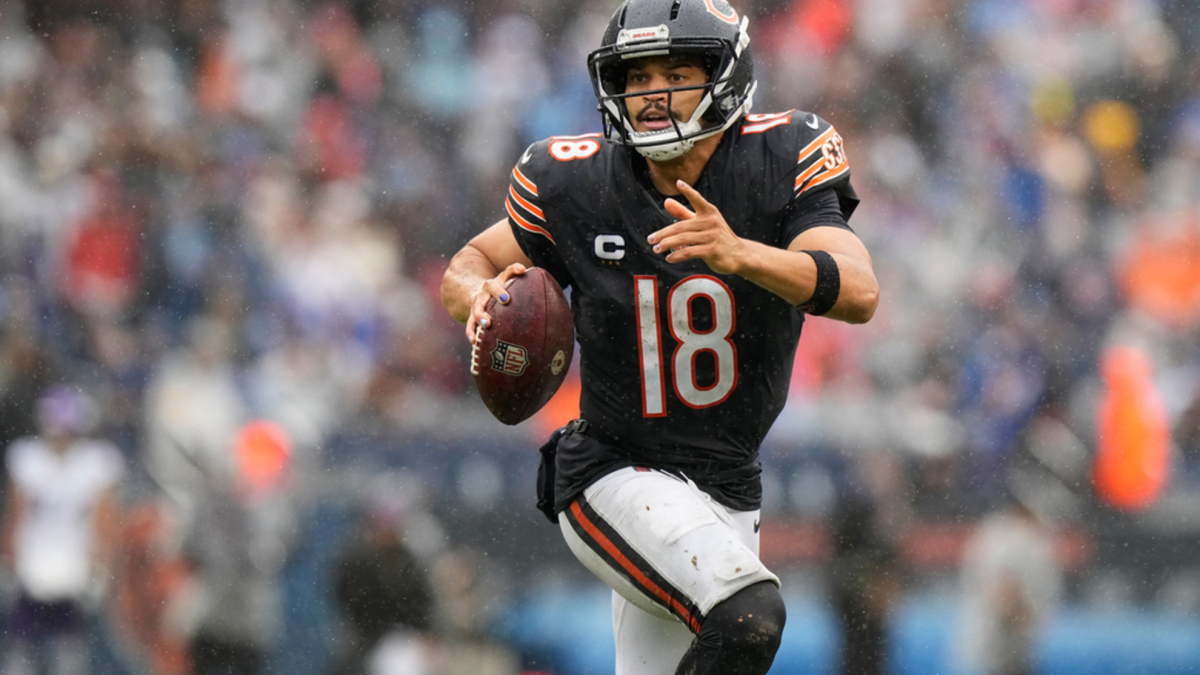
Caleb Williams’ reaction to his hamstring injury became part of the conversation before anyone really knew what had happened.
The Chicago Bears quarterback went down without contact during the Week 2 loss to Minnesota, stayed on the turf in obvious pain and eventually left on a cart. That was enough for some critics to question his toughness.
ESPN offered a much different explanation. Williams was diagnosed with a Grade 2 hamstring strain, but the intense pain may have been made worse by scar tissue tearing from an older hamstring injury he suffered at USC.
That can create an alarming sensation without necessarily meaning the player has suffered major new structural damage. That matters because Williams’ physical reaction was being judged before the medical context was known.
The Bears are currently working with an estimated recovery window of roughly three to four weeks. Chicago hasn’t placed Williams on injured reserve, which keeps open the possibility that he could return sooner if his rehab goes particularly well.
Head coach Ben Johnson has repeatedly stressed that Williams doesn’t always follow a normal recovery timeline.
“This guy’s a little bit different than the average human being,” Johnson said. “He gets back, he has in the past, a lot faster than what people can anticipate, and so I’m not putting a timeline on this. We’re going to say week-to-week. He’s going to attack this with everything that he knows.”
That optimism doesn’t mean the Bears will rush him back. Williams is the franchise quarterback, and a lingering hamstring problem would carry much greater consequences than missing a few early-season games.
Chicago suddenly has quarterback problem
The timing is especially difficult because the Bears have also had uncertainty at backup quarterback.
Tyson Bagent entered the concussion protocol after reporting symptoms, leaving veteran Case Keenum as another possible option if Bagent is unavailable. Johnson acknowledged that Chicago is weighing its choices.
“There’s a different skill set, obviously,” he said. “One guy’s a little bit more mobile than the other, and yet both are very cerebral players.”
Williams’ injury also ended a streak of 36 consecutive regular-season starts.
Pain now makes much more sense
The season had started brilliantly for Williams. He accounted for 334 total yards and four touchdowns in Chicago’s Week 1 win over Carolina before the hamstring injury disrupted everything against Minnesota.
A three-week absence would likely keep him out against Philadelphia, the Jets and Green Bay, while a Week 6 return against Atlanta would fit within the reported recovery window. The bigger takeaway is simpler.
Williams looked like a player in extreme pain because the injury may genuinely have felt that severe.
The diagnosis is significant, but ESPN’s reporting on the old scar tissue helps explain why the moment appeared so much worse than the eventual prognosis.
Read the full article here