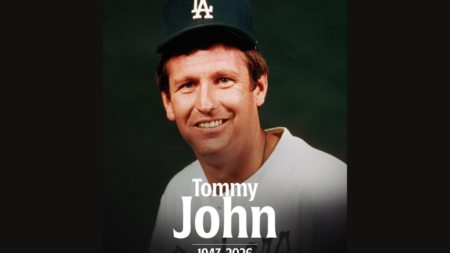






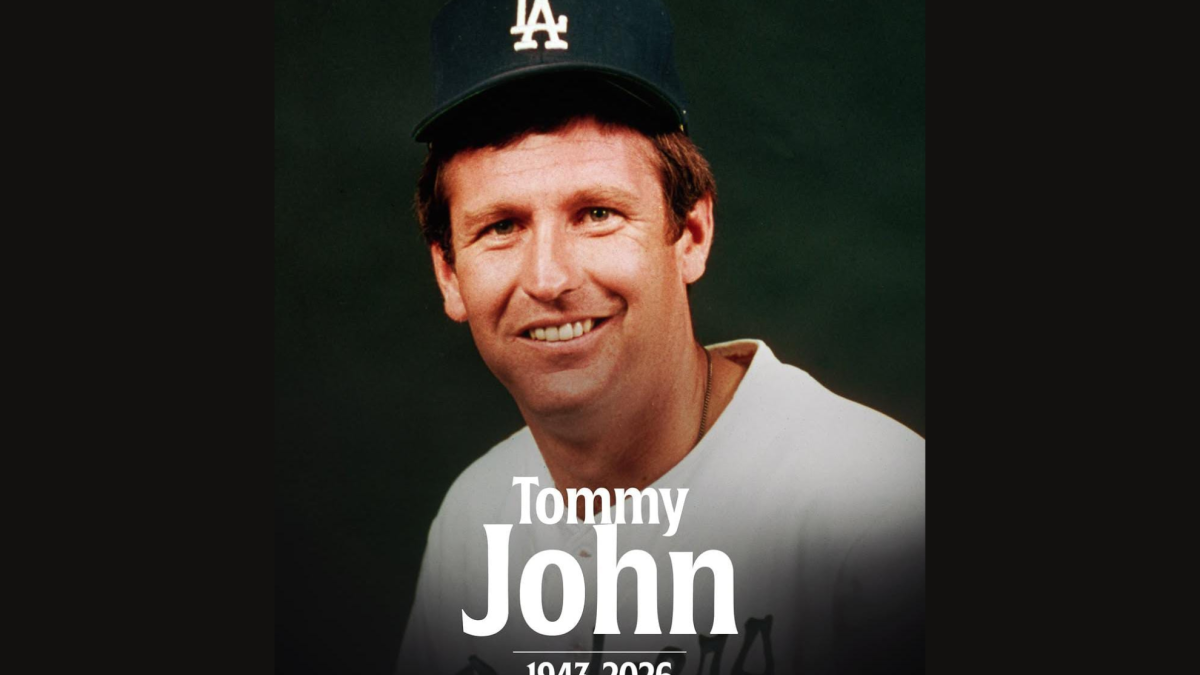
Tommy John died this Saturday, August 15, 2026, at the age of 83 in Florida. One of the longest-lasting pitchers in Major League history, whose name became forever linked to one of the most important operations in sports medicine.
John played 26 seasons in the Majors, between 1963 and 1989, and finished his career with 288 wins, 231 losses, a 3.34 ERA, and 2,245 strikeouts. He was selected to the All-Star Game four times and pitched for teams such as the Cleveland Indians, Chicago White Sox, Los Angeles Dodgers, New York Yankees, California Angels, and Oakland Athletics.
The injury that changed his life and baseball
In 1974, while pitching for the Dodgers, John suffered a tear of the ulnar collateral ligament (UCL) in his left elbow. At a time when an injury of that severity could mean the end of a pitcher’s career, the outlook seemed bleak.
The Dodgers‘ doctor, Frank Jobe, then proposed an experimental procedure. On September 25, 1974, Jobe reconstructed the damaged ligament using a tendon from John’s right forearm.
John thus became the first patient of an operation that years later would become known worldwide as Tommy John surgery.
The operation, however, did not guarantee that he would be able to pitch again.
The left-handed pitcher went through a long rehabilitation process and returned to the Major Leagues in 1976. What was extraordinary was that he not only managed to come back: he returned to pitching at the highest level and extended his career for another 14 seasons.
Better after the operation
John’s recovery ended up becoming proof that an injury considered virtually irreversible could have a second chance.
Before the operation he had achieved 124 victories. After it, he added another 164, more than in the first stage of his career.
With the Yankees he also put together two consecutive 20-win seasons, in 1979 and 1980, while with the Dodgers he once again established himself as one of the National League’s key pitchers.
His longevity was exceptional: he played in 760 games and started 700 of them.
A procedure that transcended the player
The name of Tommy John ended up becoming synonymous with an ulnar collateral ligament reconstruction, but the procedure was not invented by the pitcher.
The person responsible for developing and performing that first procedure was Frank Jobe.
As the decades passed, UCL reconstruction became a routine procedure in professional baseball and allowed numerous pitchers to return to the field after serious elbow injuries. A wonderful event in the world of sports.
A legacy that goes beyond statistics
The starting pitcher never managed to make it into the Baseball Hall of Fame, despite his 288 victories and an extraordinarily long career. His candidacy was also debated because of the significance of his longevity and the impact he had both before and after his injury.
His legacy left, however, a mark difficult to compare with that of any other player.
Although a surgery bears his name and he was not the one who created it, his greatest contribution was another: returning to the mound after being the first patient to undergo it and proving that an injury that seemed like the end of a career could, in fact, offer a second chance.
That is why, every time a pitcher returns to compete after a UCL reconstruction, Tommy John’s name comes up again.
His legacy is not only in the records he left behind.
It is also in all those who were able to keep pitching after him.
Read the full article here