



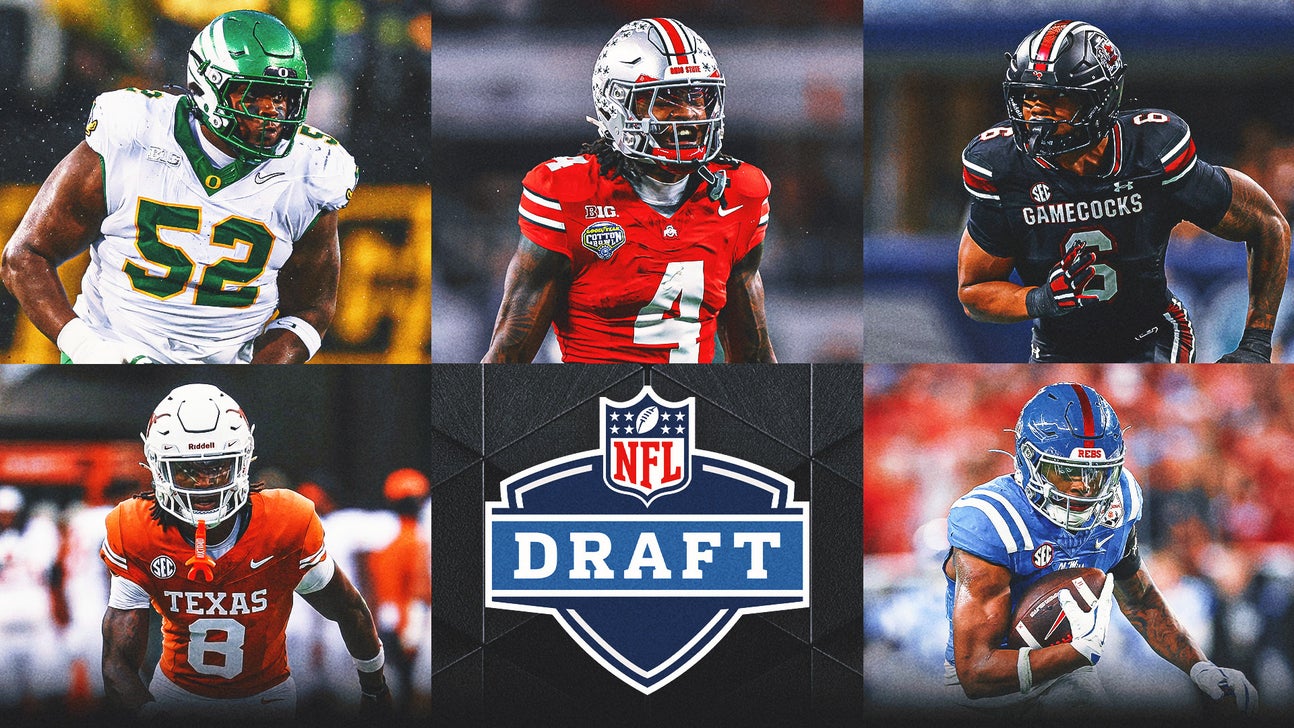
No one knows for sure how things might change during the upcoming college football season, but early indications are that the 2027 NFL Draft will be the strongest in years.
Quarterbacks — such as Texas’ Arch Manning, Oregon’s Dante Moore and Ohio State’s Julian Sayin — have dominated the early buzz because, well, they’re quarterbacks brimming with talent and potential. But the beauty of next year’s draft class is that it could offer several franchise-altering prospects at other positions, as well.
I’ve ranked the top 10 non-QBs heading into the season and, as you’d expect, all of them have a realistic chance at being a first-round pick next spring. Frankly, the top seven players would have been selected on Day 1 this year. As a bonus, I’ve included a pro comparison for each prospect.
10. Cayden Green, OT, Missouri
Grading offensive linemen is more about fit and grit than analytics, but Green checks in with the numbers that even a stat geek can appreciate. The 6-foot-5, 324-pounder is a three-year starter dating back to his true freshman season at Oklahoma. He allowed just two sacks in 751 pass drops last year, his first at the premium left tackle position after spending his first two seasons inside at left guard, where he routinely delivered pancake blocks.
Green is a talented pass blocker, as well as a spark plug in the running game. He gains impressive depth in his kick-slide and has the lateral agility and core strength to handle counters. I’m eager to see if he is even smoother in Year 2 at tackle. Between his girth, grip-strength, competitiveness and previous experience at guard, Green should offer his future NFL team plenty of roster flexibility.
Pro comp: Dion Dawkins, Buffalo Bills
 9. Kewan Lacy, RB, Ole Miss
Lacy went from a backup at Missouri to leading the entire country with 24 rushing touchdowns at Ole Miss last year. He is sudden and slippery, consistently zipping around and past would-be tacklers. His elusiveness generates plenty of highlight-reel worthy plays, but Lacy is also quite effective in short yardage, showing impressive leg drive, balance through contact and sheer determination to grind out the tough yards, too.
Kewan Lacy could be the first running back drafted in 2027. (Photo by Christian Petersen/Getty Images)
Along with his frequent trips to the end zone, the 5-foot-11, 205-pounder led the nation with 335 touches in 2025. There is no denying that Lacy was aided by the creative playcalling of former Ole Miss head coach Lane Kiffin. With Kiffin now in Baton Rouge, scouts are curious to see if Lacy can duplicate his remarkable sophomore campaign.
Pro comp: TreVeyon Henderson, New England Patriots
 8. Ellis Robinson IV, CB, Georgia
Robinson wasn’t quite as flashy as the aforementioned Lacy last year, but he was close, earning FWAA Freshman Defensive Player of the Year honors with four interceptions, tying for tops in the talent-rich SEC. Robinson is every bit the athletic phenom you’d expect as a former five-star recruit out of IMG Academy. He has a tight, low backpedal and easy hip turn to track receivers downfield, showing impressive balance and burst out of his breaks and legitimate recovery speed when necessary. He’s also a surprisingly scrappy tackler.
A rarity for a young cornerback, Robinson’s hands might be even better than his feet. Robinson can get a bit grabby downfield, but refs often let him compete because he locates the ball well, showing impressive hand-eye coordination to either catch it himself or rake it out of the hands of the intended receiver at the final moment. Interceptions against state rival Georgia Tech and this one versus Charlotte show Robinson’s rare body control and extension to make tough grabs look easy.
Pro comp: Trent McDuffie, Los Angeles Rams
 7. A’Mauri Washington, DT, Oregon
With all due respect to star quarterback Dante Moore, Washington is both literally and figuratively the biggest reason why Oregon has a chance to match Indiana from a year ago and win its first national championship in program history. He is the centerpiece of arguably the best defensive line in college football.
A’Mauri Washington was good enough to be a Day 1 pick in the 2026 draft. (Photo by Todd Kirkland/Getty Images)
Washington would have been a first-round pick last year but was one of several Ducks who chose to stay north for one more winter rather than migrate to the NFL. He is surprisingly quick and agile for someone listed at 6-foot-4, 330 pounds, and he already possesses NFL power, stacking and discarding would-be blockers like paper plates at a summer barbeque. And just ask No. 1 overall pick Fernando Mendoza about Washington’s bull rush.
Pro comp: Kenny Clark, Dallas Cowboys
 6. Cam Coleman, WR, Texas
If you thought the hype built up around Arch Manning last year was intense, just wait until this season, with the Longhorns set to stampede for a national title and dominate the first round of the 2027 draft.
Coleman — the first of three Longhorns in this article — was lured to Austin from Auburn, where he caught a combined 93 receptions for 1,306 yards and 13 touchdowns over his first two seasons, despite a limited supporting cast. The stats on Coleman are good, but the tape is even better. He is already an established playmaker whose film screams first-round pick. His star could shine from another galaxy, however, now that he’s working with Manning and Texas head coach Steve Sarkisian, one of the best offensive minds in the sport at any level.
The 6-foot-3, 200-pound Coleman has the size and athleticism of a future No. 1 NFL receiver. He is an effortless mover who accelerates in a flash and changes directions fluidly. Better yet, he offers exceptional body control and sticky hands to make acrobatic catches even with defenders draped over him.
Pro comp: George Pickens, Dallas Cowboys
 5. Leonard Moore, CB, Notre Dame
Cornerback is not universally regarded as one of the premium positions by NFL teams. Otherwise, Moore might rank even higher on this list, as his profile is spectacular. He is coming off of a unanimous All-American campaign as a true sophomore in which he recorded five interceptions and was a finalist for not only the Jim Thorpe Award as the nation’s top defensive back, but the Bronko Nagurski Award as the best overall defender in college football.
Leonard Moore was one of the best players at any position in college football last year. (Photo by Michael Miller/ISI Photos/ISI Photos via Getty Images)
Listed at 6-foot-2, 197 pounds, Moore has intimidating size for a cornerback. He has a smooth turning motion, seamlessly transitioning out of his backpedal into full gallop. He locates the ball well for a young player, instantly reading underneath routes and showing impressive downhill quickness to trigger back toward the quarterback. Moore has broken up and/or intercepted more passes (25) than he has allowed first downs (23) over his first two seasons of college football, and he’s also a physical hitter, having forced three fumbles. These numbers are all the more impressive when considering Notre Dame often asked him to travel with the opponents’ top receiver, including playing out of the nickel.
Pro comp: Christian Gonzalez, New England Patriots
4. Trevor Goosby, OT, Texas
No disrespect to former Texas OT Kelvin Banks Jr. — the No. 9 overall pick by the New Orleans Saints in 2025 — but the Longhorns might have upgraded with the 6-foot-7, 325-pound Goosby succeeding Banks at left tackle.
Pro Football Focus pinned three sacks (out of 492 reps in pass protection) on Goosby last year, but I don’t know that he was truly at fault for any of them. His tape was as clean as any blocker in the 2026 draft, and remember, there were nine blockers drafted in the first round this past spring.
Goosby is still just growing into his body, but he already moves with such an exciting combination of grace and force that it is easy to project him as a future Pro Bowler, if not All-Pro. He eases off the snap in pass protection, sliding laterally and keeping himself square to the rusher. Goosby surges low and hard as a run blocker, as well, showing impressive bend, balance and power to move defenders in the running game.
Pro comp: Laremy Tunsil, Washington Commanders
 3. Dylan Stewart, Edge, South Carolina
Stewart promises to be one of the most scrutinized non-quarterbacks of this draft class because he is remarkably gifted yet has not generated the eye-popping production his talent portends. He checks in at a prototypical 6-foot-5, 250 pounds, with long arms, which he already effectively uses to lock out and shed would-be blockers, as well as lasso ballcarriers from behind. As a pass-rusher, Stewart is sudden off the snap and has excellent core flexibility to dip under the reach of offensive tackles, greasing the edge and closing in a flash. He’s recorded 11.5 sacks over his first two seasons of SEC football, but his frequent pressures suggest his production could be twice that.
Dylan Stewart’s stats don’t tell the true story of how good he is. (Photo by Rich von Biberstein/Icon Sportswire via Getty Images)
Stewart’s blend of size and athleticism are exciting build blocks. He’s already quite strong and is technically sound with some refined pass rush techniques. He’s just growing into his frame and game, projecting as a future All-Pro caliber edge.
Pro comp: Robert Quinn (retired)
2. Collin Simmons, Edge, Texas
Similar in many ways to 2026 No. 5 overall selection Arvel Reese, Simmons is a malleable monster capable of starring off the edge or as an off-ball linebacker. He is as swift on the perimeter as any rusher in this class, accelerating off the ball like a receiver getting into his route. He isn’t just explosive, he’s flexible, slithering his way through waves of blockers. Watch his anticipation on this snap. The quarterback (and left tackle) had no chance.
Moreover, Simmons is shockingly strong at 6-foot-3, 240 pounds. Like all great speed rushers, Simmons generates impressive power with the momentum he gains off his rush, often bulldozing through blockers nearly 100 pounds larger. He has recorded 21 sacks over his first two seasons — despite starting just 13 games.
Simmons’ physical gifts are undeniable and will almost certainly earn him a top-five selection whenever he chooses to enter the draft. He isn’t a prospect without flaws, however. He’s been penalized a dozen times in just two collegiate seasons, with most of his penalties coming from mental errors, such as lining up in the neutral zone or unnecessary late hits on the quarterback. Even with the occasional hiccup, Simmons has the look of a future franchise cornerstone.
Pro comp: Von Miller, Dallas Cowboys
 1. Jeremiah Smith, WR, Ohio State
It is difficult to discuss Smith and not venture into hyperbole. Ohio State’s track record for producing superstar NFL wide receivers has been well documented and Smith’s production over his first two years in Columbus is unprecedented even among them. His 2,558 receiving yards and 27 touchdowns during his first two seasons on campus aren’t just records for an Ohio State receiver; they top all pass-catchers in Big Ten history. Along with current and future Hall of Famers Calvin Johnson, Julio Jones, Derrick Henry, Myles Garrett and Penei Sewell, Smith is one of a handful of players I’ve evaluated over my career who I believe were capable of playing in the NFL as true freshmen.
At a rocked up 6-foot-3, 223 pounds, Smith can simply bully most defensive backs at the college level. His size and strength make him an ideal weapon in the red zone, where he shows good timing and hand-eye coordination to play above the rim. And he’s a legitimate vertical threat who accelerates smoothly and tracks the ball well over his shoulder. Smith is also excellent on slants and crossing routes, utilizing his frame to keep himself between the defender and the ball and showing good vision to rack up yardage after the catch. It is remarkable how many times he outruns pursuit angles or slips between defenders seemingly in position to stop him. We’ve often heard the expression “runaway freight train” used to describe running backs, but the characterization also applies to Smith at receiver.
Jeremiah Smith looks to be one of the best receiving prospects in years. (Photo by Ben Jackson/Getty Images)
Comparisons to past size-speed phenoms such as the aforementioned Johnson, Jones and DK Metcalf will be common throughout the draft process. The scary part about Smith is that he’s already further along as a route-runner than any of these receivers were coming out of college.
Pro comp: Julio Jones (retired)
Read the full article here