





The quarter-finals of the 2025-26 Champions League already have a first reading. And it is not footballing, but mathematical. Based on the Elo system – a model taken from chess that measures the real ‘strength’ of teams based on their results – it is possible to estimate the chances of qualification in each tie. The result: four clear favourites, although none with a completely clear path.
The starting point for the entire model is the ClubElo ranking. It is not a traditional ranking: it does not count titles or accumulated points, but rather performance. Teams, national teams and even analysis houses use it because it allows differences in level to be translated into probabilities of victory. In soccer, for example, FIFA uses a modified version of the Elo system (called the “SUM” algorithm) for its World Ranking since August 2018.
Each match modifies the score that teams can obtain according to the opponent, the result and the context. Beating a big team adds much more than doing so against a smaller team, and losing against a smaller team penalizes more. That is why Elo is a fairly accurate picture of each club’s current competitive level.
With this basis, the first thing we do is translate this difference in level into match probabilities. In other words, if one team has more Elo than another, it becomes the favorite, but not in absolute terms: the system converts this into a percentage chance of winning. This gives a realistic estimate, where even the inferior team always has room for improvement.
Our predictive adaptation
From there, taking the ranking at the time the pairings were established (March 18), MARCA has adapted the model to real knockout rounds. First, by incorporating the home field factor – which is key in the Champions League. It is not the same to play at home as away, and the model incorporates this as a small “bonus” for the home team, an average advantage of +65 Elo points. In practical terms, this means that many ties are balanced: a team may be inferior overall, but favorite in its own stadium. This explains why several ties appear so close when analyzed match by match.
The next step is to adapt these probabilities to what actually happens in football: it’s not all about wins and losses, there are also draws. To do this, an average draw rate based on historical Champions League data is introduced, which is around 27%, allowing the chances of each match to be divided into three possible outcomes. This is an important detail, because draws carry a lot of weight in two-legged ties.
Finally, we crossed all possible scenarios back and forth, including extra time and penalties (assumed to be 50-50), to obtain the final probability of qualification. The final result is not a closed prediction, but a sum of scenarios: a percentage that reflects how many times each team would go through if that tie were played many times. It is, in short, a way of converting each team’s ‘strength’ into real odds of reaching the semi-finals.
Real Madrid vs Bayern Munich: Bavarians hold the edge
The balance is more tilted between Bayern Munich and Real Madrid, although not definitively. The German side has a 55.5% chance of qualifying compared to 44.5% for Madrid. The key is in the return leg in Munich. The model reflects that the German team has a superior margin in their stadium, which compensates for the equality of the first leg.
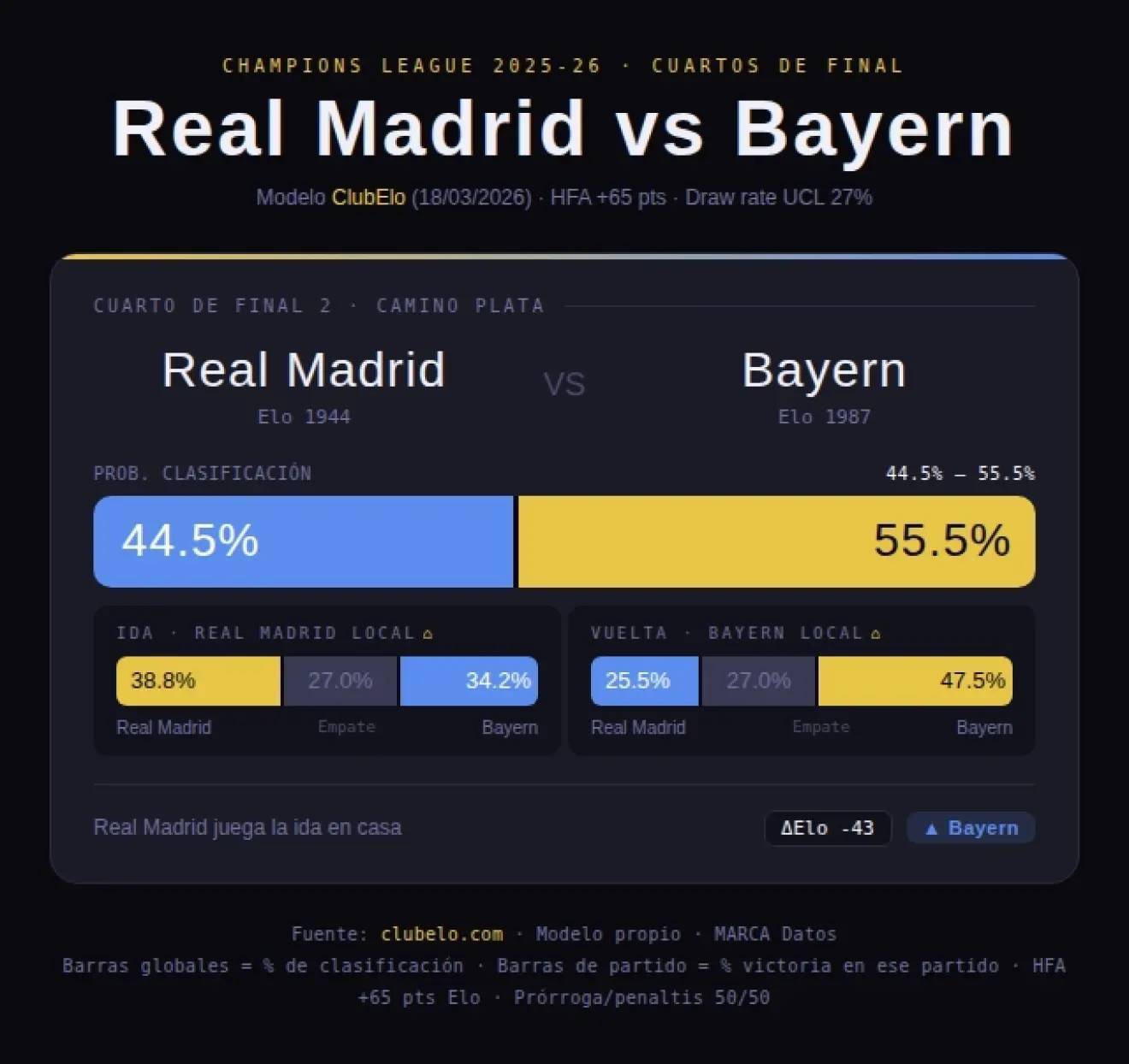
In the first leg at the Bernabeu, Madrid is slightly favored (38.8% vs. 34.2%), but in the second leg the model is much more emphatic: 47.5% victory for Bayern compared to only 25.5% for Madrid. This imbalance in the second game is what ends up tipping the tie in Bayern’s favor. Even so, the overall difference is still small, which places the tie in that intermediate ground where there is a favorite, but not a dominant one.
PSG vs Liverpool: A coin toss with a slight French advantage
With this process, the most evenly matched tie is Paris Saint-Germain against Liverpool. PSG have a 54% chance of qualifying, a minimal advantage that is explained more by the context than by a clear superiority. Both teams are favourites when playing at home, which makes for a very sensitive tie: one goal more or less can completely change the scenario.
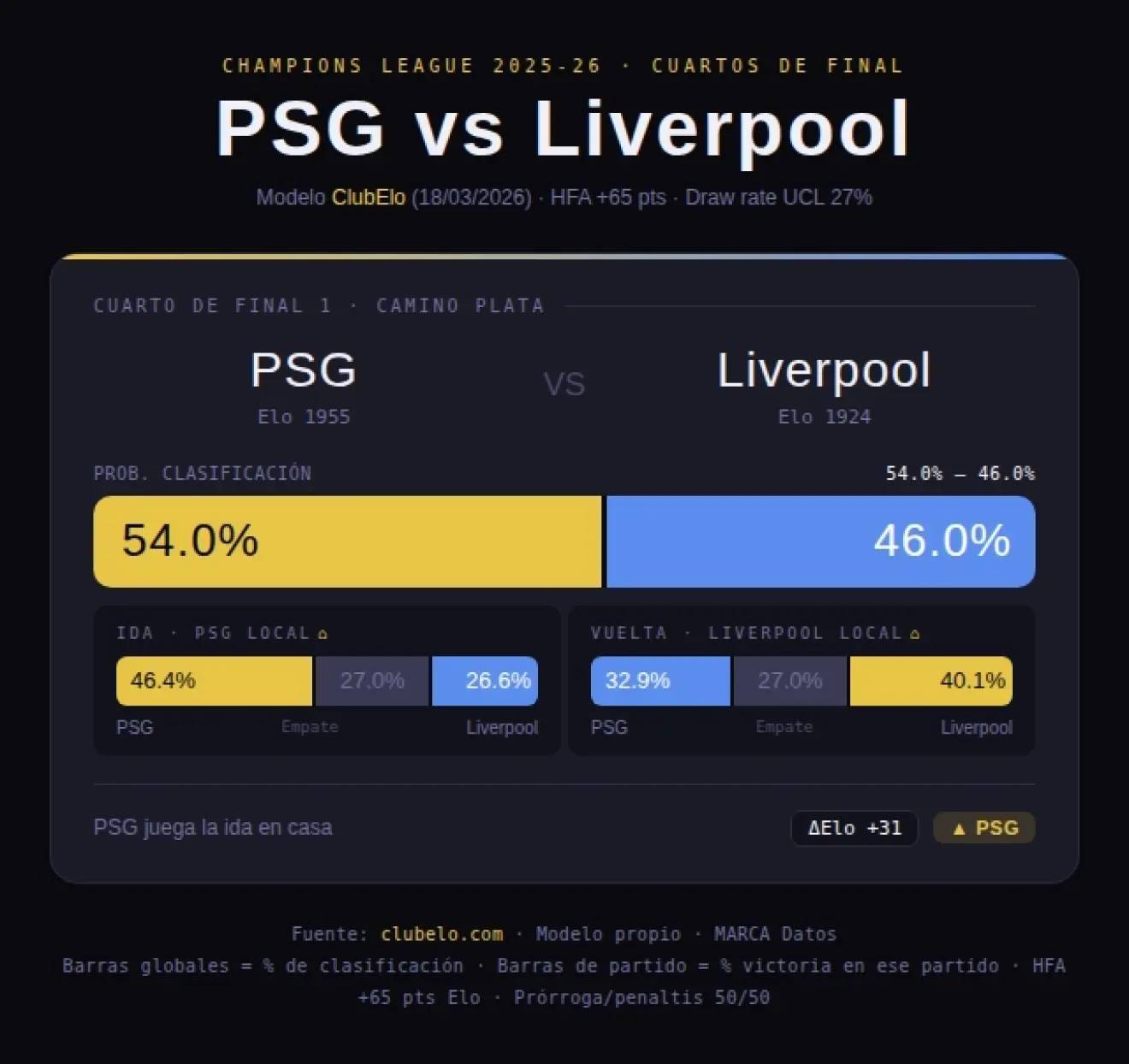
In the first leg, in Paris, the French have a 46.4% chance of victory, compared to 26.6% for Liverpool (remember that we set the average draw at 27%), while in the second leg at Anfield the scenario is reversed: 40.1% for the English and 32.9% for PSG. It is, in terms of probabilities, the pairing closest to a coin toss.
Barcelona vs Atletico Madrid: Blaugrana superiority even at the Metropolitano
The Spanish duel between Barcelona and Atletico Madrid shows a clearer gap. Barca have a 62.1% chance of qualifying and, most significantly, are favourites in both matches according to the model, even at the Metropolitano. In the first leg at the Camp Nou, the Blaugrana have a 52.3% chance of victory compared to Atletico’s 20.7%, and in the second leg at the Metropolitano they are still favourites: 39.8% compared to 33.2%.
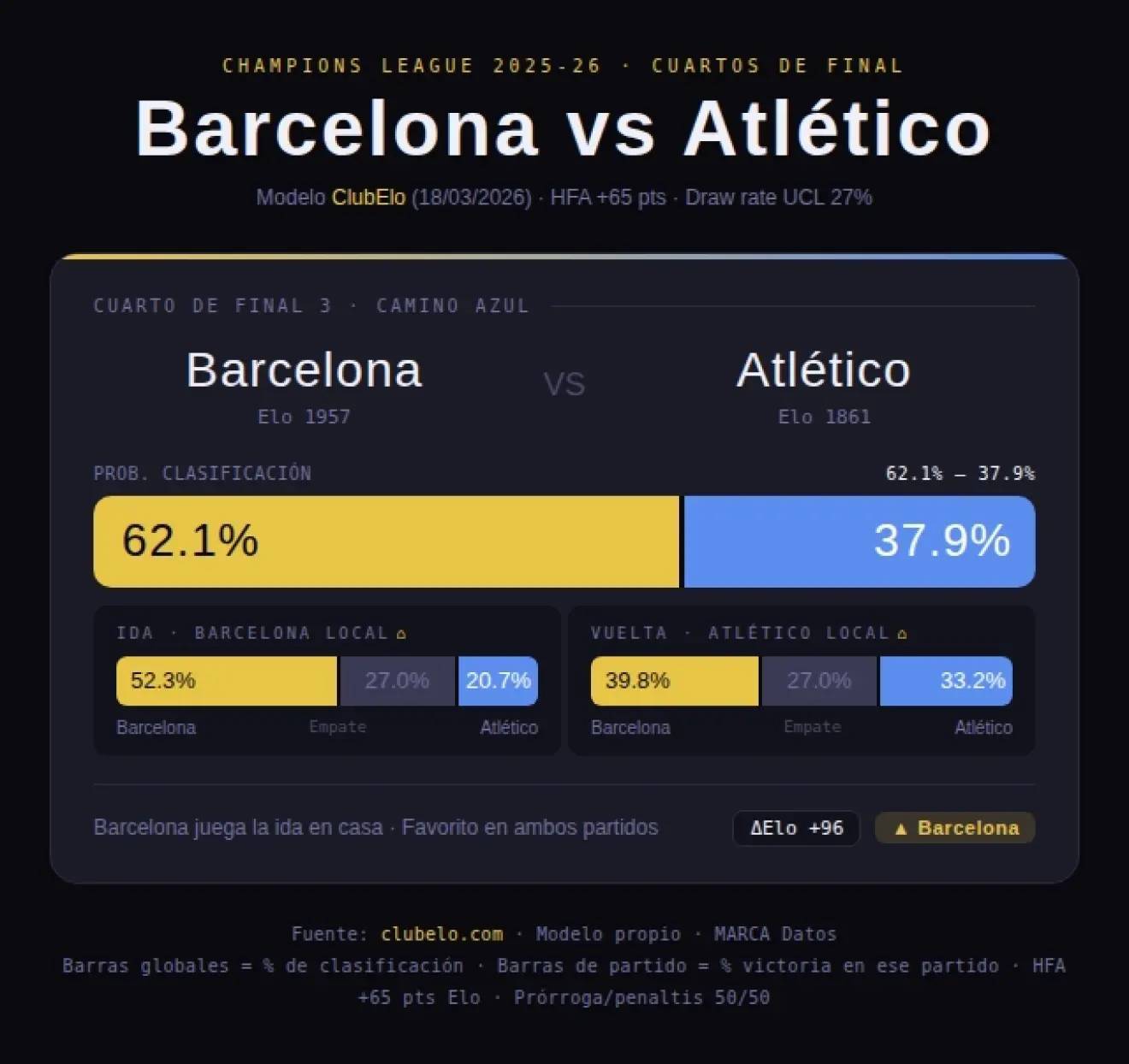
That double condition is what triggers their final probability: it does not depend solely on the home field factor, but on a sustained difference in “strength”. Even so, the weight of the draw and the close scenarios keep Atletico with real options.
Sporting vs Arsenal: The most unbalanced duel
Finally, the most unbalanced match-up is Arsenal against Sporting CP. The English side have a 73.1% chance of qualifying, being favourites even in the first leg in Lisbon (49.6% to 23.4%). In the second leg in London, the difference is even greater: 59.7% chance of victory to just 13.3% for Sporting.
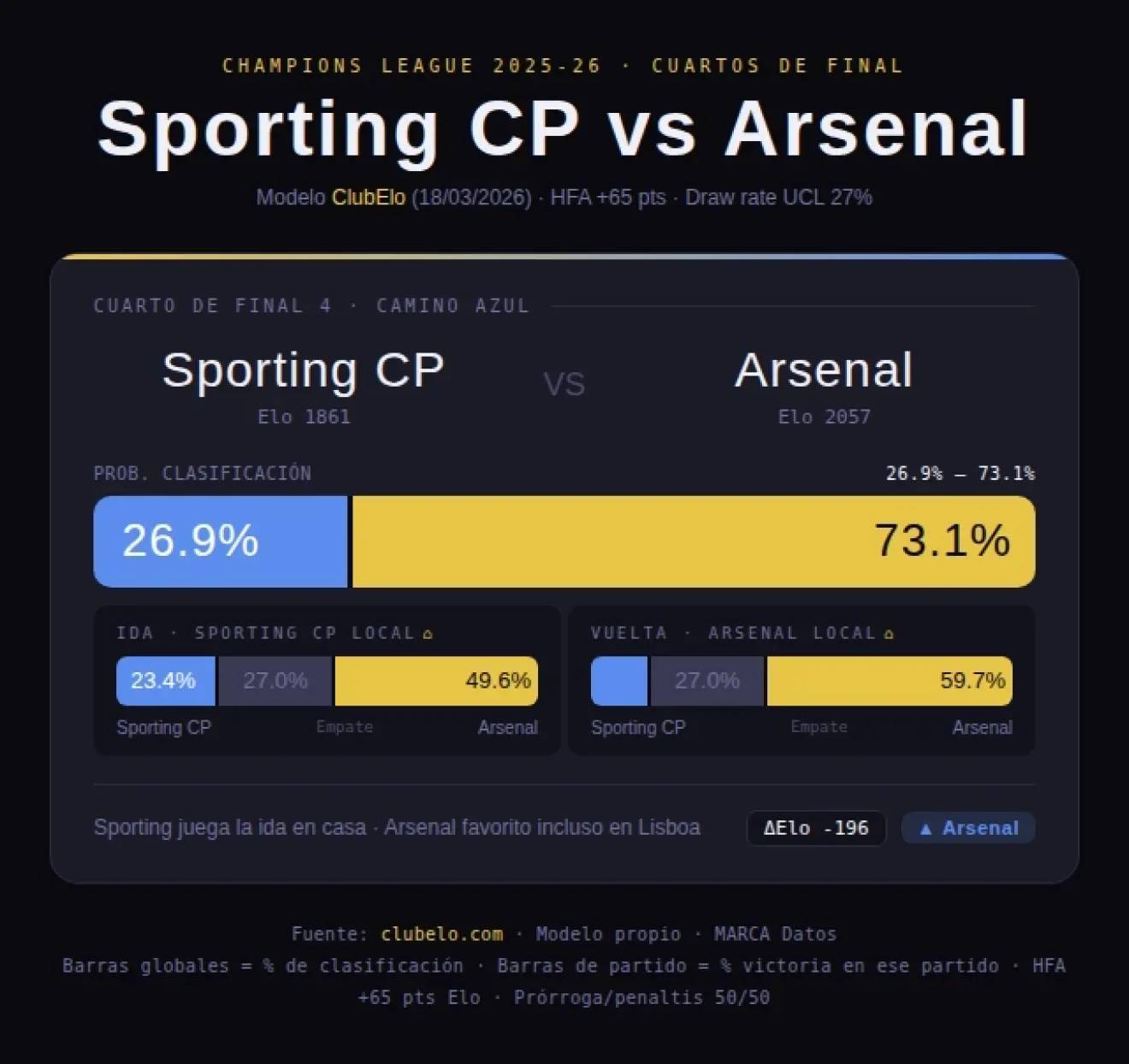
These figures reflect a significant gap in level and explain why it is the least uncertain clash of all.
In short, the Elo system draws a quarter-final with two very open ties (PSG-Liverpool and Bayern-Madrid),one with a clear favourite (Barca-Atletico) and another with an obvious dominant (Arsenal-Sporting). The ‘strength’ shows the way… but as always in the Champions League, reality still has a lot to say.
Read the full article here