



The Indianapolis Colts have taken an unconventional route in addressing the future of quarterback Daniel Jones, issuing the rarely used transition tag as they navigate a pivotal offseason. Jones, who was in the midst of a career-best campaign before suffering a torn right Achilles tendon in early December, now finds himself at the center of one of the league’s most unusual contractual decisions in recent memory.
The move signals both belief in his upside and caution regarding his recovery timeline. According to NFL insider Ian Rapoport of the NFL Network, the tag is worth $37.8 million.
“It is the first time since 1996, when the #Falcons transition tagged Jeff George, that this was used on a QB. If Jones reaches a deal with another team, Indy can match,” Rapoport tweeted.
The historical context outlines the magnitude of the decision. Transition tags are seldom deployed on quarterbacks due to the premium nature of the position and the inherent leverage signal-callers typically command.
The last time such a tag was used on a quarterback was nearly three decades ago, when the Atlanta Falcons applied it to Jeff George in 1996.
According to Jeremy Fowler of ESPN, the situation may not be contentious from the player’s perspective.
A source told Fowler that “‘He’s not afraid of it,” regarding the transition tag being applied to Jones.
“Team and player will continue working on a long-term deal, but the tag is something Jones could embrace, too,” reported Fowler on X.
A promising start derailed by injury
Before the injury, Jones was playing arguably the best football of his career.
In his first season with the Colts, he propelled the team to an 8-2 start, positioning Indianapolis among the top contenders in the AFC through the first half of the season.
Statistically, the production was elite. Jones posted career highs in passer rating (100.2) and completion percentage (68 percent), while throwing 19 touchdowns against just eight interceptions.
He also added 164 rushing yards and five scores on the ground. During that stretch, the Colts ranked fifth in the NFL in scoring at 28.9 points per game.
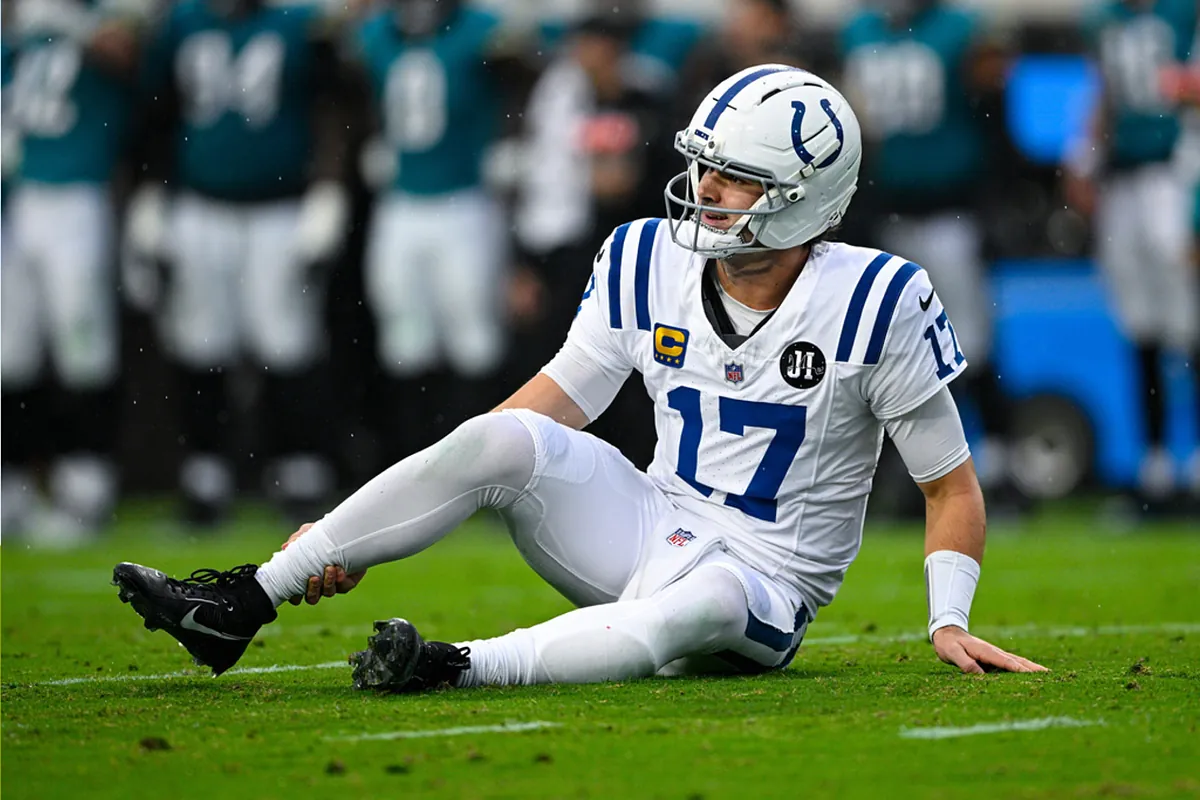
The trajectory shifted dramatically in a Week 14 loss to Jacksonville Jaguars, when Jones suffered the Achilles injury that ended his season.
Without their starting quarterback, the Colts dropped their final seven games, finishing outside the playoff picture for the fifth consecutive year. They became the first team since the 1995 Oakland Raiders to miss the postseason after starting 8-2 or better.
QB uncertainty remains for Colts
Complicating matters is the quarterback landscape in Indianapolis. Entering last season, Jones was engaged in a legitimate competition with former first-round pick Anthony Richardson.
Now, Richardson has reportedly been granted permission to seek a trade. The roster also includes 2025 sixth-round selection Riley Leonard, though neither option provides the established production Jones displayed prior to his injury.
The central question is availability. The Colts remain uncertain when Jones will be fully cleared following the December 7 injury.
Achilles recoveries for quarterbacks can vary significantly, and while modern rehabilitation protocols have improved outcomes, performance post-repair is never guaranteed.
By using the transition tag, Indianapolis has effectively retained negotiating control while keeping flexibility. If another team presents Jones with an offer sheet, the Colts maintain the right to match.
At the same time, both sides can continue discussions toward a long-term agreement. In a league defined by quarterback stability, the Colts have chosen a rare mechanism to protect their investment – and it may the right call.
Read the full article here