





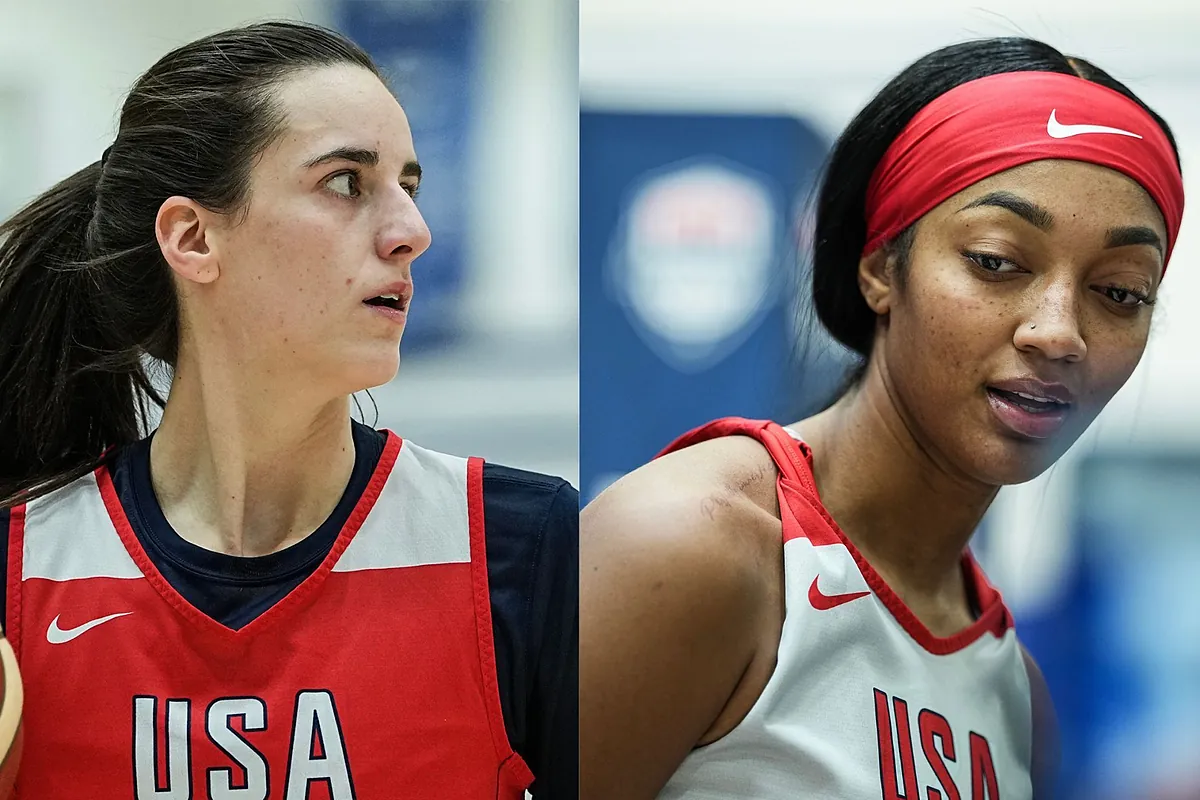
For years, the rivalry between Caitlin Clark and Angel Reese has been one of the most talked about storylines in women’s basketball. It started in college, when Clark led Iowa and Reese starred at LSU, facing each other in high-stakes NCAA matchups that quickly turned emotional, competitive and at times confrontational.
Their battles were never just about basketball. There were gestures, words, intensity and moments that fueled a narrative of two stars who not only competed, but genuinely did not seem to get along. That tension carried into the WNBA, where Clark joined the Indiana Fever and Reese the Chicago Sky as rookies in the same season, continuing a rivalry that felt as personal as it was competitive.
On the court, their matchups remained physical and emotional. Off the court, there were few signs of a friendly relationship. For many fans, it became one of the defining rivalries of the new WNBA era.
But something different is now happening inside Team USA
During the recent FIBA World Cup qualifying game against Spain women’s national basketball team, where Team USA secured an 84-70 win, Clark and Reese showed a completely different dynamic one that few expected.
At one point in the game, Clark fell while driving and immediately looked to the officials, asking for a foul. Instead of walking away, Reese approached her, extended her hand and helped her up. It was a simple gesture, but one that carried weight considering their history.
Later in the game, Clark delivered a sharp pass into the paint, and Reese finished at the rim. As they reset, they exchanged a quick handshake. It was not overly emotional, not exaggerated, almost mechanical but meaningful.
They are not suddenly best friends. They are not celebrating together or showing obvious chemistry yet. But something is changing. The dynamic is shifting from rivalry to coexistence, from tension to functional teamwork.
Being part of Team USA forces a different mindset. They train together, run the same systems, defend as one unit and share a common goal. And in that environment, even the strongest rivalries have to evolve.
This shift does not erase the past. When they return to the WNBA, Clark with Indiana and Reese with Chicago, the rivalry will still be there. The intensity, the competitiveness, the edge all of it will come back.
But it may not be the same.
What is happening now could be the beginning of a more mature version of that rivalry, one built not only on competition, but also on respect. Less visceral, more controlled, but still just as compelling.
For Team USA, this evolution is a positive sign. The ability of two strong personalities to adapt and work together could be key in upcoming international competitions.
The matchup between Team USA and Spain in the FIBA Women’s World Cup turned out to be more than just another game, as both teams had already secured their qualification for the tournament. In fact, the game served as a high-level test between two of the strongest programs in women’s basketball, ultimately becoming the final, where both nations confirmed their status among the elite on the international stage.
The rivalry between Clark and Reese will likely return to the WNBA soon, but this time with a bit more respect.
Read the full article here