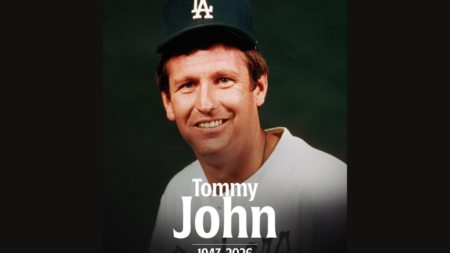





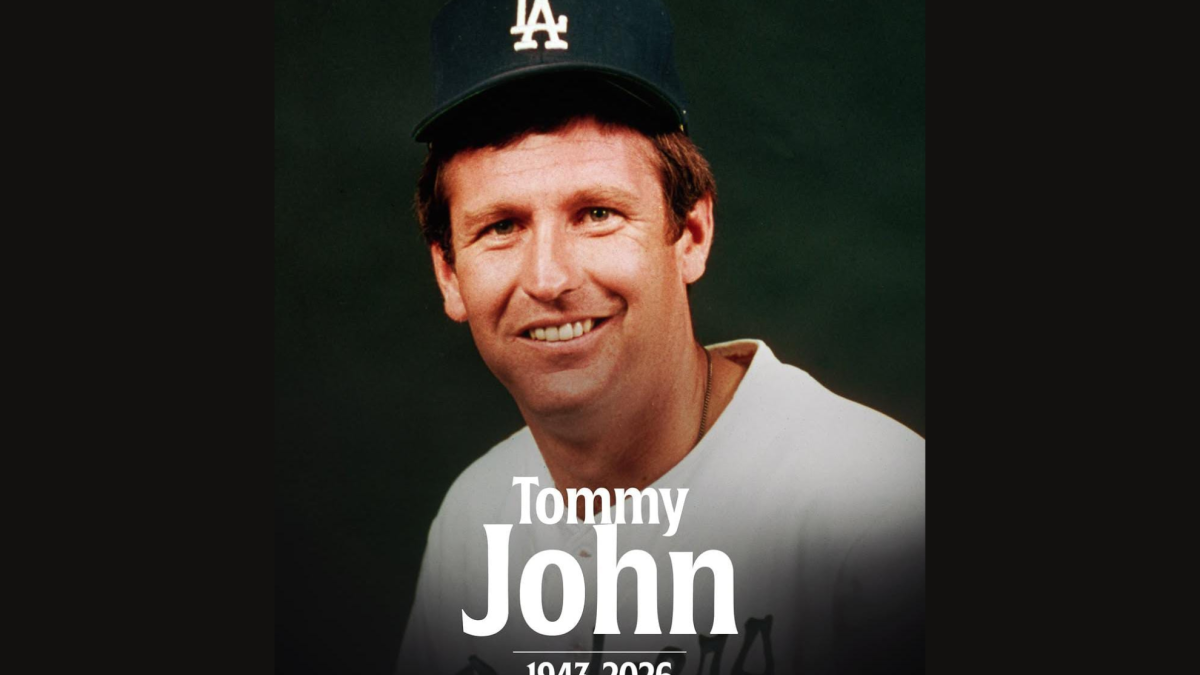
The most famous surgery in baseball was never supposed to become routine. When Tommy John tore the ulnar collateral ligament in his left elbow in 1974, pitchers with that injury were generally facing the end of their careers.
John, then 31 and pitching for the Los Angeles Dodgers, chose a different path: he agreed to an experimental reconstruction proposed by team physician Dr. Frank Jobe.
The odds were brutal. Jobe later estimated the operation had roughly a one percent chance of working.
“Dr Jobe, if you do your job, I’ll do mine,” John told him. That decision ultimately did far more than save one pitcher.
John, who died Saturday at 83, returned from the procedure and pitched another 14 seasons.
The operation eventually became known as Tommy John surgery and has since given thousands of pitchers a realistic path back from an injury that once looked like a career sentence.
How original Tommy John surgery worked
The landmark operation took place on September 25, 1974. During the four-hour procedure, Jobe drilled holes into the humerus and ulna and used a tendon from John’s right forearm to reconstruct the damaged ligament in his pitching elbow.
Recovery was difficult from the start. Nerve complications initially left John’s hand shriveled and reduced feeling in several fingers, forcing Jobe to perform another procedure.
John then spent four months in a cast and missed the entire 1975 season while rebuilding his arm. The payoff was extraordinary.
He had 124 career victories before surgery. After returning in 1976, John won another 164 games and finished his career with a 288-231 record, 3.34 ERA and 2,245 strikeouts.
The operation reshaped MLB careers and contracts
The procedure’s influence is now visible across generations of elite pitchers.
John Smoltz returned from surgery to become a dominant closer and later resumed starting, eventually becoming the first Tommy John recipient elected to the Hall of Fame.
Justin Verlander came back to win the 2022 Cy Young Award at age 39.
Chris Sale, Shohei Ohtani, Jacob deGrom, Zack Wheeler, Max Fried, Stephen Strasburg and Tarik Skubal are among the other prominent pitchers whose careers continued after significant UCL repairs.
The transformation has been enormous. What was once a 100-to-1 medical gamble developed into a procedure with a far stronger return rate, changing not only careers but the financial futures of players who went on to sign massive contracts.
John understood the significance, but he was also troubled by how common the surgery became among younger athletes.
“I am sick my name is attached to a surgery happening in kids more than pros,” he wrote in 2018.
In one of his final messages, he returned to the man who had taken the original risk with him.
“Thanks to Dr. Jobe, who saved my arm & made it possible for me to continue pitching,” John wrote. “That surgery has since gone on to save the careers of countless pitchers.”
His pitching numbers alone made John remarkable. The operation that carries his name made his impact on baseball immeasurable.
Read the full article here