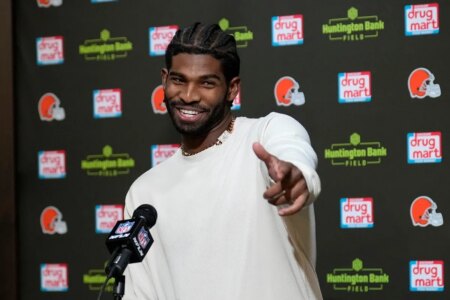



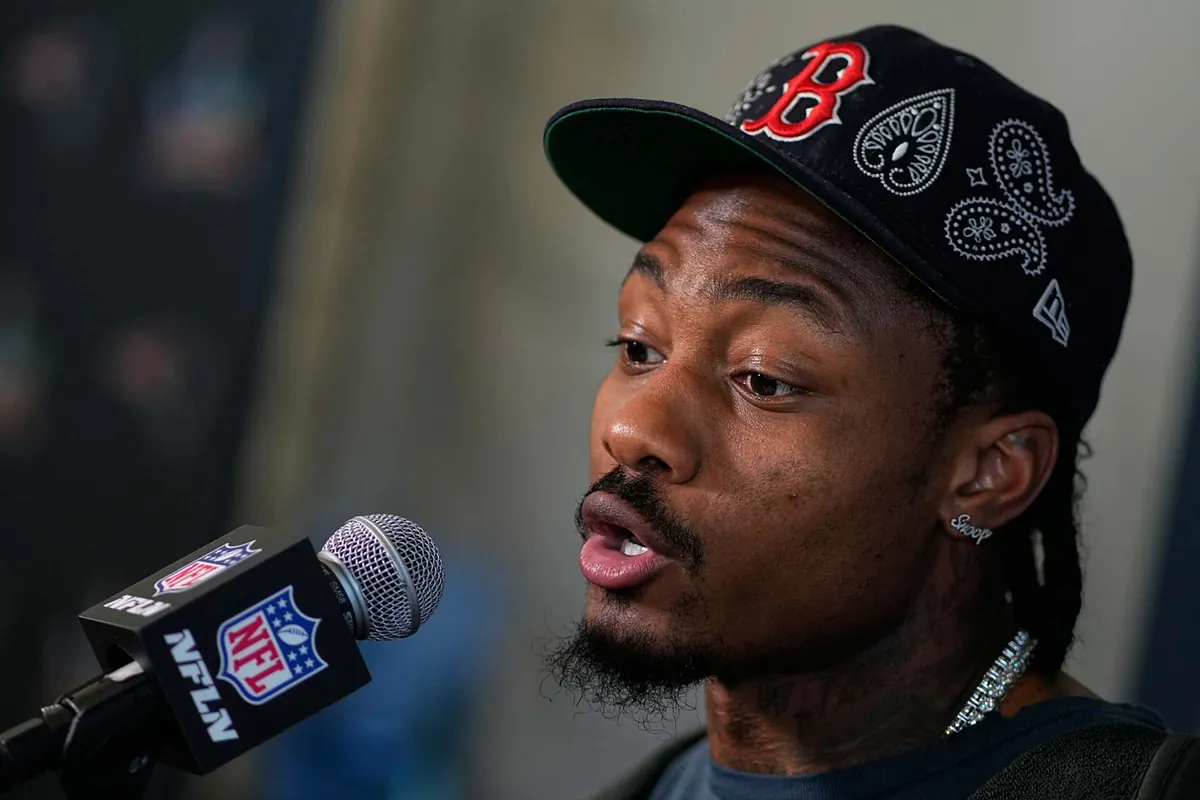
The future of Stefon Diggswith the New England Patriots has shifted from a redemption story to a complex legal and financial puzzle that the franchise must solve just days after losing the Super Bowl, all with the objective of building a competitive roster for next week.
After a season in which the 32-year-old receiver defied the odds by returning from a torn anterior cruciate ligament (ACL) to post the franchise’s first 1,000-yard campaign since 2019, the tide has dramatically turned due to serious off-field allegations and declining production in the highest-pressure moments.
The weight of the law: Assault allegations
Diggs’ stability in Boston now faces a formidable opponent: an accusation from his former personal chef, who alleges she was the victim of assault by the player.
According to a report obtained by WBZ-TV, the woman claims a workplace dispute escalated quickly: “She alleges that the male then smacked her across the face… The male then tried to choke her using the crook of his elbow around her neck.”
Although Diggs has pleaded “Not Guilty,” and his attorney, Mitchell Schuster, maintains that “Stefon is completely innocent,” the Patriots’ front office finds itself in a delicate position. The organization must decide whether to continue its support or sever ties to prevent off-field issues from tarnishing the locker room culture.
The ‘Number 1’ dilemma and the financial factor
Beyond the legal matters, Diggs’ postseason performance has raised questions about whether he can still serve as the primary offensive weapon for Drake Maye. Despite his regular-season success, Diggs totaled just 110 yards across four playoff games.
Analysts such as Greg A. Bedard suggest his role must evolve if he wants to remain: “I still think he is a good player… but I think he needs to be more of an auxiliary piece of this offense instead of the centerpiece. He needs to be the number 3 option.”
Financially, Diggs’ contract represents a major hurdle. Scheduled to carry a $26.5 million cap hit with only $1.7 million guaranteed, the deal appears unsustainable. Bedard proposes a middle-ground solution: “I am siding with keeping him and probably doing something with his contract where there’s phony extension with voids that sort of spreads up cap hit.”
Without him, the Patriots would fall to one of the league’s weakest receiving corps; with him, they risk committing real money to a player whose peak production may already have passed.
Read the full article here