


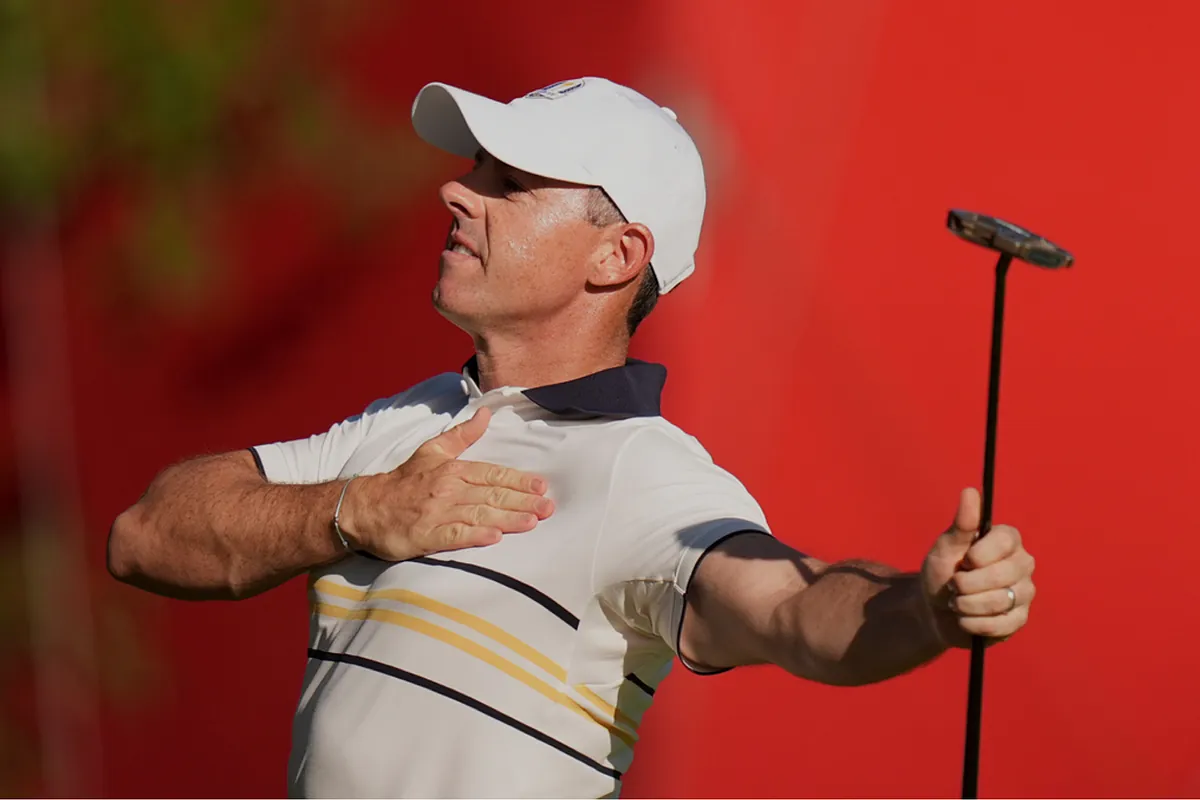
Rory McIlroy‘s long-awaited Masters triumph was built on composure under extreme pressure, but a newly revealed exchange with Bryson DeChambeau shows just how intense, and unpredictable, that Sunday at Augusta National really was.
In an upcoming documentary charting his journey to a first green jacket, McIlroy reflects on a brief but telling moment during the final round, when he and DeChambeau found themselves locked in a subtle battle of nerves over who would putt first on a crucial hole.
The situation arose when both players faced near-identical birdie chances and disagreed on who was furthest from the hole. What followed, McIlroy admitted, caught him off guard.
“We sort of looked at each other, and I thought it was clearly my turn,” McIlroy explained. “He thought it was his.”
DeChambeau then suggested settling the matter with a tee flip, an idea McIlroy immediately rejected.
“And I’m like, ‘No,'” McIlroy said. “This is the final round of the Masters. This isn’t some casual game somewhere.”
While seemingly minor, the exchange revealed the mental chess match that unfolds during major championships.
In elite golf, the order of play can influence confidence and pressure, especially when both players are in contention.
“It’s a bit of gamesmanship,” McIlroy said. “Both of you want to go first because if you hole it, it puts the other guy under pressure straight away.”
By refusing to leave it to chance, McIlroy asserted control in a moment where composure was everything. He later described it as a point where he had to trust his instincts and stand firm.
“I wasn’t going to back down in that situation,” he said. “I wanted to be the one who dictated what happened.”
That decision proved decisive. McIlroy rolled in his birdie putt, while DeChambeau missed, a subtle but significant shift in momentum during a round filled with tension.
A victory shaped by resilience
McIlroy’s path to the title was far from straightforward. Despite entering the final round in a strong position, he faced a late surge from Justin Rose, whose charge forced a playoff.
After 72 holes couldn’t separate them, McIlroy held his nerve in extra time, sealing victory with a birdie to finally claim the Masters title and complete the career Grand Slam.
The documentary suggests that beyond the dramatic finish, it was moments like the standoff with DeChambeau that defined the round.
“I felt like that was a really important moment,” McIlroy said. “I was proud of myself for holding my ground there.”
Attention turns to Augusta once again
With the 2026 Masters approaching, the focus returns to whether McIlroy can build on that breakthrough and defend his title against a field that includes familiar rivals.
DeChambeau, who has shared a competitive edge with McIlroy in recent majors, will be eager to respond after falling away late last year. Meanwhile, Rose remains a persistent threat after pushing the eventual champion to the limit.
For McIlroy, the challenge now is different. The pursuit of history has been replaced by the pressure of expectation.
If his reflections are anything to go by, however, success at Augusta National is often decided not just by the big shots, but by the small moments, and the willingness to take control when it matters most.
Read the full article here