


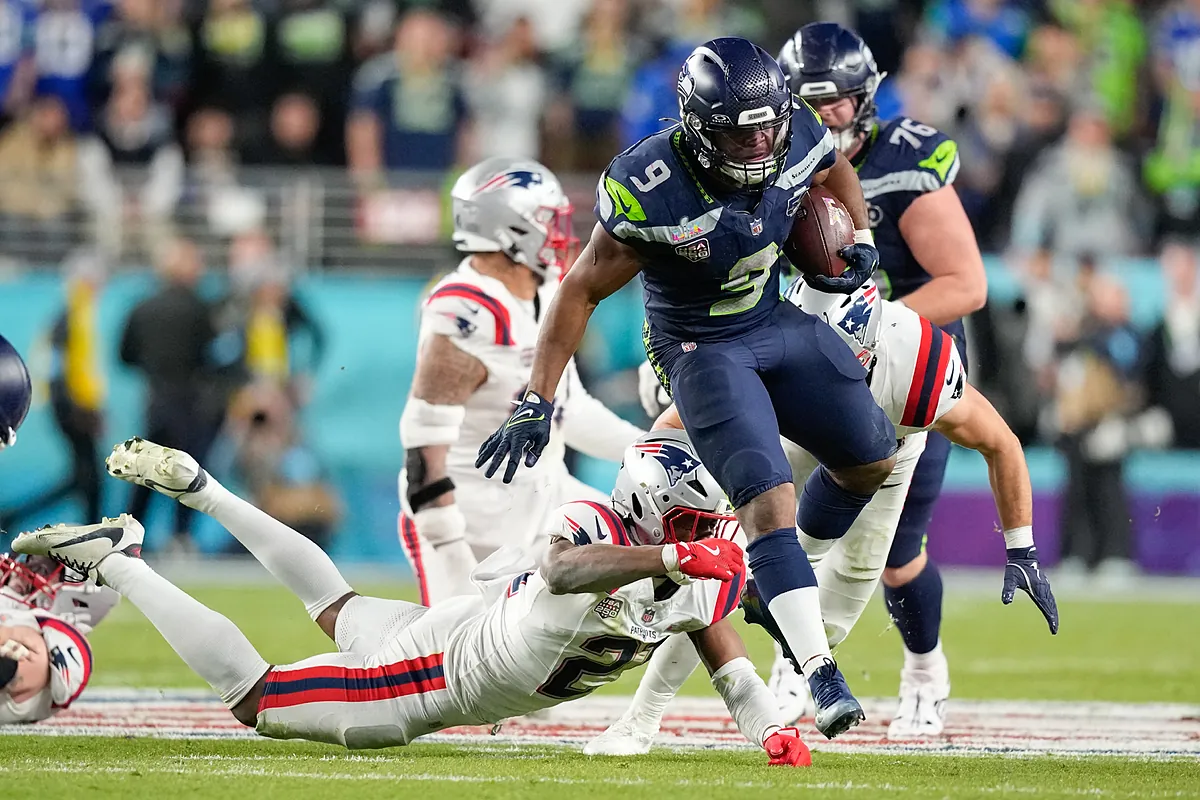
When the Kansas City Chiefs signed Kenneth Walker III on Monday, it was more than just another free-agent acquisition – it was a clear statement about the backfield’s future. Walker’s ability to create big plays, regardless of scheme, made him the ideal solution for a team that has long relied on Patrick Mahomes to carry the offense both through the air and on the ground.
Walker’s track record is striking. Since 2022, he’s posted 29, 24, 13, and 33 explosive runs – and if you remove the 13 from a particularly messy first-year Seattle offense, the numbers demonstrate his knack for generating extra yardage in almost any system.
He was fourth in the NFL last year in broken tackles and ranked ninth in 2023, a testament to his ability to fight through contact.
Even as the Seahawks’ offensive line struggled – finishing 24th, 30th, and 28th in run-block win rate before finally breaking into the top 10 – Walker still produced.
That resilience, combined with his consistent play style, made him a highly attractive free-agent target.
Walker signing to halt a worrying trend in Kansas City
Kansas City’s own backfield production over the past four seasons underlines the need for Walker. The team’s running backs combined for 20, 14, 21, and 20 explosive runs during that span.
Only Clyde Edwards-Helaire, as a rookie in 2020, cracked the top 20 in broken tackles, despite Kansas City’s run-block success consistently landing in the top 10 league-wide.
“After years of searching and patchworking, the impatience over a difference-making back reached its boiling point,” an NFL insider said.
Walker arrives as the Chiefs recalibrate their roster following key changes.
Trading Pro Bowl cornerback Trent McDuffie to the Los Angeles Rams, along with early-season injuries to Mahomes and the loss of wideout Rashee Rice, highlighted the need for a dependable, self-sufficient running game.
Last season, Mahomes carried the team on his back more than ever – 38 of his 64 rushing attempts came in the first six weeks – highlighting the urgency of strengthening the ground attack.
Adding Walker also complements the return of Eric Bieniemy as offensive coordinator, a former running back whose philosophy emphasizes balance and power in the run game.
For a quarterback recovering from his first significant ACL injury, a reliable back like Walker is crucial to preventing Mahomes from being forced into hero-ball situations week after week.
Walker is not a situational or scheme-dependent back. Unlike many in free agency who fill a Jerick McKinnon-style role – mostly as check-down options or occasional blockers – Walker generates offense independently.
That quality mirrors historic greats, such as Peyton Manning’s top backs, who excelled regardless of system design.
Walker a difference maker for the Chiefs
Kansas City’s investment – reportedly up to $45 million – reflects a belief that Walker can immediately elevate a backfield that, for years, has lacked a true difference-maker.
His combination of power, agility, and vision allows him to excel in multiple scenarios. Walker immediately addresses Kansas City’s top need: a running game that can create yardage without relying solely on Mahomes’ improvisation.
As Mahomes recovers from his ACL tear, the Chiefs now have a back capable of generating chunks of offense.
For Kansas City, signing Walker is both a practical solution and a long-term statement: the Chiefs finally have a running back who can dominate in any environment, ensuring the offense remains explosive, balanced, and less dependent on hero-ball heroics.
Read the full article here