


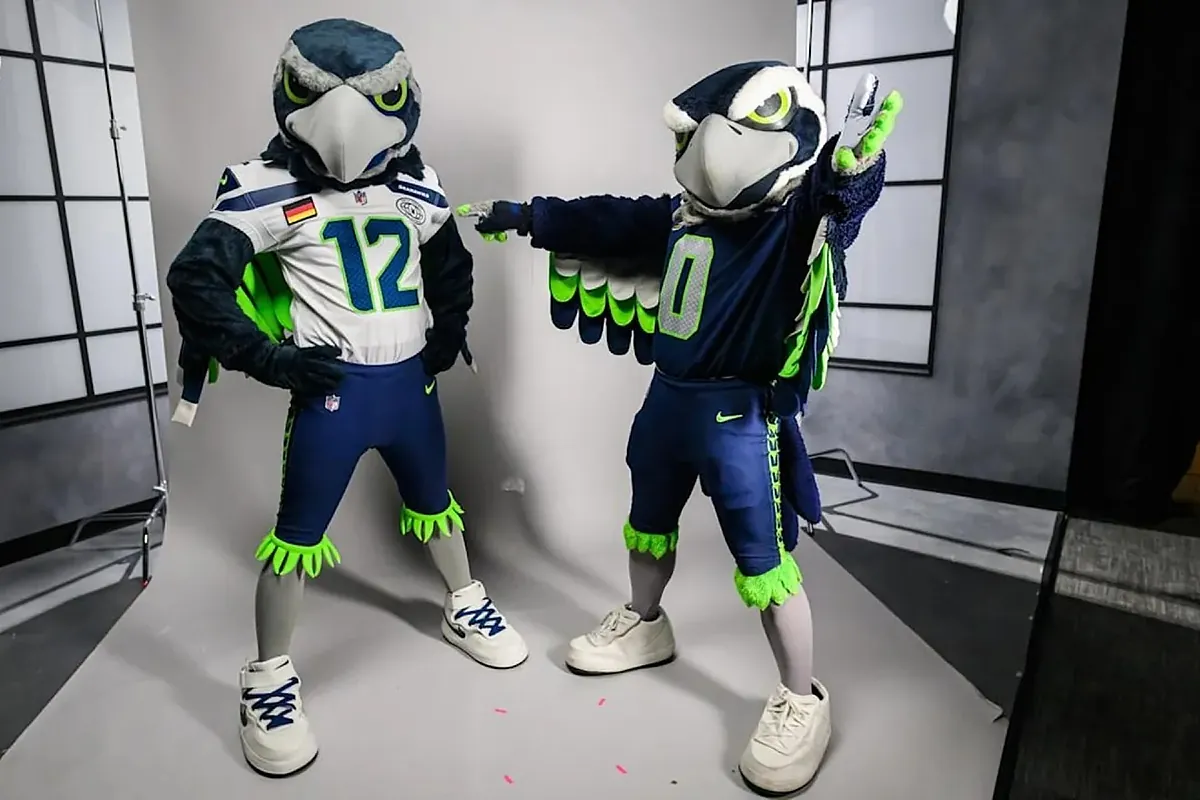
Talking about the Seattle Seahawks without mentioning the 12th Man is impossible. But to reduce this phenomenon solely to the noise of Lumen Field would be to fall short. The franchise understood years ago that identity is not built solely on victories, but on recognizable symbols, and that is where Blitz and Boom cease to be mere mascots and become strategic pieces of the Seahawks’ story.
Both mascots, despite their impact with the people, are outside the Top 10 highest paid mascots in the League, earning $55,000 a month.
In an NFL where many franchises still use their mascots as secondary entertainment, Seattle put them at the center of the show. They don’t decorate the game: they push it.
Blitz, the face of adult fanaticism
Blitz is more than just the team’s official bird. Since its introduction in 1998 and its redesign in 2014, it went from being a cartoonish character to a more aggressive, more realistic figure, more in line with the competitive spirit of the franchise.
His current image is no coincidence: less muscle, more fierceness. More bird of prey than fairground doll. Blitz represents the adult fan, noisy, intense, the one who understands that in Seattle the home factor is felt.
And their role goes beyond Sunday:
- Constant presence at community events
- The visible face of charity campaigns
- Emotional connection during the off-season
Blitz doesn’t disappear when there’s no football. It keeps the narrative alive.
Boom, the generational change
The arrival of Boom in 2014 was as simple as it was clever. While Blitz consolidates the mystique, Boom looks to the future. It is the link with the children, the first contact of many young fans with the Seahawks brand
Its more youthful design, its cap on backwards and its role in family events respond to a clear logic: to build loyalty before the fan chooses another team.
Seattle doesn’t wait for the audience to come to them. They shape it.
Emotional marketing, not improvisation
Behind Blitz and Boom is a fine reading of the modern sports business. Franchises no longer compete only on the field, they compete for attention, belonging and emotional memory.
Seattle understood that:
- The noise of the stadium is trained
- Loyalty is built from childhood
- The gaming experience starts before kickoff
Keys to the Seahawks’ Blitz and Boom model
- Blitz has been around since 1998 and was redesigned in 2014
- Boom was created to connect with children
- Both reinforce the identity of the 12th Man
- Pets actively participate in community events
- Seattle uses its symbols as branding tools, not decoration
The Seahawks don’t have mascots, they have ambassadors
Blitz and Boom are not there to fill dead time. They are there to remind the opponent where they are playing and the fan why they belong.
In Seattle, the noise is not spontaneous. It is cultivated. And their pets are an essential part of that ecosystem that makes the Seahawks more than just a team: a recognizable identity throughout the NFL.
Read the full article here