


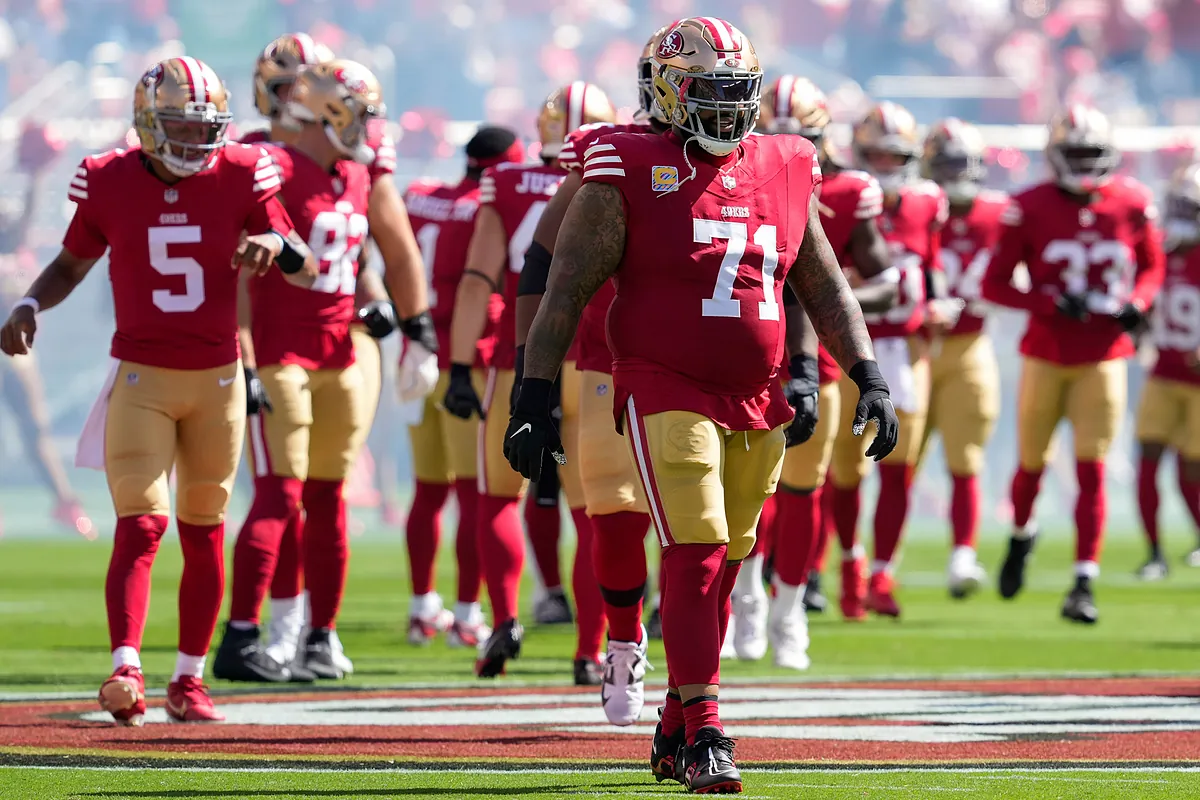
The San Francisco 49ers are at a crossroads with veteran tackle Trent Williams as the clock ticks on his final contract year.
The 37-year-old lineman, widely regarded as one of the best at his position over the past decade, enters 2026 with $32 million in non-guaranteed base salary and a cap hit of $38.841 million.
Sources tell ESPN’s Adam Schefter that both sides are currently “struggling” to reach an agreement, leaving Williams’ future in San Francisco uncertain.
Williams‘ situation carries significant financial and roster implications. Without a new deal, the 49ers face the possibility of releasing him outright. That move would free cap space but also remove a cornerstone of their offensive line, a unit that has long been critical in protecting the quarterback and establishing the run game.
Complicating matters, Williams is set to receive a $10 million payment on April 1. If the team opts to carry his cap number through March, a trade remains a possibility, though it’s unclear which teams could absorb that kind of contract.
The uncertainty represents a major shift from last season. Following the 2025 campaign, Williams publicly stated he intended to return to the 49ers in 2026. At the time, the message seemed clear: a veteran leader committed to finishing his career in San Francisco.
Yet, in just a few months, the narrative has shifted dramatically. Negotiations over salary, role, and long-term security have stalled, creating a rare standoff between a player of Williams‘ stature and one of the NFL’s most strategically minded franchises.
The stakes for both sides
For Williams, this is more than a contract dispute. At 37, his window for peak-level play is limited, and securing a guaranteed payday is crucial. While still dominant in pass protection and widely respected for his technique and intelligence on the field, age inevitably factors into negotiations.
The league is moving toward younger, more cost-controlled talent, and Williams‘ asking price may make some teams hesitant to commit long-term.
From the 49ers’ perspective, the stakes are equally high. San Francisco must weigh loyalty and production against salary-cap flexibility and roster construction. Releasing Williams would open significant cap space, allowing the team to pursue other free agents or extend younger players, but losing an elite tackle could disrupt the offensive line for years to come.
Trading him, while an option, presents challenges in finding a partner willing to take on his full contract, particularly in a league increasingly focused on balancing cost and upside.
Williams‘ situation also highlights the tension between aging superstars and teams trying to balance competitiveness with long-term planning.
In the coming weeks, all eyes will be on San Francisco and Williams as both sides attempt to chart a path forward.
Read the full article here