



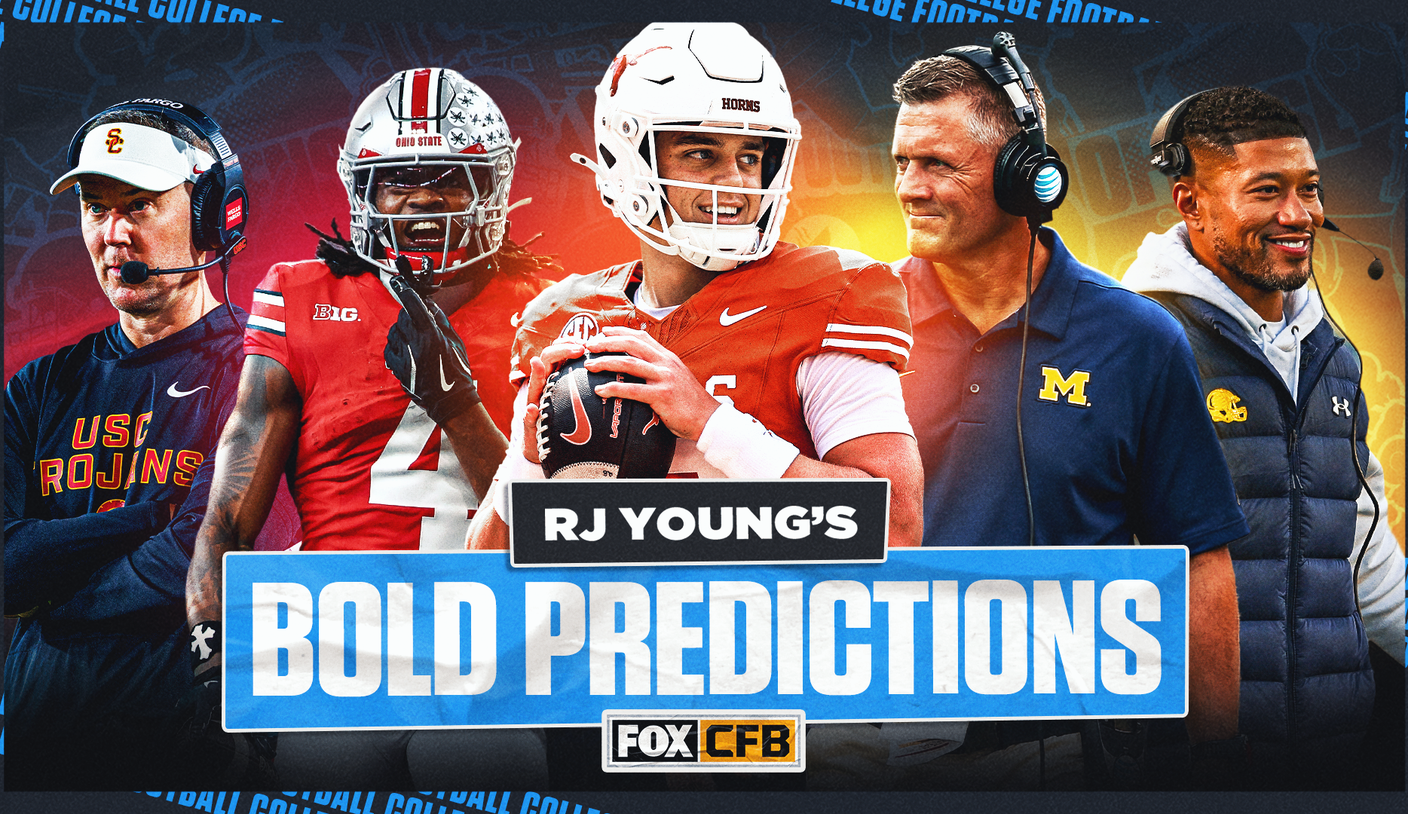
I want all of these things to be right — every last one.
However, had I made bold predictions in January 2025, listing Indiana quarterback Fernando Mendoza as the 2025 Heisman Trophy winner might’ve appeared rather obnoxious.
Listing Miami as the No. 10 seed to reach the College Football Playoff national championship game and predicting it would become the first team to play a home game for the belt might’ve appeared ludicrous. But, today, not 48 hours removed from Indiana’s national title victory, those are simply facts. Let’s see how close I can come to writing facts into existence less than one year from right now.
Here are my very early bold predictions for the 2026 college football season:
7. Arch Manning will be a Heisman finalist and lead Texas to the CFP
(Photo by Alex Slitz/Getty Images)
Manning played the second half of the season better than the first. After passing for 300 yards just once in the first six games of the season, he enjoyed three 300-yard passing performances in the final six. Texas coach Steve Sarkisian said multiple times over the course of the 2025 season how he watched Manning mature as a player, and he’s invested in that maturity with the addition of dynamic tailbacks Hollywood Smothers (NC State) and Raleek Brown (Arizona State) in the backfield and Cam Coleman (Auburn) out of the 2026 transfer portal cycle.
And then defensive coordinator Will Muschamp promises to bring a fiery edge to his defensive coaching and play-calling to help return the Longhorns to their third CFP in four years.
6. Kyle Whittingham will lead Michigan to the playoff
(Photo by Dustin Markland/Getty Images)
Whittingham finally has the chance to coach at a program benefiting his resume as one of the best coaches of the last 20 years. While at Utah, his teams finished without a winning record just three times, made a New Year’s Six Bowl four times and won 10 games or more in four out of the last seven years.
At Michigan, he’ll have the resources to procure and develop the most talented team of his career. What’s in place already though, especially quarterback Bryce Underwood, is more than enough for the Wolverines to make the CFP.
[ALL-TIME TURNAROUNDS: Where do Indiana, Patriots, Cubs Rank?]
5. Notre Dame returns to the CFP as the No. 12 seed
(Photo by James Black/Icon Sportswire via Getty Images)
Fighting Irish coach Marcus Freeman brought in a couple of former Ohio State Buckeye wide receivers in Mylan Graham and Quincy Porter that will give his quarterback, CJ Carr, even more talent in a passing game that should feature in offensive coordinator Mike Denbrock’s scheme.
Notre Dame can finish as one of the sport’s top-ranked programs. What remains to be seen is whether Freeman and Fighting Irish administrators will quit playing in the postseason for two consecutive years if they miss the CFP field again.
4. Ohio State will win its first Big Ten title since 2020
(Photo by Matthew Visinsky/Icon Sportswire via Getty Images)
The Buckeyes have made their league title game just once since they last won it. Winning the national championship in 2024 certainly soothed the disappointment to finish seasons 2021, 2022, 2023 and even 2025.
But Ohio State fans must burn each time they remember Michigan beat their Buckeyes, won the Big Ten title and national championship and did it all without dropping a game. With the return of quarterback Julian Sayin, wide receiver Jeremiah Smith and running back Bo Jackson, the Buckeyes have foundational pieces and talent to run the table this season.
3. Jeremiah Smith will win the Heisman Trophy
(Photo by Jason Mowry/Getty Images)
This is the season for Ryan Day and the Buckeyes to use up what’s left of Smith in an attempt to finally win the trophy awarded to the nation’s best player. Smith stands a great chance of becoming the first No. 1 overall NFL Draft pick at wide receiver since Keyshawn Johnson in 1996 if he plays the kind of season he’s capable of putting together.
The last wide receiver to win the Heisman was Alabama’s DeVonta Smith, who caught 117 passes for 1,856 yards with 23 receiving touchdowns on a team that finished undefeated and won the 2020 national championship. Jeremiah Smith will have to come close to those numbers and that team outcome to clutch the stiff-armed trophy.
[COLLEGE FOOTBALL: Why We’ll Remember the Dramatic 2025 CFB Season]
2. Oklahoma and USC meet in the CFP
(Photo by Harry How/Getty Images)
The two programs have been due for another fistfight — I mean match-up — since 2005. The last time USC and Oklahoma played, the Trojans left no doubt who the best team in the country was when they destroyed the Sooners, 55-19, in the Orange Bowl.
But since 2021, when Lincoln Riley left Norman, Oklahoma, to coach in South Central Los Angeles, a return to defense-first football at Oklahoma has emerged since Brent Venables took over as head coach and USC’s move to the Big Ten. Each team looks like it could reach the CFP this season for the first time in the same field.
Perhaps then a true clash of styles — Hollywood glitz and high-flying offense vs. red-dirt grit and suffocating defense — can make for a memorable test in the tournament.
1. The Big Ten will feature a team in the CFP national title game for the fourth season in a row
(Photo by Jamie Schwaberow/Getty Images)
The Big Ten has usurped the SEC as the most dominant league in the sport. The conference has produced three different teams who have made the CFP national championship game in three-straight years: Michigan, Ohio State and Indiana — all of whom won their respective titles. The SEC has failed to produce a team that can qualify for the national title game since 2022.
Factoring in Oregon (2024, 2025) and Penn State (2024), the Big Ten has had six schools reach the CFP since the 2023 season. In that same span, the SEC had six teams featured. But, crucially, Indiana is the only one of those 11 in each league that reached the national title game for the first time — ever.
Indiana only got better in a league that has gotten better.
Above the Mason-Dixon Line, the caliber of play just means more, and that does not look like it will change in the 2026 college football season.
Read the full article here