




The NFL is taking a closer look at how defenders are allowed to challenge receivers, reinforcing illegal contact rules as the league tries to preserve the fast, open style of football it believes keeps fans engaged.
The competition committee has identified illegal contact beyond five yards and offensive pass interference as continuing points of clarification for the 2026 season.
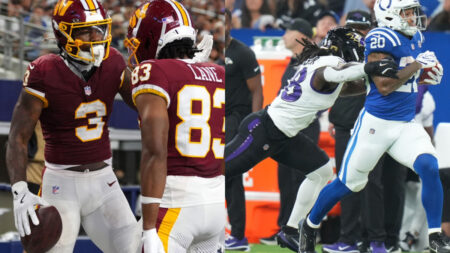
The message to officials is straightforward: receivers and defensive backs shouldn’t be gaining an advantage through grabbing, clutching or pushing once routes develop downfield.
The renewed emphasis arrives after a complicated Week 1 television picture.
NFL games averaged 19.5 million viewers, down 13% from the opening week of 2025 and 9% from 2024. Even so, it was still the league’s third-most-watched Week 1 of the past decade.
Officials told exactly what to watch
The NFL used its Week 2 officiating video to show coaches and players what should draw a flag.
“This is a clear illegal contact,” the league said while reviewing one example. “There’s that overt push, clearly beyond [five yards]. Quarterback is still in the pocket. Illegal contact would be the proper call.”
Only seven illegal contact penalties were called during Week 1, compared with 10 during the same period last season. Offensive pass interference moved in the opposite direction, with six flags compared with one in Week 1 a year ago.
Receivers are also being warned that greater freedom doesn’t mean they can simply shove defenders away.
“What the receiver cannot do is go to the [defender’s] body,” the NFL said in the video. “You can take and you can knock those [defender’s] hands up, down, swim across through those hands and arms. But you cannot go to the body and extend and push off.”
Ratings fell overall, but several games still delivered
The push shouldn’t be interpreted as evidence that Week 1 lacked offense. Teams combined for 791 points, tying the record for the most ever during an opening weekend. Week 2 then began with Buffalo defeating Detroit 41-31 in another high-scoring game.
Several broadcasts also performed strongly despite the overall decline. Dallas-New York drew 25.7 million viewers and became Sunday Night Football’s most-watched season opener since 2015, while ESPN recorded its biggest Week 1 Monday Night Football audience in the program’s history.
The Rams-49ers game in Australia averaged 18.5 million U.S. viewers on Netflix and 21.7 million globally. That leaves the NFL balancing two realities as scoring is already strong, but overall audiences slipped from unusually high recent levels.
Strict enforcement in the secondary is one way the league hopes to keep passing lanes open, produce more explosive plays and maintain the kind of pace that can hold viewers from kickoff to the final whistle.
Read the full article here