





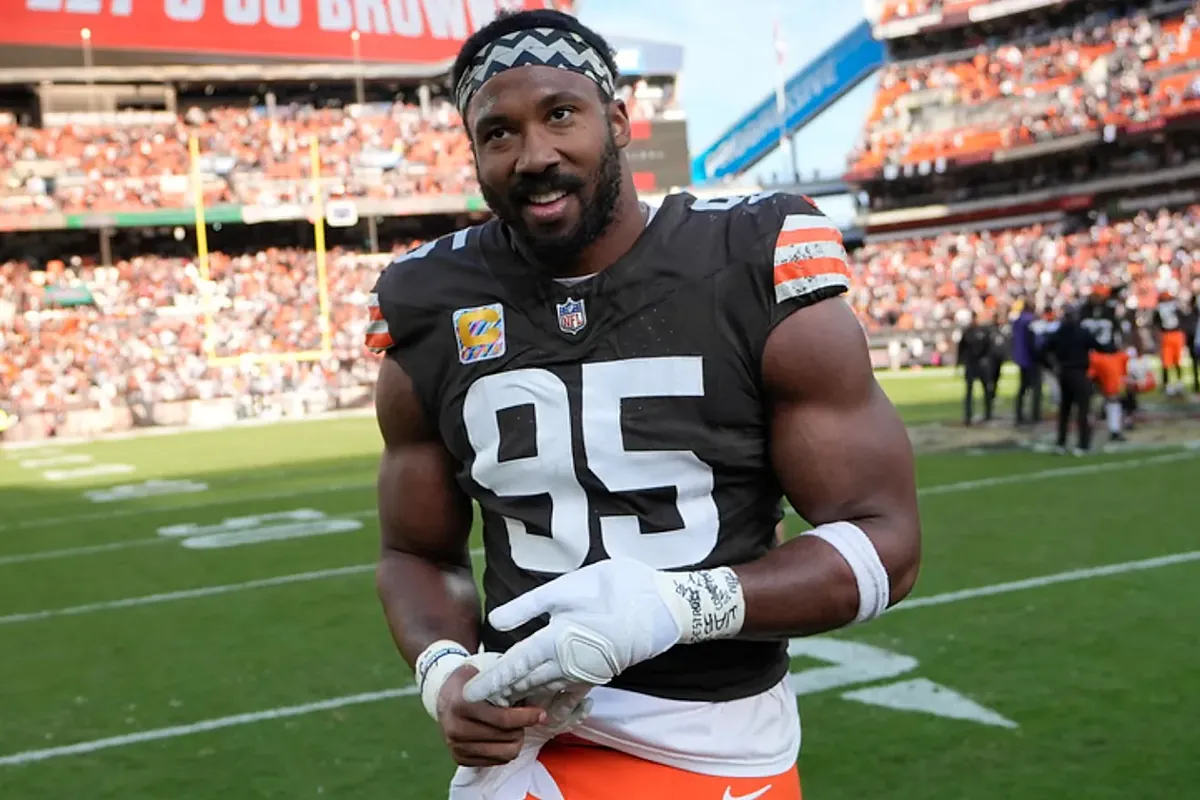
The future of Cleveland Browns defensive star Myles Garrett continues to draw attention across the NFL, but league sentiment is increasingly pointing in one direction: an extension, not an exit.
Despite ongoing trade chatter that inevitably follows elite players, the organizational reality in Cleveland suggests that keeping Garrett remains the far more realistic, and financially logical path.
At the heart of the discussion is the rapidly escalating edge-rusher market.
According to reporting highlighted by Sportskeeda and insights attributed to NFL insider Dan Graziano, the expectation around the league is that Garrett is far more likely to receive another major contract adjustment than to be moved before or during the next competitive window.
That projection comes as top defensive contracts continue to push toward, and beyond, the $40 million-per-year benchmark, a figure that now defines the upper tier of non-quarterback compensation.
For Cleveland, the equation is about more than just money. Garrett is not only one of the most productive pass rushers of his era, but also the centerpiece of a defense built around his ability to disrupt game plans at the snap.
Since being selected first overall in the 2017 NFL Draft, he has developed into a consistent All-Pro presence, routinely producing double-digit sack seasons and serving as the defensive identity of the franchise.
What makes the situation more compelling is how the modern NFL values elite pass rushers. Across the league, teams have shown a clear reluctance to part with game-wrecking edge defenders in their prime.
Even when trade rumors surface, the return package required, typically multiple first-round selections plus immediate defensive replacements, often outweighs the certainty of keeping a proven star.
Why the Browns view an extension as the safer long-term investment
From a roster construction standpoint, the Browns are in a familiar position: balancing high-end defensive talent with broader team stability.
Moving Garrett would not only strip away one of the league’s most dominant defensive players but also create a long-term gap that is extremely difficult to replace through the draft or free agency.
That challenge is amplified by the timing of the salary cap cycle. As league revenues continue to rise, contract benchmarks for elite edge rushers are expected to climb even further.
In that environment, locking in Garrett before the market escalates again becomes less about rewarding past production and more about preventing future cost inflation.
There is also the competitive reality. Teams with elite pass rushers tend to remain in contention longer, even when offensive inconsistency exists.
Garrett’s presence alone alters protection schemes and forces opposing quarterbacks into faster decisions, a value that does not easily translate into draft capital.
While trade speculation is a natural byproduct of star-level visibility, the broader NFL consensus aligns with Cleveland’s incentives.
The franchise has invested heavily in Garrett as its defensive foundation, and all indications suggest that investment is not nearing its end.
As the $40 million threshold becomes less theoretical and more standardized for elite defenders, the Browns appear positioned not to move on from their cornerstone, but to financially double down on him.
Read the full article here