





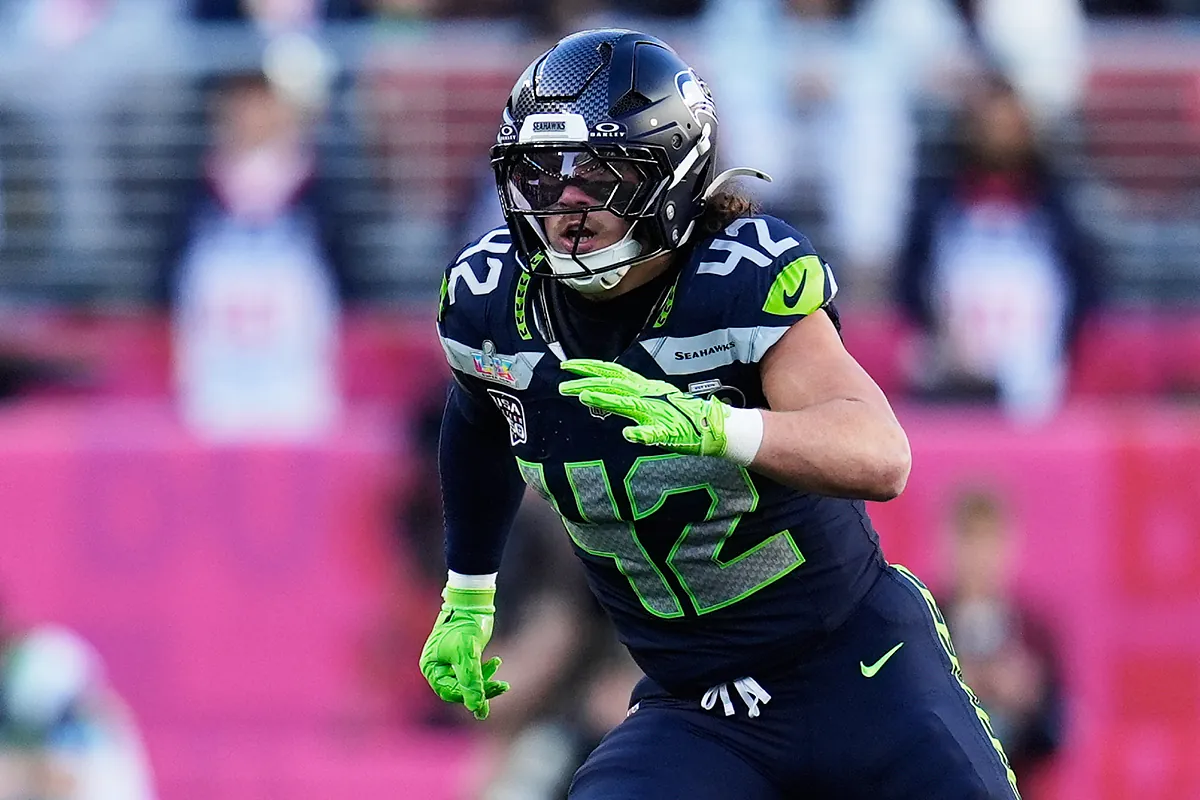
The Seattle Seahawks have secured a key piece of their championship defense by signing linebacker Drake Thomas to a two year, $8 million extension, keeping the breakout defender with the team through the 2027 season.
Thomas had a career year in 2025, stepping up from special teams to a starting role, and Seattle clearly values his versatility and instincts, as evidenced by this contract, which removes any uncertainty about his future with the club.
Originally undrafted and briefly on the Raiders‘ roster in 2023, Thomas was claimed off waivers by the Seahawks, where he contributed mainly on special teams before earning a larger role, showing a steady rise that now has him locked in long term.
In 2025, Thomas made 47 solo tackles, with eight passes defensed, six quarterback hits, 3.5 sacks and a fumble recovery, becoming a disruptive force in Seattle‘s defense, which dominated en route to a Super Bowl victory and cemented its status as a league elite.
Thomas was slated to become a restricted free agent next week, but the new deal ensures he remains a Seahawk as the club builds around its core talent, and the decision signals confidence in his continued development as a defensive difference maker.
The Seahawks‘ defense was a foundational strength in their Super Bowl run, blending a fierce pass rush, disciplined coverage, and playmaking that complemented their offensive attack, and Thomas now figures to be a key part of that formula.
Seattle‘s defensive front, led by edge rusher Uchenna Nwosu and veteran tackle Poona Ford, generated 52 sacks, second in the league, creating pressure that allowed the secondary time to react, reducing big plays and keeping opponents off balance.
Linebackers Kenneth Murray and C.J. Mosley provided stability against the run and in intermediate coverage, allowing defensive coordinators to disguise looks and force hurried decisions, which often resulted in mistakes from opposing quarterbacks.
The secondary, anchored by cornerback Darious Williams and safety Jamien Sherwood, played strong coverage, with Williams limiting completions and Sherwood contributing six interceptions and numerous pass breakups, strengthening both pass defense and run support.
Seattle‘s defense also made pivotal plays in crucial moments, forcing turnovers in the playoffs, including a fumble in the NFC Championship and an interception in the Super Bowl, both of which swung momentum and contributed directly to wins.
Overall, the Seahawks‘ 2025 championship was shaped as much by defensive excellence as offensive execution, and retaining Thomas reflects Seattle‘s intention to maintain that steadfast defensive identity going forward.
Why did the Seattle Seahawks refuse to franchise tag their Super Bowl MVP?
The Seahawks opted not to apply their franchise or transition tag on Kenneth Walker III before free agency, meaning the 25 year old will become an unrestricted free agent when the new league year begins.
A franchise tag would have secured Walker a one year salary at the top rate for his position, roughly $14 million, but Seattle chose not to take on that cap hit, prioritizing flexibility over a short term guarantee.
Under general manager John Schneider, the Seahawks have rarely used the franchise tag, doing so only twice since 2010, indicating a preference to build contracts without large one year guarantees or sudden cap spikes that can limit other roster moves.
Entering the offseason with significant cap space, the club also faces numerous free agents it hopes to re sign, including defensive and offensive stars, complicating the decision to commit a huge portion of the cap to one position.
Wide receiver Jaxon Smith Njigba is eligible for a major extension, and retaining multiple starters is a priority, making it difficult to allocate substantial cap dollars to a running back, especially in a market where the position’s value has declined.
Walker‘s role in Seattle‘s championship was significant, as he rushed for 135 yards in the Super Bowl and totalled 1,027 yards in the regular season, yet his career production does not match the highest paid backs, making the tag’s price point harder to justify.
Allowing Walker to test the open market also lets Seattle assess his value without a tag, a tactic that can lead to a team friendly long term deal, and if they agree on an extension before free agency, he could still remain in Seattle.
Otherwise, he is free to negotiate with any team when the new league year starts, potentially commanding a lucrative contract that surpasses typical running back deals, especially given a thinner draft class at the position.
Read the full article here