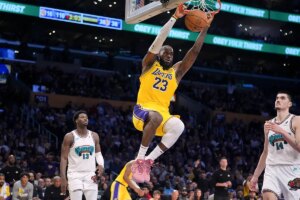




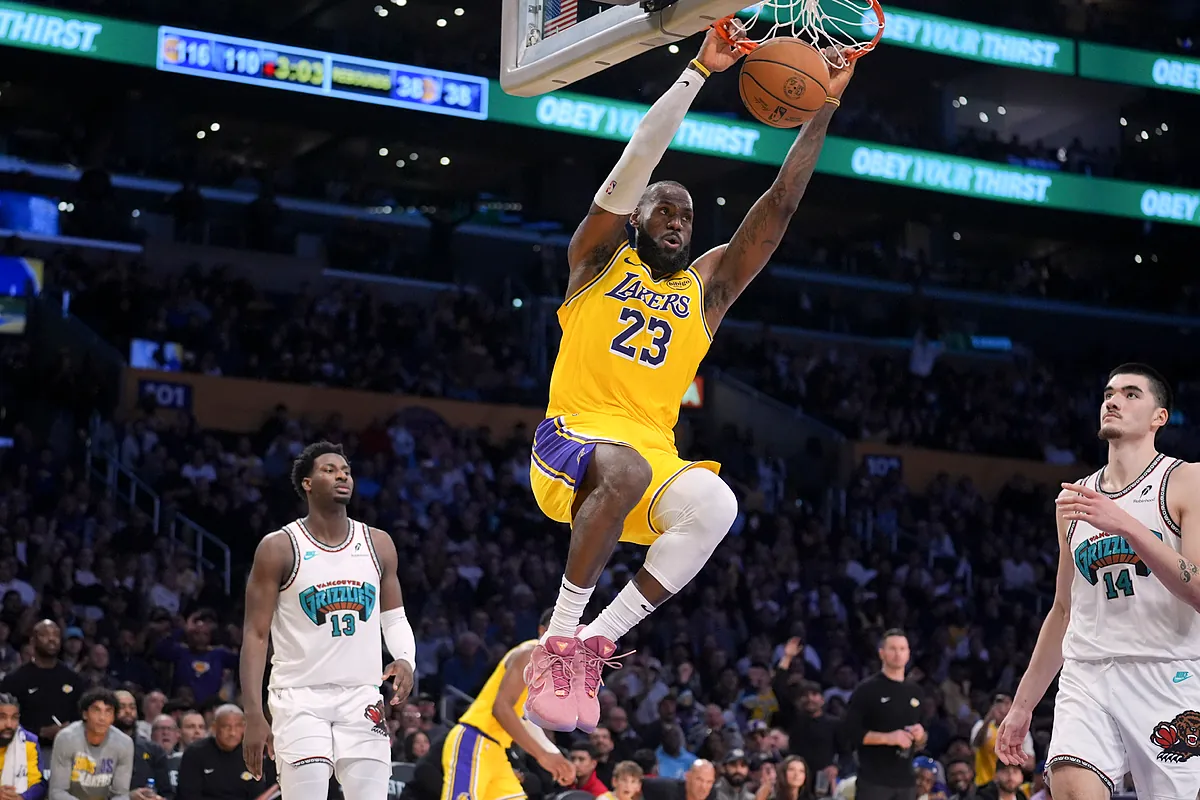
The Los Angeles Lakers are heading toward a pivotal offseason decision, and the focus is squarely on LeBron James.
As the 2026 NBA Playoffs approach, questions surrounding his contract status and market value have intensified, fueled in part by recent commentary from NBA insider Brian Windhorst.
While LeBron continues to perform at a high level deep into his career, the financial dynamics of the league appear to be shifting.
Teams are increasingly cautious with cap space, and that reality could play a significant role in determining how negotiations unfold between the Lakers and their franchise cornerstone.
Windhorst offered a blunt assessment of the situation, emphasizing that LeBron’s contract remains the central issue impacting the Lakers‘ flexibility moving forward.
“Until you deal with LeBron, I do not want to get into a cap space discussion here, but functionally, the Lakers will not have cap space until the deal with LeBron,” Windhorst explained.
That statement underscores the broader challenge facing Los Angeles. With limited financial maneuverability, the organization must decide not only how much LeBron is worth in the current market, but also how his deal aligns with the team’s long-term strategy.
A shifting market raises difficult questions about LeBron’s value
Windhorst’s reporting suggests that the broader NBA landscape may not support the type of contract LeBron once commanded.
Despite his legendary résumé, there appears to be hesitation among teams to commit significant cap space to a player entering the later stages of his career.
“I have specifically spoken to people on both sides of the negotiation of ‘what do you think his value is in the 2026-27 NBA season,” Windhorst continued.
“Knowing there’s no team out there with cap space that is going to say ‘here’s $35M to play for us.'”
That reality creates a unique negotiating environment. Traditionally, a player of LeBron‘s stature would command multiple high-value offers, giving him leverage in discussions. However, according to Windhorst, that leverage may not exist in the same way this time around.
“Yeah, the Warriors or the Cavs would take him for the Mid Level Exception … There’s not a team that’s going to clear $35-$40M for him and say come to us. So, who are the Lakers bidding against? I talk to both sides, and I don’t hear an answer.”
This raises a critical point: if there is no robust external market, the Lakers may find themselves negotiating from a position of relative control. At the same time, they must weigh the value of retaining a generational talent against the need to build a sustainable, competitive roster.
The timeline for a decision is also becoming increasingly urgent. Windhorst highlighted a key date that could shape the franchise’s direction.
“A big, big question mark that’s hanging over the Lakers, and they’ve got to decide it by around June 15,” Windhorst said. “LeBron’s going to have to decide whether he wants to be a Laker and what he wants to play for by June 15… they can’t sit there and be wishy-washy about it.”
For the Lakers, this moment represents more than just a contract negotiation. It is a defining crossroads that will influence roster construction, financial planning, and the team’s competitive outlook in the years ahead.
LeBron‘s legacy in Los Angeles is already secure, highlighted by a championship and sustained relevance.
However, as the business side of basketball takes center stage, both player and franchise must navigate a complex and evolving landscape, one where past achievements may not fully dictate future value.
Read the full article here