




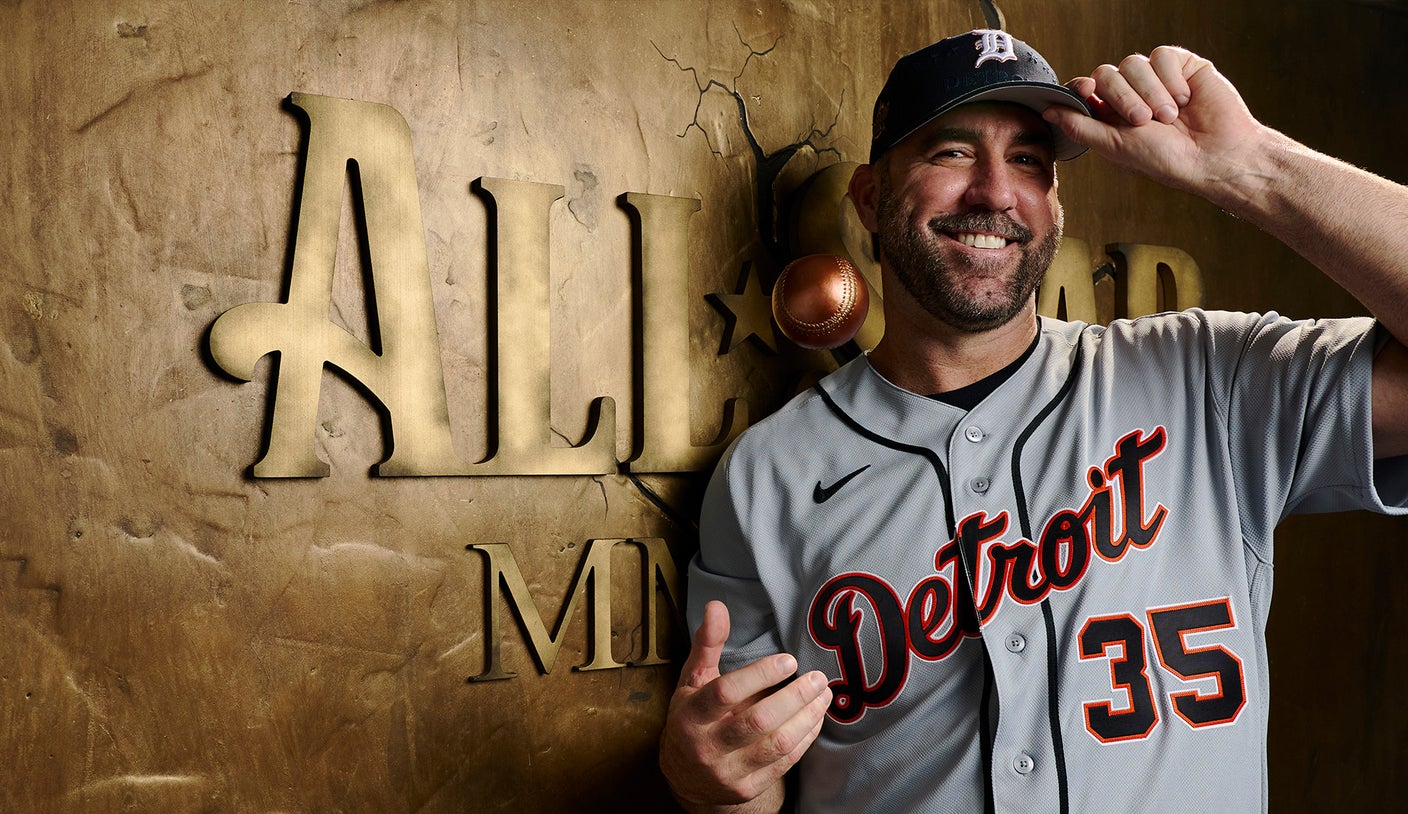
CITIZENS BANK BALLPARK (Philadelphia) – There was no “aha” moment for Justin Verlander.
In announcing his retirement from a spectacular baseball career, Verlander slowly came to the conclusion earlier this season that his physical health was preventing him from accomplishing everything he wanted from the game.
Verlander, the oldest active player in MLB at age 43, is at peace with his decision to call it a career.
“I feel good about it,” he told me on Monday at Citizens Bank Park during All-Star Game festivities. “I’m in a good mental space. I do feel like it’s the right time. And if I want to control my own destiny, which I do, I want to leave the game when I’m ready to go, and not have the game force me out.”
Justin Verlander walks the red carpet at the MLB All-Star Game with his family. (Hunter Martin/MLB Photos via Getty Images)
After this season, Verlander will retire as one of the greatest pitchers in baseball history.
“It’s tough. It’s hard to see him go,” Braves All-Star left-hander Chris Sale told me. “Since I’ve been in the big leagues, to be completely honest with you, I think pound for pound, if he’s not the best pitcher in the league, he was damn close.
“You’re talking about a guy with three Cy Youngs, MVP. You look at what he’s done in the regular season, look at what he’s done during the postseason, look at his All-Star appearances. He’s got about as impressive as a trophy case that you’re going to see.”
Verlander is the last of an era that blended dominance, durability and championships. He’s the active leader in strikeouts (3,554), wins (266), games started (556), complete games (26), shutouts (nine), and innings (3571.1). He’s a three-time Cy Young award winner, a two-time ERA title winner, and the 2011 American League MVP. He’s a two-time champion and the 2006 AL Rookie of the Year award winner, plus a 10-time All-Star.
Justin Verlander received a warm ovation when introduced to the crowd at the MLB All-Star Game. (Emilee Chinn/Getty Images)
As decorated as Verlander’s career has been — let’s not forget that, in a handful of years, he will be a first-ballot Hall of Famer — he still believes he fell short of a couple of milestones.
“There’s a couple things that I would love to have been able to check off my career,” Verlander said on Monday at Citizens Bank Park. “And that would be 300 wins and 4000 strikeouts. But those are both a ways off. And everything would have to go absolutely perfect. One thing I think I’ve done really well in my career is to be objective of myself.
“That’s allowed me to adapt when I need to and be successful on the mound, and what I’ve been doing this year is trying to find that again. I know what I need to do mechanically to be healthy and compete at this level. And my body’s not letting me do that. So the adjustments that I need to make to be the pitcher that I expect myself to be, some parts of my body can’t quite keep up. So I feel good about the decision.”
Verlander has made just one start for the Detroit Tigers so far this season. He described dealing with his injuries this year, including hip pain and a hamstring strain, as “plugging holes in a leaky boat.” He may not know that, throughout it all, his peers have admired his dogged determination to do whatever it takes to get back on the mound.
Reigning National League Cy Young award winner Paul Skenes said he admires Verlander’s consistency across a 24-year career.
“He’s a legend,” Skenes told me. “I think he’s been in the league as long as I’ve been alive. He’s the greatest pitcher of his generation. I think he shaped the game in a lot of different ways. He’s been really good for a really long time. It’s an honor to share the field with him. It’s an honor to meet him.
“It’s a heck of a career winding down. I don’t want to see him retire. I don’t want to see him not in this game anymore. But it’s been special to watch as a fan for a really long time, and now as a player.”
Dodgers All-Star first baseman Freddie Freeman joked that “a lot” of Verlander’s 3,554 career strikeouts “were me.” It may have felt that way to Freeman, facing Verlander’s cutthroat dominance, but he has only struck out two times in nine career plate appearances against Verlander.
“I’ve been facing him for a long time,” Freeman told me. “We’ve had some great interactions. Just one of the best pitchers of all time. First-ballot Hall of Famer. To pitch for as long as he has, as good as he has, that’s special. Those guys don’t come around very often. Hopefully he can get back on the field one last time this year and be healthy. But what a tremendous career.”
Verlander’s greatest legacy is being the ultimate workhorse of his generation. His massive career volume and incredible counting stats — including 12 seasons with 200-plus innings pitched — may never be surpassed by a modern starter. He learned to pitch deeper into games by watching older pitchers, in particular, refuse to leave the mound until they felt and knew they were exhausted.
“Personally, I think you need veterans to fight for it, and show that it’s OK to be out there and fight for that,” Verlander said. “If you’re at 95 pitches, and you’re feeling good and fresh, your body is recovering, it’s OK to fight for that next inning and throw 110 (pitches) if you want. I was raised, I got to see guys do that.
“Luckily, I was pretty good right out the gate. I felt empowered by watching other people want the ball. All these guys point to their predecessors, and it’s getting harder and harder in this game to fight for that. The analytics, they’re monitoring everything.”
These days, there are pre-planned pitch limits for starters stemming from various data based on optimal recovery times. And the reason pitchers need more rest built into their seasons is the pressure to throw the ball harder. Shoving triple-digit heaters every five days requires extreme physical exertion, and it leads to greater wear and tear on the body, which can lead to injuries and surgeries.
Verlander said his career would likely be different if at age 17 he went to Driveline Baseball, which is a data-driven training facility used by many active players to help increase pitch velocity, among other things.
Verlander wasn’t a hard thrower out of high school. His fastball topped out at 93 mph when he was a teenager. He said it wasn’t until he went to college, started working out, and “things weren’t rushed” before he found his fastball. Suddenly, after his body matured, the ball started coming out of his hand at 98, 99, and 100 mph naturally.
“In today’s world, if I’m a parent that doesn’t know anything about baseball, which my family did not, and you find out your son has a God-given talent, what do you do? Today, you go online, and you get help. We had to get help.
“My dad bought a ‘How to Pitch for Dummies’ book. I’m not joking. Literally, he’s like, OK. Step one, you step back with your left foot. Step two, you turn this way. We were like, doing that in my front yard because he learned I could throw rock really far. Like, we should try this baseball thing.
“So, I think as a parent now, the first thing you would do is probably say, I need to go to Driveline, or one of these velocity-building camps. And it’s a trickle down from what you’re expecting at this level.”
In the future, Verlander would like to be involved in the game in some way to try and encourage pitchers to get back to basics, prioritize personal and unique pitching mechanics, and maybe focus less on increased velocity as the only answer to being dominant in the major leagues. Verlander believes pitching mechanics are supposed to be “like the gait of a horse.” All horses run differently, so just let the horse run.
But, for now, Verlander is following the advice of the legends that came before him.
“At the end of your career, I think, one of the things I’ve heard from people is sometimes you wish you were able to take things in a little bit more. It’s such a blur while you’re in it. And then you get towards the end, and it’s like, man, I wish I had enjoyed X, Y, and Z a little bit more.
“And so to have the opportunity to come back in this situation and really absorb it, and know it’s your last time, it’s a really special feeling.”
Read the full article here