



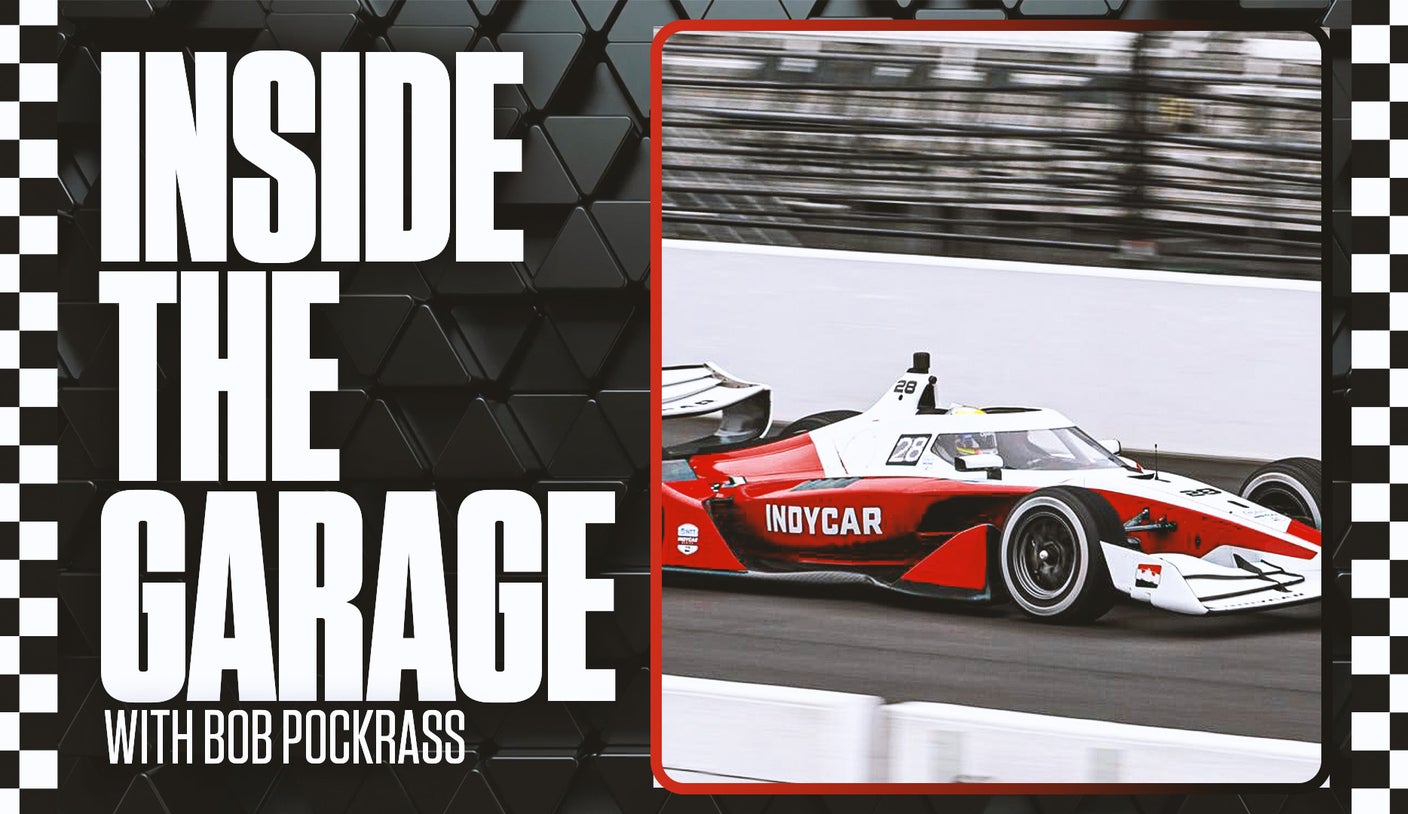
INDYCAR HEADQUARTERS (Indianapolis) — Anyone who has watched INDYCAR’s rollout of its 2028 car probably already knows what the buzzwords (or buzz slogan) is for its new machine.
Track Records.
To say that INDYCAR is focused — maybe even a little obsessed — with setting track records with its new car (the IR-28 is what it is called) would be accurate. The Indianapolis 500 qualifying record was set in 1996 by Arie Luyendyk, whose 237.498 mph qualifying lap and 236.986 mph four-lap run have lasted for 30 years.
INDYCAR’s newly designed car is set to debut on track in 2028.
To INDYCAR officials, that’s been long enough. And they hope to start breaking track records in 2028, and not only at Indianapolis.
“One of the first things [among our goals] was to break track records,” INDYCAR SVP Mike Sibla, who oversees the car’s development, told me and other reporters last Friday. “We felt that was something that we were ready to do.
“We felt the technology was there where we could do this safely, responsibly, and it’s a good way to really continue the momentum that the sport’s under right now.”
The car, of course, can only do so much when it comes to posting fast speeds. The tires and the weather at the track certainly influence how fast a car can go at any particular time.
But what about the 2028 INDYCAR is designed to make it go faster than the current version?
Well, it starts with safety. The car, designed by Dallara, has to be safe enough for INDYCAR officials to land on an engine configuration capable of approaching 240 miles an hour on the speedways.
The safety elements of the aeroscreen, as well as other safety devices to keep the car from lifting, have been incorporated into the design of the car. That means that the air should flow over the car more seamlessly. INDYCAR and Dallara have worked on the aerodynamics of the car to allow for less dirty air that would impact cars further behind if they are running single file.
That has included the shape and endplates of some of the wings. In the simulator, INDYCAR and Dallar put in the data to be able to simulate multiple cars.
“Although two cars haven’t been on track at the same time, the best science that we can use to determine if the car is going to be a good race car and a raceable car, everything we’ve seen so far is pointing to that we’ve made some gains there,” said INDYCAR VP Mike O’Gara, who leads the group working on the new car.
The tub has been tested to handle crashes at high speeds. The cockpit is bigger to allow for more padding to protect the driver.
And then there’s the engine, as INDYCAR goes from a 2.2-liter V-6 engine to a 2.4-liter V-6.
The hybrid unit, made by Helix, which was not involved in the current INDYCAR hybrid, won’t produce any additional horsepower. But it has 14 times the amount of power storage, meaning the amount of boost the car gets from the hybrid is going to increase dramatically.
With the engine regulations finally settled on by INDYCAR, Honda and Chevrolet just a few weeks ago, the target for the engine is 760 horsepower, which is 60-100 more than the current engine. It is expected as they continue to develop the engines that they could reach closer to 800 horsepower. The hybrid and push-to-pass systems can add up to 120 horsepower.
The hybrid is about 20 pounds lighter and the gearbox is 25 pounds lighter. Those are the most dramatic changes that bring the car back to approximately 1,700 pounds. That weight is about what it was originally with the current chassis.
“You’re taking weight out, you’re increasing the horsepower, and I think the biggest thing for us, a lot of people will say, ‘OK, safety, that’s great, but is it that exciting?’” Sibla said.
“We wanted to make this car safe so that we could break records. And that’s what we’ve done here.”
And it could be lighter.
After the initial validation tests at the Indianapolis Motor Speedway road course last weekend and upcoming tests on the IMS oval, a shorter oval and a street course in the next couple of months, INDYCAR will analyze the spec parts and pieces to see if it can take out even more weight from the car.
For instance, the aeroscreen was reduced by a few pounds in its latest iteration.
“We learn from these initial tests, you know what can be optimized, what can be changed, and that’s where you get that weight out,” Sibla said.
How will the teams tune the car to make it go faster?
They used to design and manufacture (or outsource) their own dampers, which are suspension pieces that impact how the car handles. They will no longer be doing that, as the suspension pieces and dampers in this car will be provided by one company (Custom Access).
But the options when it comes to those pieces, which ones the teams use and how they are installed are well into the thousands.
The wheels will also be different, with a stronger wheel that handles more loads.
And the car is designed to potentially evolve with speeds.
“Some of the magnesium wheels we have are at the very peak of their stress levels at some of the tracks we run at right now,” O’Gara said. “So, the wheels are more robust, the suspension is going to be more robust.
“There are also things like we currently aren’t going to run brake-by-wire, which is a thing a lot of hybrid race cars run currently. The car is future-proof for it. There’s a spot under the sidepod for a brake-by-wire system. And as the car evolves, as the engines make more power, as the hybrids make more power, then we can introduce some of those other systems.”
The current testing is being done with an old 2.4-liter engine developed by Ilmor from when INDYCAR was going to change engine packages about four or five years ago. So in these initial tests, they won’t know if the car is truly faster.
Chevrolet and Honda should get cars early next year.
“This engine … is an older version so you can’t really read too much into that,” Alexander Rossi said in a video news release following his test Saturday on the IMS road course.
“But all in all, it’s been incredibly smooth and it’s a joy to drive.”
What About Power Steering?
The new INDYCAR still lacks power steering.
Maybe one of those most debated issues is whether the cars should have power steering. Many forms of racing have it, but INDYCAR does not.
It certainly challenges the drivers and gives it a little bit of gladiator effect. But it has also been cited as a reason few women attempt to go the INDYCAR route.
Jamie Chadwick won the 2024 Indy NXT race at Road America and tested an INDYCAR. She cited the physical challenge as one of the reasons that making a move to INDYCAR would have been difficult for her to compete on road courses.
O’Gara said the new car is set up to add more of a “power assist” element that sports cars use but there is no guarantee it will be in the car.
“It’s not a full hydraulic system like Formula 1 cars run,” O’Gara said. “It’s an electric assist system similar to what’s been run in sports cars throughout the world. So the system exists.
“The car doesn’t currently have it. We have some basic testing we’re to do without the power assist, and then later in the testing phase, we plan on introducing it. … We need to test it at a few different places to see one, if it’s needed, and two, where it’s needed. Is it a road-course only thing? Do we require it everywhere or only certain track types? So that’s going to come with track testing as we run.”
IN THE NEWS
— Joe Gibbs Racing withdrew a pivotal allegation against Spire Motorsports and Chirs Gabehart as part of its suit: “A Spire employee has informed a JGR employee that Gabehart is in charge of and/or significantly participating in Spire’s competition strategy and decisions.” Gabehart is prohibited from doing similar work at Spire as he did as JGR competition director, so that would have violated that order. JGR, in a court filing, said after Spire asked for evidence that “it does not possess non-privileged information sufficient to support the allegations.”
— Front Row Motorsports announced Chandler Smith won’t return to its truck team next season. His future landing spot has not been announced, but it’s expected to be in an O’Reilly car at Richard Childress Racing.
— Tommy Baldwin, on the podcast “Door Bumper Clear” that he co-hosts, said he has parted ways with Rick Ware Racing. Baldwin was the competition director there.
Social Spotlight
They Said It
“We’ve all been waiting for this for a long time. Drivers, fans, teams, sponsors and all of you have been looking forward to it, and now it’s finally here. It’s like Christmas morning.”
— Alexander Rossi after testing the IR-28
Read the full article here