





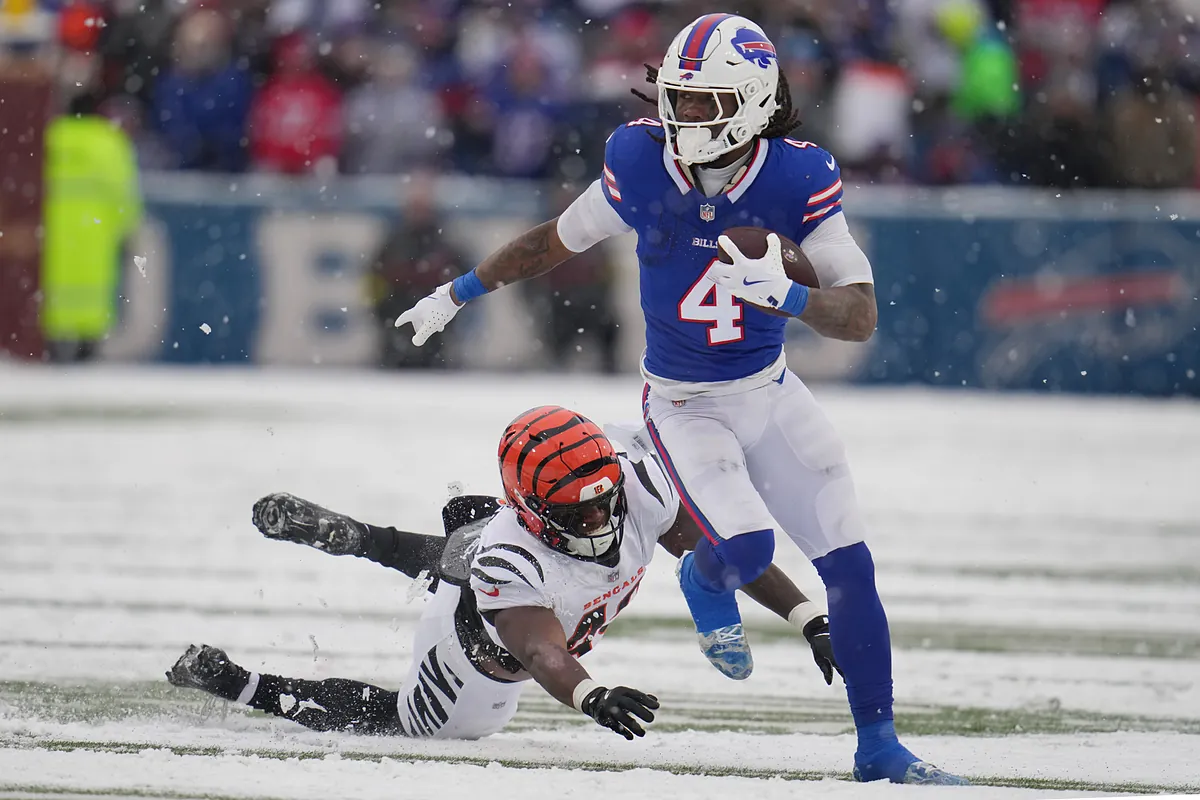
A long-awaited contract extension seemed to settle things – but it may have only delayed the next debate. James Cook could already be viewed as underpaid just one year after signing a $48 million deal with the Buffalo Bills.
Cook agreed to a four-year extension worth $48 million, including $30 million guaranteed, following a tense negotiation period in which he made it clear he was seeking a major payday. At the time, there was even speculation the Bills might move on rather than meet his demands.
Instead, the team committed – and Cook delivered.
The 26-year-old responded with a historic season, capturing the franchise’s first rushing title in more than 50 years and continuing a run of elite production. He has now surpassed 1,200 scrimmage yards in three straight seasons and scored 32 total touchdowns over the last two years.
Despite that output, questions about his value are already resurfacing.
Why James Cook could be underpaid again
According to Bleacher Report analyst Brad Gagnon, Cook currently ranks among the most underpaid players on his team – even after his recent extension.
Gagnon pointed to Cook‘s projected $5.9 million salary-cap hit in 2026, which would place him just 19th among NFL running backs. For a second-team All-Pro with consistent production, that number stands out.
“Productive running backs on rookie deals are special, and Cook is the definition of that,” Gagnon wrote, highlighting the gap between performance and compensation.
The situation is notable because Cook is already under contract through 2029, meaning any potential adjustment would likely require renegotiation rather than a new deal. For Buffalo, this is a familiar balancing act.
The team values Cook not just as a traditional running back, but as a versatile offensive weapon. General manager Brandon Beane has emphasized his ability to contribute in multiple phases of the offense, describing him as a “three-down-type player.”
At the same time, the Bills have been careful about workload management, aiming to keep Cook fresh by rotating other offensive pieces.
This approach underscores his importance – but it also complicates how his value is measured compared to other backs who may carry heavier workloads.For now, there are no signs of immediate tension.
Cook previously expressed satisfaction with how negotiations played out, stating that the process was handled the right way and that both sides reached a fair outcome. Even public pressure – including comments from his brother Dalvin Cook – did not escalate into a prolonged dispute.
However, the perception of being underpaid can evolve quickly, especially if production continues at a high level while market values rise.
The Bills are unlikely to revisit Cook‘s deal immediately, but the conversation could resurface if his performance continues to outpace his salary ranking.
Much will depend on how the running back market evolves and whether Cook pushes for another adjustment down the line.
For now, Buffalo has a productive and seemingly content cornerstone in its backfield – but as history has shown, in the NFL, value debates are never fully settled.
Read the full article here