




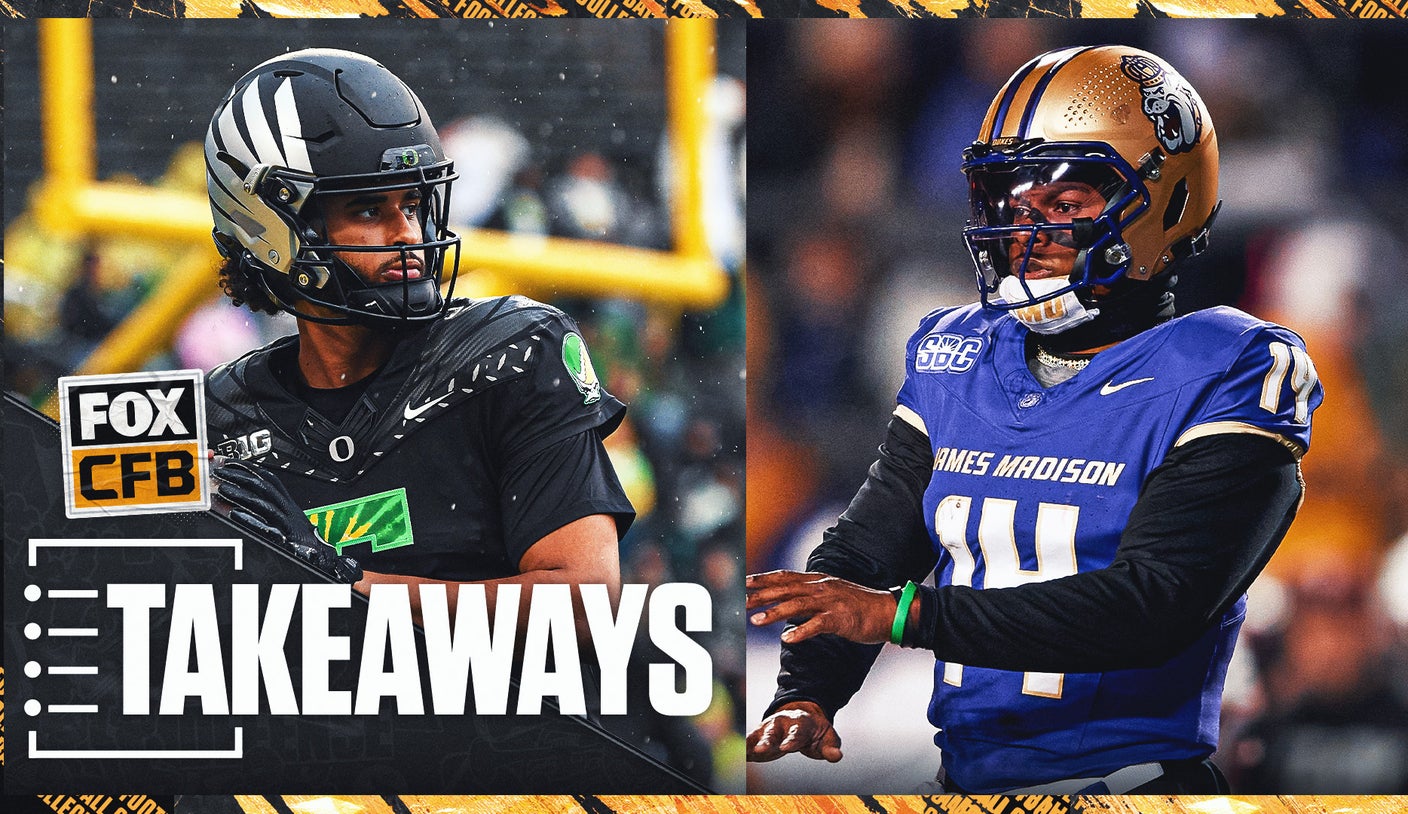
Because of the circumstances surrounding the Big Ten championship game earlier this month — No. 1 Ohio State vs. No. Indiana; both teams unbeaten; top overall seed in the College Football Playoff at stake — it was easy to overlook the conference’s third high-level team that had hovered in the upper tier of the national rankings all season: Oregon.
Head coach Dan Lanning and his team entered the playoff at 11-1 overall and 8-1 in the league, with their only defeat coming against the eventual-champion Hoosiers. The Ducks had beaten everyone else on their schedule and won nine of those games by double figures. Everything about Oregon’s résumé suggested it was a legitimate national championship contender.
Somehow, though, the No. 5 Ducks kicked off against No. 12 James Madison on Saturday night having largely flown under the radar in recent weeks, overshadowed by the Hoosiers, the Buckeyes and two other conference champions ahead of them in the final rankings. But the 51-34 hurting Oregon inflicted at Autzen Stadium in Eugene, Oregon offered everyone in college football a reminder of just how dangerous Lanning’s team really is, how real the Ducks’ dreams of winning a national title really are.
[Best Teams in the College Football Playoff Era: Creating the Ultimate 12-team CFP]
Here are my takeaways from the Oregon-James Madison CFP first-round game:
1. This version of Dante Moore can lead the Ducks to a national title
EUGENE, OR: Oregon Ducks quarterback Dante Moore drops back to pass during the College Football Playoff first-round game between the Oregon Ducks and James Madison Dukes on December 20, 2025 at Autzen Stadium.(Photo by Brian Murphy/Icon Sportswire via Getty Images)
Back in late September, when the score went final at Beaver Stadium and then-No. 6 Oregon upset then-No. 3 Penn State in double overtime, quarterback Dante Moore was in the thick of the Heisman Trophy race. He led the Ducks to five straight wins to begin the year and accounted for 14 touchdown passes and only one interception during that span — all in his first season as Oregon’s starter after spending the 2024 campaign learning behind Dillon Gabriel.
But Moore’s hot start gave way to an unfortunate mid-season wobble against then-No. 7 Indiana, whose defense harassed and tormented him into a multi-interception performance that cost Oregon, the defending Big Ten champion, control of its own destiny in the conference race. Two games later, Moore only completed nine of 15 passes for 86 yards and no touchdowns in an unconvincing win over struggling Wisconsin. Two weeks after that, Iowa limited Moore to just 112 passing yards in a second consecutive outing without a touchdown. Any discussion of the Heisman Trophy fizzled.
What Moore has done since then, though, is reclaim the white-hot form he displayed early in the season, the level necessary for Oregon to make a deep postseason run. He played near-flawless football in comfortable wins against Minnesota, then-No. 15 USC and Washington to end the regular season — six total touchdowns, one interception — to ensure the Ducks would earn an at-large berth in the CFP field. And then on Saturday night against James Madison, an overmatched opponent from the Sun Belt, he sizzled in a manner that will strike fear into every defensive coordinator remaining.
Moore played brilliantly in Oregon’s one-sided demolition of James Madison, completing his first eight passes and 10 of his first 11 on a night the Ducks scored five consecutive touchdowns to begin the game. He spread the ball to eight different targets overall, including four who finished with at least 40 receiving yards, and produced three touchdowns of more than 40 yards. Moore finished having completed 19 of 27 passes for 313 yards and four touchdowns, tying a season high.
He was the best player on the field for either team. And that bodes very well for Oregon’s national championship pursuit.
[MORE CFP: 4 Takeaways From Miami’s Defense-Heavy CFP Upset Win vs. Texas A&M]
2. Mixed results from Oregon coordinators juggling multiple jobs
Oregon Ducks Defensive Coordinator Tosh Lupoi (Photo by Tom Hauck/Getty Images)
In a showdown between two programs with decidedly little in common, there was a shred of shared territory among the respective coaching staffs, thanks to the crowded calendar in modern college football.
The remarkable success engineered by James Madison head coach Bob Chesney across the last two seasons meant that he arrived at Autzen Stadium having already been hired to take over at UCLA once the Dukes’ playoff run ended. And a similar scenario is unfolding at Oregon, where offensive coordinator Will Stein has already been named the next head coach at Kentucky and defensive coordinator Tosh Lupoi the next head coach at Cal. They, too, will remain with the Ducks through the postseason.
Still, it was fair to wonder just how sharp the respective units overseen by Stein and Lupoi would look against James Madison after several hectic, sleep-deprived weeks that included plenty of hours on private jets and even more on cell phones and Zoom. An incredibly explosive start from the Ducks’ offense suggested Stein’s group was thoroughly unaffected by any division of attention. Oregon tore through the Dukes to produce touchdowns on its opening five possessions, all of which required five plays or fewer and never drained more than 2:37 off the clock. The Ducks were still averaging 14.4 yards per play by the time quarterback Dante Moore knelt to end the second quarter and had amassed 360 yards of total offense while only facing a single third down.
Oregon’s defense, meanwhile, was significantly less crisp — even if the scoreboard seemed to reflect a dominant, one-sided performance. Lupoi’s group surrendered five drives that gained at least 50 yards and six scoring drives overall in an effort that was particularly sloppy for large chunks of the second half. The Dukes converted all four of their attempts on fourth down and burned Oregon with multiple trick plays, including a 50-yard double pass and a 2-yard toss-reverse run for a touchdown. They racked up 197 yards by halftime against a Ducks’ defense that only surrenders 251.6 yards per game total — fourth-best in the country this season — and by game’s end, James Madison had amassed 509 total yards.
Oregon certainly deserves credit for tightening up its operation in and around the red zone, blocking the Dukes’ second field goal attempt to drain any hope James Madison had of hanging close beyond the opening minutes. But there will be plenty for Lupoi to fix before the quarterfinals, where a far more talented Texas Tech offense awaits.
[MORE CFP: 4 Takeaways From Alabama’s Comeback, Oklahoma’s Collapse in CFP First-Round Game]
3. The Ducks are finally getting healthier at wide receiver
EUGENE, OR: James Madison Dukes cornerback Elijah Culp (2) tackles Oregon Ducks wide receiver Dakorien Moore (1) after a reception during the College Football Playoff first-round game between the Oregon Ducks and James Madison Dukes on December 20, 2025 at Autzen Stadium.(Photo by Brian Murphy/Icon Sportswire via Getty Images)
Though Oregon enjoyed a wire-to-wire victory against Washington in the regular season finale late last month, assuring the Ducks of an at-large playoff berth, the offense navigated that game without a considerable amount of firepower at wide receiver due to injury. True freshman Dakorien Moore, the highest-ranked wideout in the country coming out of high school, was sidelined for a fourth straight contest with a knee injury he suffered earlier in November. Plus, receiver Gary Bryant Jr., who was second on the team with four receiving touchdowns, needed a third straight week to recover from an ankle problem.
Without them, Dante Moore connected with veteran receiver Malik Benson five times for 102 yards and a score in Oregon’s controlled, 26-14 win over the Huskies. But Benson, who entered this weekend leading the Ducks’ receivers with 31 catches and 526 yards, was the only wideout who caught more than three passes that afternoon. There wasn’t as much variety in an offense that typically thrives on widespread distribution.
But the extra week off before Saturday’s date with James Madison afforded Bryant and Dakorien Moore enough time to return. They were both listed as questionable on the final availability report and joined the rest of Oregon’s receivers in pre-game warmups. While their involvement in such a one-sided game was fairly minimal — both players rotated into the lineup during the first half, though only Dakorien Moore caught a pass — it signified quite a boost to the Ducks’ national championship aspirations.
It could be argued, however, that the most encouraging news for Oregon had arrived earlier in the week when a report from CBS Sports suggested that wideout Evan Stewart could potentially make his season debut in the quarterfinals. A former Texas A&M transfer, Stewart suffered a knee injury over the summer that required surgery and has sidelined him ever since, forcing the youthful Dakorien Moore into a larger role almost immediately. Stewart had previously established himself as a dynamic, speedy weapon for the Ducks by catching 48 passes for 613 yards and five touchdowns last year.
Though he was officially listed as doubtful for Saturday’s game, Stewart also participated in pre-game warmups but did not see the field. Any contributions he can make in the quarterfinals or beyond would be an added bonus for an already explosive offense.
[MORE CFP: 4 Takeaways From Ole Miss’ Dominant CFP First-Round Win Against Tulane]
4. James Madison can withstand the loss of head coach Bob Chesney
EUGENE, OREGON: Head coach Bob Chesney and Wayne Knight #3 of the James Madison Dukes embrace prior to the game against the Oregon Ducks during the 2025 College Football Playoff first-round game at Autzen Stadium on December 20, 2025. (Photo by Tom Hauck/Getty Images)
It’s easy to imagine the conflicting emotions experienced by James Madison fans in recent years. The program has experienced a stunning stretch of wide-ranging success that it simply can’t hang onto head coaches for very long.
First, there was Curt Cignetti, now the mastermind at Indiana, who assumed control of the Dukes in 2019 when they were still competing in the FCS. Cignetti promptly guided James Madison to one national championship game and two more national semifinal appearances before the Dukes jumped to the Sun Belt. And they never stopped winning, even as newbies against FBS competition: eight victories in 2022 and 11 more in 2023, until Cignetti had enough clout to take over the Hoosiers.
His replacement, Bob Chesney, formerly the head coach at Holy Cross, maintained the standard with relative ease. Chesney won nine games in 2024 and then turned that into arguably the greatest season in program history with a trip to the College Football Playoff this season. He parlayed those new heights into a Power 4 coaching opportunity at UCLA.
The sustained success across multiple regimes makes James Madison one of the most attractive jobs outside the power conferences, which is why the Dukes were able to land a replacement like Billy Napier, the former head coach at Florida. Though Napier was fired by the Gators in mid-October — he only won 22 games in three-plus seasons — his history in the Sun Belt made him an appealing candidate. Napier went 40-12 as the head coach at Louisiana from 2018-21, including three consecutive years with at least 10 victories and back-to-back conference championships before an ill-fated venture into the SEC. Now, Napier will have better resources, infrastructure and talent to work with at James Madison than he ever had with the Ragin’ Cajuns.
The Dukes should be just fine.
4 ½. What’s next?
ARLINGTON, TEXAS: Terrell Tilmon #18 of the Texas Tech Red Raiders celebrates following the team’s win over the BYU Cougars for the Big 12 championship game at AT&T Stadium on December 6, 2025. (Photo by Ron Jenkins/Getty Images)
Oregon’s emphatic win against James Madison sets up a fascinating quarterfinal between the No. 5 Ducks and No. 4 Texas Tech in the Orange Bowl on Jan. 1. The victor will take on whichever team emerges from the Rose Bowl showdown between No. 1 Indiana and No. 9 Alabama later that same day.
Though the financial backing for the Ducks and Red Raiders comes from drastically different sources — the former is heavily underwritten by Nike co-founder Phil Knight; the latter leans on capital infusions from billionaire oil and gas tycoon Cody Campbell — both programs have leveraged those resources to reach the forefront of modern roster-building efforts. Oregon entered its 2025 campaign with the fifth-best transfer portal class in the country, according to 247Sports, ranking among the top 10 for a third consecutive season. While Texas Tech, which hadn’t won a conference championship since 1994 until it knocked off BYU in the Big 12 title game earlier this month, spent massive sums last winter to compile the second-best portal haul in the country behind LSU.
The unflinching aggression from both schools has carried over to the high school recruiting ranks as well, where both rank among the top-20 classes nationally in 2026. They are two of just eight programs around the country to sign multiple five-star prospects ahead of next season, with Texas Tech being the only such team from the Big 12. A quarterfinal between the Red Raiders and the Ducks represents modern college football at its money-driven finest.
Michael Cohen covers college football and college basketball for FOX Sports. Follow him at @Michael_Cohen13.
Want great stories delivered right to your inbox? Create or log in to your FOX Sports account and follow leagues, teams and players to receive a personalized newsletter daily!
Read the full article here