



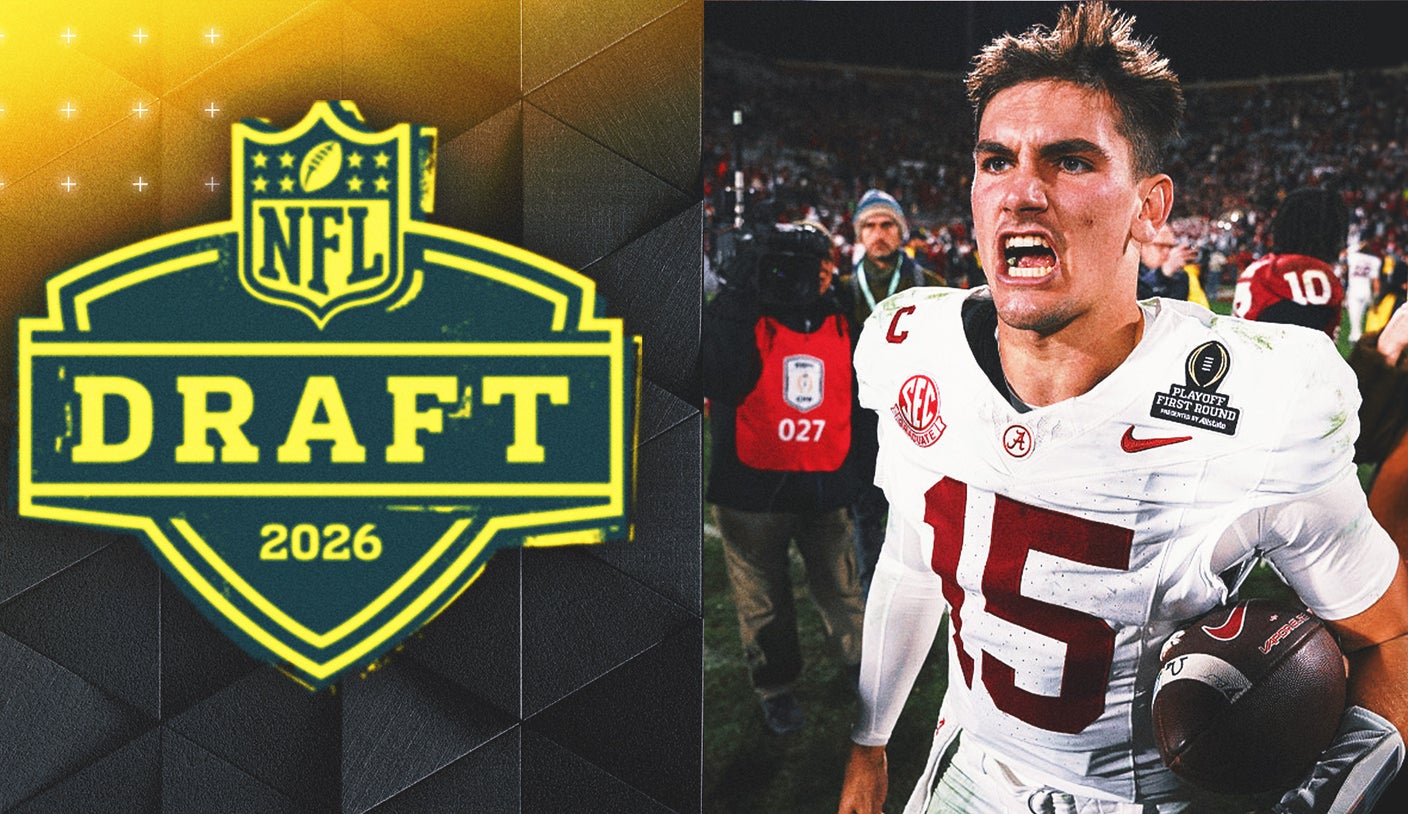
With the 2026 NFL Draft less than a month away, Alabama quarterback Ty Simpson has entered the chat as the most polarizing prospect in the class. After Simpson’s impressive throwing exhibitions at the NFL Scouting Combine and Alabama Pro Day created a buzz in scouting circles, evaluators could not wait to dig into the tape to determine whether the consensus QB2 of the class is worthy of a first-round pick.
Simpson, who passed for 3,567 yards with 28 touchdowns and five interceptions in 2025, is a mechanical marvel with flawless footwork and throwing mechanics that stand out on his tape. As the son of a college football coach with an extensive offensive background, Simpson operates like a clinician from the pocket, working through his reads at warp speed before routinely delivering darts to open receivers.
The combination of his high-IQ and refined mechanics resulted in a sizzling nine-game run in 2025 — a 66.8% completion rate with 21 touchdowns and one interception during that span — that had scouts buzzing about his prospects as a QB1. Directing a pro-style offense created by former NFL offensive coordinator Ryan Grubb, Simpson showcased his managerial skills and big-play potential with his surgical dismantling of four ranked opponents — Georgia, Vanderbilt, Missouri and Tennessee.
In a 24-21 upset over No. 5 Georgia last September on the road, Ty Simpson threw for 276 yards and two touchdowns and ran for a third TD. (Photo by Kevin C. Cox/Getty Images)
That scintillating stretch piqued the interest of evaluators intent on finding a potential QB1 in the 2026 or 2027 classes. Few expected Simpson, with another year of college eligibility and only 15 starts on his résumé, to enter this year’s draft. But the flashes from his spectacular run have stirred debate between old-school evaluators and new-age scouts on the importance of traits, experience, production and projection for quarterback prospects.
After studying Simpson’s 2025 season, here are my thoughts on the most polarizing player in the draft.
This Upside
If you were coaching a young quarterback on how to play the position and needed to show him a demonstration reel, Simpson’s highlight tape would suffice. The 6-foot-1, 211-pounder is a talented technician with footwork and mechanics that coaches rave about when teaching young players new skills.
He complements his polished mechanics with a high football IQ, enabling him to quickly work through his reads until he finds an open receiver or the weak spot in coverage. Simpson’s quickness in processing and game-day urgency separate him from most young quarterbacks who are hesitant and uncertain in the pocket. He has mastered the art of playing quickly without hurrying or rushing through the process when making post-snap reads.
As a result, Simpson consistently plays on time, trusting his awareness and diagnostic skills to make anticipatory throws against various coverage. He displays a keen understanding of his scheme and which routes should be available against the defensive coverage or pressure. Moreover, he maintains a big-picture focus, enabling him to play in attack mode and exploit the defense’s vulnerabilities at all times.
Where Ty Simpson ranks in Joel Klatt’s top 50 players
Additionally, Simpson’s exceptional intangibles enable him to carve up coverage with surgical precision despite lacking elite arm talent. His arm strength grades out at a “plus” level, but it would not rank as a superpower on par with the likes of Patrick Mahomes, Josh Allen or Joe Burrow. While it has been proven that a strong arm is not required to succeed in the NFL, Simpson must win with superior timing, anticipation and ball placement rather than throwing fastballs past defenders.
Coaches intrigued by Simpson will certainly want to incorporate the rhythm throws and play-action concepts that accentuate his game. He consistently nails the strike zone on “catch, rock and throw” concepts with in-breaking routes attached to the progression, and he’s just as effective on comebacks and deep outs thrown outside the numbers. With Simpson also capable of layering throws over intermediate defenders after executing play-action fakes, offensive coordinators can open up the playbook with the Alabama product under center.
In addition, Simpson’s athleticism, movement skills and effectiveness as a mobile playmaker shine on bootlegs and naked passes. He is a credible dual-threat with the potential to pick up first downs on nifty scrambles or pinpoint tosses to the boundary.
The Downside
Despite the impressive résumé and highlight reel Simpson has compiled as a one-year starter, there are some concerns about his ability to thrive as a pro due to his inexperience (15 career starts), size and arm talent. The recent failures of Anthony Richardson (13 college starts), Dwayne Haskins (14), and Mitchell Trubisky (13), combined with the inability of Trey Lance (17) to crack an NFL starting lineup, makes Simpson a high-risk prospect due to his limited reps.
Additionally, skeptics will point to his late-season struggles, particularly against Auburn and Georgia (in the SEC Championship Game), as potential concerns about his ability to adapt to defensive adjustments. Defensive coordinators successfully copied pressure patterns and coverage tricks that disrupted his rhythm in the initial Oklahoma matchup, as evidenced by Simpson completing just 58.5% of his passes in his final five games with six touchdowns and three interceptions.
With Simpson’s injuries also impacting his play, concerns over his size and durability are also major factors in his evaluation. As a slender quarterback, his late-season decline will lead to questions about his ability to withstand the pounding and wear-and-tear as a pro.
[2026 NFL Draft Confidential: Unfiltered Scouting Takes On Top 5 QBs]
Factor in his lack of elite arm talent, and there are plenty of red flags for evaluators to consider when breaking down Simpson. The naysayers will point to his underthrown vertical passes and his soft tosses between the numbers as potential concerns, especially since NFL defensive coordinators design game plans that force quarterbacks to make tight-window throws.
If Simpson is unable to punish opponents for their aggressive tactics, the offense will face a condensed field, making it harder to operate over a 17-game season.
At the NFL Combine, Ty Simpson received a prospect grade of 6.30 from NextGen Stats, putting him in the category of “will eventually be a plus starter.” (Photo by Cooper Neill/Getty Images)
The Verdict
Simpson is the ultimate high-risk, high-reward prospect at the position. He dazzles as a pocket passer, with pristine mechanics and a high IQ that will endear him to quarterback gurus across the league. Offensive coordinators employing intricate schemes that rely on touch, timing and precision will fall in love with Simpson due to his ability to execute advanced concepts at the collegiate level.
His strongest supporters within the league will see the Alabama star as a Brock Purdy-like playmaker. They’ll argue that Simpson could excel in an offense featuring a smorgasbord of creative concepts designed to exploit defensive vulnerabilities through clever scheming and misdirection, including play-action and bootleg passes.
While his lack of experience will require a detailed developmental plan that might include a “redshirt” year to adapt and adjust to the pro game, Simpson’s skills could translate into him becoming a successful starter down the road. Due to the time needed for him to develop, and the risks associated with his inexperience and size, I would grade him as a second-round prospect (future starter), knowing that he faces long odds of becoming a franchise-caliber player.
Read the full article here