





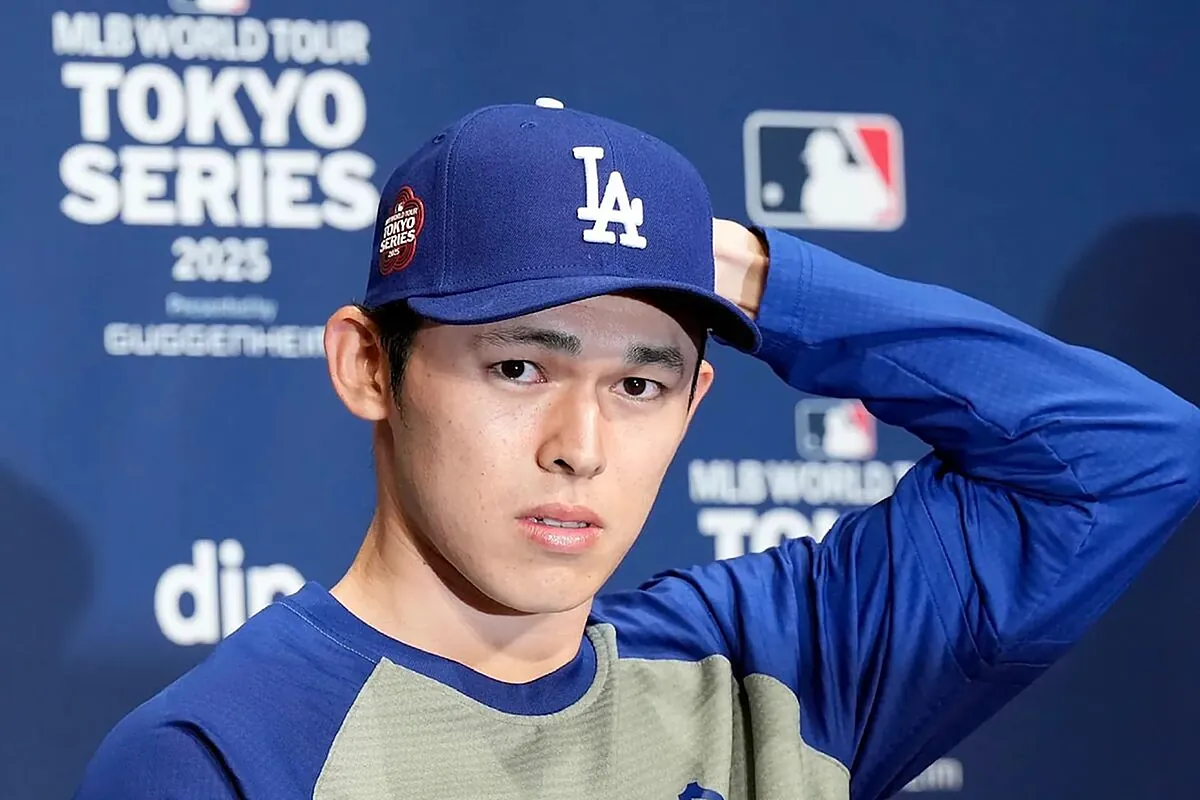
The Los Angeles Dodgers and Roki Sasaki are facing a complicated situation which neither party envisioned when they signed him. The highly coveted Japanese right-hander, signed after the Dodgers outmaneuvered 29 other MLB teams, is now facing a critical crossroads just weeks before the regular season begins.
Instead of refining an already elite skill set, Los Angeles now finds itself in a position where it may need to completely rebuild Sasaki‘s mechanics, confidence, and approach on the mound.
The 24-year-old has endured a disastrous spring, posting a staggering 15.58 ERA during exhibition play, with his inability to throw consistent strikes emerging as the most alarming issue.
The uncertainty surrounding Sasaki is perhaps the most concerning element. He does not appear to have clear answers for his struggles, openly admitting confusion about why his command has deteriorated so rapidly.
“If that’s the judgement, if that’s better, I think that’s fine,” Sasaki said in his native Japanese when asked about a potential minor-league assignment.
His latest outing in the Freeway Series against the Los Angeles Angels only amplified those concerns.
Sasaki failed to record a single out in the first inning, forcing the Dodgers to navigate an unconventional scenario in which he re-entered the game later due to exhibition rules. Even then, the performance offered little reassurance.
Across just over two innings of work, Sasaki walked six batters and repeatedly put himself behind in counts. Of the 66 pitches he threw, only 32 were strikes-a ratio that underscores the depth of his command issues.
Even more troubling, each of the four innings he started began with either a walk or a hit-by-pitch, immediately placing him under pressure.
Worrying parallels with a former Japanese star
A major-league scout in attendance drew an unsettling comparison, suggesting Sasaki resembled Shintaro Fujinami, another former Japanese standout whose career trajectory was derailed by sudden and persistent control problems.
The parallel highlights just how precarious Sasaki‘s situation could become if the underlying issues are not resolved.
Despite the struggles, Dodgers manager Dave Roberts has publicly backed his pitcher. “I believe in him,” Roberts said. “I really do. I told him that in the dugout.”
However, Roberts also acknowledged that continuing to give Sasaki opportunities at the major-league level is partly about evaluation.
“That’s the big, big driver of that,” he added, signaling that the organization is still trying to determine exactly what it has in the young arm.
For Sasaki, the challenge is not just physical but deeply technical and psychological. He noted that his control issues do not manifest during warmups, suggesting a disconnect between bullpen sessions and live-game situations.
“Part of it is that, but there are a lot of factors,” Sasaki explained. “Technical elements are what change. I can perform the same way if I can understand what changes when there’s a batter in front of me.”
When pressed further, his uncertainty became even more evident. “If that was clearer, it would be easier,” he admitted.
What will the Dodgers do next?
The Dodgers have attempted to expand his arsenal by encouraging him to develop a glove-side pitch, but Sasaki does not believe that adjustment is the root cause of his struggles.
Instead, the issue appears tied to execution and confidence – two elements that are notoriously difficult to rebuild quickly.
There are still flashes of promise. His fastball averaged 97.1 mph against the Angels, indicating that his raw velocity remains intact. Yet even that offers limited reassurance if he cannot consistently locate the pitch.
At this stage, a stint in the minor leagues feels increasingly inevitable.
For the Dodgers, the objective to guide Sasaki back to the dominant form he displayed in Japan is clear. But it may require some patience and more time than they originally signed up for.
Read the full article here