





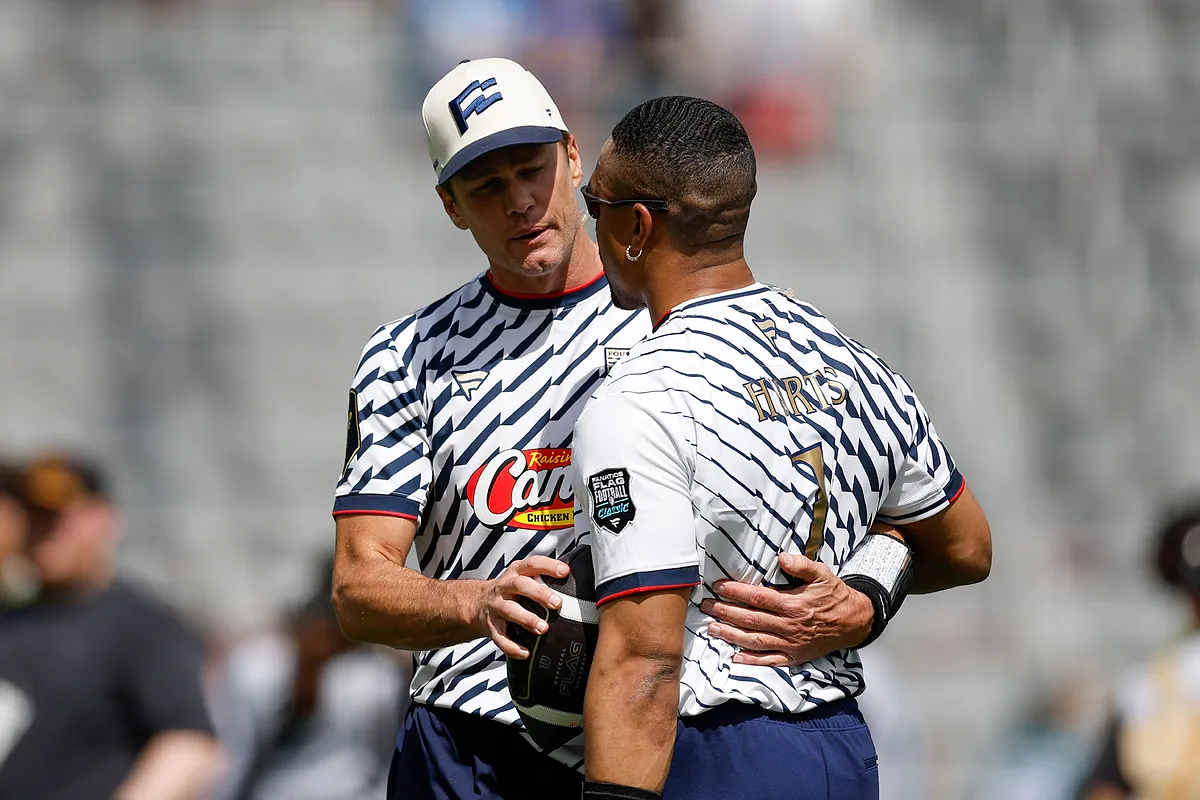
Scenes from Saturday afternoon at BMO Stadium told a story that even casual observers couldn’t miss: rows of blue seats stood empty as the Fanatics Flag Football Classic unfolded, an exhibition cofounded by NFL legend Tom Brady and designed to spotlight flag football on the road to its Los Angeles 2028 Summer Olympics debut.
Promoted as a marquee opportunity to elevate flag football’s profile ahead of its debut at the 2028 Summer Olympics, the event arrived with plenty of buildup.
However, it seemingly failed to generate the type of live attendance typically associated with professional sporting spectacles.
Originally announced in 2025 as a tournament that would bring NFL stars together under Olympicstyle rules, the Fanatics Flag Football Classic was set for March 21, 2026, at Kingdom Arena in Riyadh, Saudi Arabia, before geopolitical tensions prompted organizers to relocate it to Los Angeles.
The exhibition, played five-on-five with a round-robin format among three teams, including the United States men’s national flag football team, was designed to show off a non-contact variant of football that will appear for the first time in the Olympic program in 2028.
But it seemingly failed in its first large-scale event on the world, with attendances lower than expected.
Can Flag Football draw big crowds?
Yet at a venue built to seat over 22,000, broadcast footage and stills from the game day made clear that many seats remained unfilled, especially in the upper deck, with portions of the stadium even behind tarps despite being open for spectators.
This contrasted sharply with packed arenas and stadiums that host NFL, NBA, and other professional competitions around the country.
The turnout raised questions about the appeal of flag football as a live draw, even at an event featuring household names from the tacklefootball world and built around a sport with fastgrowing participation at the youth and amateur levels.
With grassroots programs expanding and flag football gaining global traction, organizers and governing bodies have cited the sport’s accessibility and suitability for international competition as key factors in its Olympic inclusion.
But the gap between participation and live event interest was on display at BMO Stadium.
Brady’s presence lent cachet to the event, marking his first competitive return to the field since retiring from the NFL, and the rosters assembled for the Fanatics Flag Football Classic included a mix of current and former professional stars drafted into teams alongside elite flag football competitors.
Flag football’s growing pains
Observers in and around the sport have noted that while flag football’s popularity has surged, particularly at youth and amateur levels, it has yet to secure the same passionate following that traditional tackle football commands.
Youth leagues, high school programs, and international competitions have all helped broaden the base of players, but translating that into spectator enthusiasm requires a separate set of dynamics.
Until then, it seems flag football needs some more backing and legitimacy before it can truly explode on the world stage.
But as long as Brady is attached, there is always a chance that fans will eventually catch on and tune in.
Read the full article here