




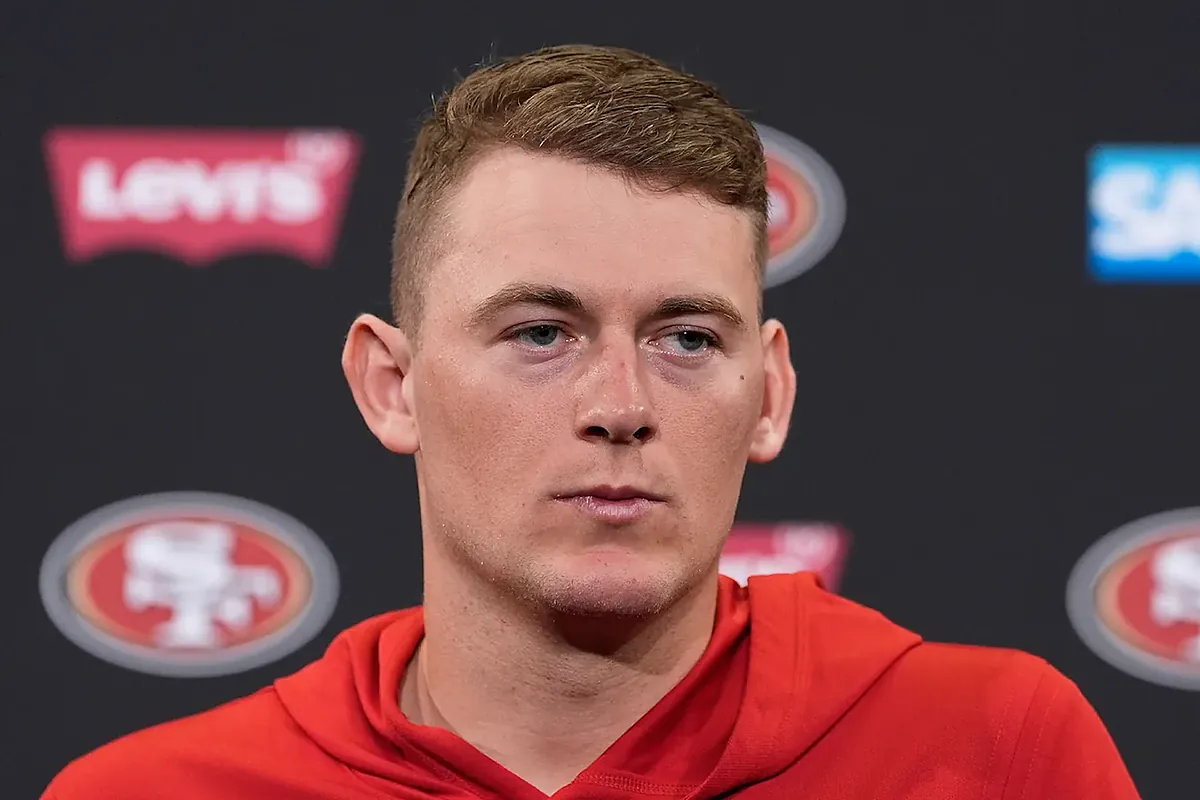
Mac Jones may not have the trade market many expected, and that reality reshapes his immediate NFL future, despite a productive 2025 stint as desperate suitors have yet to line up.
After stepping in for Brock Purdy with the San Francisco 49ers, Jones delivered steady results, yet quarterback-needy teams appear focused elsewhere.
League dynamics help explain the hesitation, because franchises can pursue veteran free agents without surrendering draft capital – and more names may surface as roster cuts unfold.
Through eight appearances in 2025, Jones threw for 2,151 yards with 13 touchdowns and six interceptions, posting a 69.6 completion rate and guiding the club to a 5-3 mark.
Those numbers compare favorably to several current starters, yet teams such as the Minnesota Vikings and New York Jets continue surveying broader options.
Reports indicate the Vikings are evaluating quarterbacks including Anthony Richardson, Kyler Murray and Geno Smith, while also monitoring other veterans.
San Francisco signed Jones to a two-year deal in 2025, thereby retaining contractual control through 2026. Publicly, the organization has downplayed trade talk, although leverage always depends on compensation. Jones is scheduled to earn $3.25 million in 2026, a team-friendly figure.
However, if acquired as a starter or true competitor, he could reasonably seek an adjusted contract. This could be money teams are not quite ready to table yet.
Consequently, Jones may need patience, because once the initial free-agent wave subsides, a team still unsettled at quarterback could revisit trade discussions.
Mac Jones’ rocky history and why the market remains cautious
Jones entered the league as the 15th overall pick in 2021 with the New England Patriots, and he immediately became their Week 1 starter.
As a rookie, he threw for 3,801 yards and 22 touchdowns, earned Pro Bowl alternate recognition, and led New England to a playoff berth, exceeding most expectations.
However, coordinator turnover and schematic instability in 2022 disrupted continuity, and the numbers reflected that shift, as efficiency dipped and mistakes climbed.
After throwing 3,801 yards with 22 touchdowns and 13 interceptions in 2021, Jones fell to 2,997 yards, 14 touchdowns and 11 interceptions in 14 games during 2022. His completion rate slipped from 67.6 percent to 65.2 percent, while his passer rating declined from 92.5 to 84.8, underscoring the broader offensive stagnation.
The Patriots finished 8-9, and although Jones still flashed upside, the statistical downturn contrasted sharply with his playoff-bound rookie campaign.
By 2023, inconsistency and repeated benchings further clouded his trajectory, and production dropped again amid mounting pressure. In 11 starts that season, Jones managed 2,120 passing yards with 10 touchdowns and 12 interceptions, posting a 77.0 passer rating before being sidelined late.
Turnovers, including multiple multi-interception games, compounded concerns, and New England‘s 4-13 finish cemented the perception that his development had stalled.
A 2024 trade to the Jacksonville Jaguars offered limited opportunities before his 2025 revival in San Francisco restored credibility, especially given injuries and a depleted supporting cast reliant on playmakers like Christian McCaffrey and George Kittle.
Still, front offices often prioritize upside or mobility in today’s quarterback market, and Jones is viewed more as a distributor than a dynamic creator, while financial calculus also matters. Signing a released veteran carries fewer transactional costs and yields no draft capital impact, so his situation may remain unchanged until closer to the start of the 2026 NFL season in September.
Read the full article here