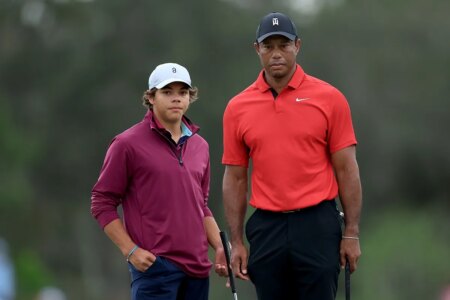





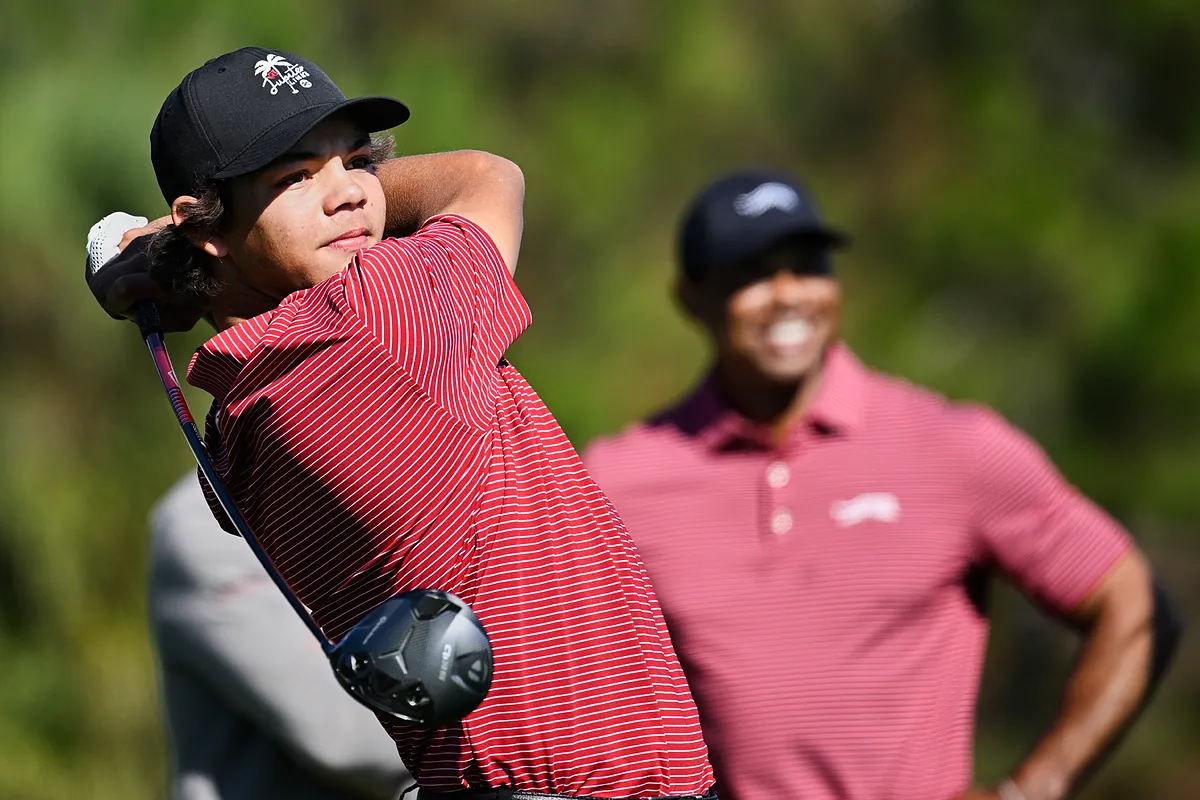
For as long as Charlie Woods has competed in junior tournaments, conversations about his future have rarely sounded like those surrounding a typical 16-year-old golfer.
Instead of asking which amateur event he might win next, many observers jump straight to a far bigger question: when – not if – he will capture a major championship.
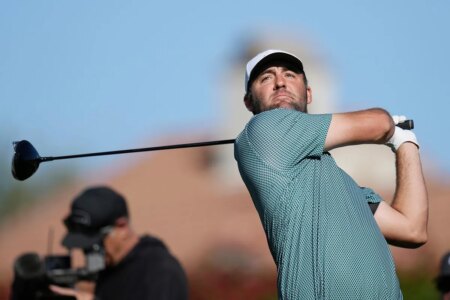
That level of projection is exactly what PGA Tour rookie Neal Shipley believes makes the young golfer’s journey uniquely complicated.
Appearing on Fore Play Episode 837, Shipley reflected on his interactions with Charlie Woods and offered both encouragement and realism.
“Knowing Charlie a little bit and having the opportunity to interact with him a few times, I think he’s really well adjusted. He loves competing,” Neal Shipley spoke on the podcast.
But admiration quickly gave way to empathy for the burden that comes with being the son of Tiger Woods.
“I wouldn’t want to trade shoes with him. He’s got it tough for a 17 or 18-year-old kid. It’s a lot of attention.”
That attention has followed Charlie Woods at every step, from televised appearances alongside his father to scrutiny over his college choice. When he committed to Florida State in February 2026, he quietly broke from a narrative that many had treated as destiny. In 1993, Tiger Woods chose Stanford, won the NCAA individual title three years later, and launched one of the greatest professional careers in golf history. For years, fans assumed his son would retrace that exact path.
Instead, Charlie Woods opted to create his own.
“Talk about it since you were 13 years old about how he’s going to win majors,” Shipley said on the podcast, highlighting how premature expectations can distort a young player’s development.
Then came the reality check that cuts through legacy and hype.
“Just because your last name is Woods does not mean you’re going to put the ball in the hole better than other people on the golf course.”
Why development, not destiny, will define his path
The statement underscores a fundamental truth about elite golf: reputation does not translate into lower scores. Shipley, who carved his own route to the PGA Tour after beginning at James Madison and transferring to Ohio State, understands how fine the margins are between a decorated junior career and professional success. Many highly ranked amateurs never secure a tour card.
At the time of his commitment, Charlie Woods was ranked No. 21 in the AJGA standings – a dramatic improvement from outside the top 600 just a year earlier. His recent résumé includes a victory at the Team TaylorMade Invitational, a T9 finish at the Junior PGA Championship, and a clutch final-round 68 to capture a state title for The Benjamin School.
Meanwhile, future teammate Mike Russell enters Florida State as the nation’s top-ranked junior, already boasting a deeper collection of national accolades. The contrast illustrates how competitive college golf has become – even for players with famous surnames.
“Great facility. Great coaches. Great decision for him,” Shipley said of the move to Tallahassee.
The Seminoles’ program, guided by veteran coach Trey Jones, has produced major champions like Brooks Koepka and PGA Tour standouts such as Daniel Berger. The infrastructure is in place. What remains uncertain is how Charlie Woods will continue to evolve within it.
Ultimately, Shipley‘s message was not dismissive – it was grounded. “It’s hard,” he said plainly. Golf does not grant exemptions based on lineage. Every player must earn results against equally driven competitors.
For Charlie Woods, the hardest truth may also be the most freeing: his future will be shaped not by comparison to his father, but by whether he can consistently outperform the field on his own terms.
Read the full article here