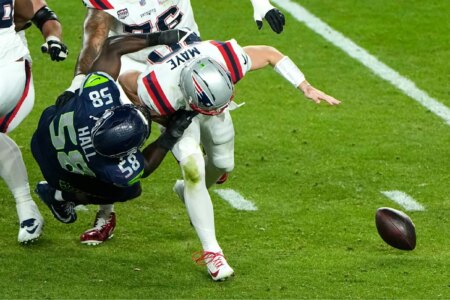
Super Bowl LX was supposed to mark the arrival of Drake Maye as the unquestioned future of the New England Patriots.
Instead, it became a harsh lesson in how quickly championship defenses can dismantle a young quarterback’s confidence.
While the 29-13 defeat to the Seattle Seahawks felt jarring to many in New England, league insiders had already identified the issues that surfaced under the brightest lights.
Throughout the season, Maye’s physical traits, arm strength, mobility, and fearlessness sparked optimism. However, evaluators across the NFL had also studied the finer details of his pocket mechanics.
According to Mike Sando of The Athletic, some opposing coaches believed Maye’s structured approach to reading plays made him predictable.
One coach explained, “Maye is going to look exactly where he is supposed to look for as long as he is supposed to look. He will stay there and that is why he takes sacks. If you can break that timing, you can get after him.”
Seattle built its defensive strategy around that very principle. By collapsing the pocket quickly and disguising coverage responsibilities, the Seahawks disrupted the rhythm Maye relies on.
Rather than progressing fluidly through reads or adjusting on instinct, he appeared stuck to the original script of each play. The hesitation allowed defenders extra time to close passing lanes and pressure the quarterback into hurried decisions.
Veteran awareness meets young quarterback mistakes
The turning point came in the fourth quarter, when former New York Giants safety Julian Love stepped in front of an errant throw to extinguish any realistic hope of a Patriots rally. Love had already diagnosed what was happening.
On the sideline, he described Maye’s approach in blunt terms: “Classic young quarterback. As soon as the back foot hits, he’s going to where he wants, but he’s pausing for a second to confirm he’s open. He’s not blindly doing it like Stafford.”
The comparison to Los Angeles Rams quarterback Matthew Stafford, a veteran known for anticipatory throws, was telling.
Experienced passers often release the ball before receivers fully separate, trusting the concept and timing. Maye, by contrast, appeared to seek visual confirmation, a split-second delay that proved costly against disciplined coverage.
Love also stressed the importance of defenders choosing to “stay patient,” reinforcing the idea that Seattle expected Maye to eventually test tight windows.
That patience paid off. The interception was not simply the product of pressure, but of anticipation from a defense prepared for Maye’s tendencies.
This issue has surfaced before. Earlier in the season, head coach Mike Vrabel criticized Maye for attempting to “win it all in one play” following a loss to the Pittsburgh Steelers.
That aggressive instinct can energize an offense, but it also invites mistakes when combined with heavy pressure and layered coverage schemes.
To move forward, the Patriots must address multiple factors. Improved offensive line play is essential, as constant disruption magnifies any quarterback’s flaws.
Yet coaching adjustments are equally critical. During the franchise’s most successful years, Tom Brady thrived within the disciplined framework of Josh McDaniels‘ offense, consistently taking what defenses allowed rather than forcing high-risk throws.
Maye’s ceiling remains high, and young quarterbacks often grow significantly from painful postseason defeats. But Super Bowl LX demonstrated that raw talent is only part of the equation.
Until Maye refines his anticipation, speeds up his internal clock, and embraces situational patience, opposing defenses will continue to prepare for the very habits Seattle so effectively exploited.
Read the full article here