





At the 82nd Academy Awards, the winner of the Oscar for Best Foreign Language Film was The Secret in Their Eyes, an Argentinean film directed by Juan Jose Campanella, who co-wrote the screenplay with Eduardo Sacheri, author of the novel on which the film was based, The Question in Their Eyes.
A passionate and romantic soccer fan, lyrical about the ball and letters, Sacheri has written stories and novels that have the ball as the protagonist or as a pleasant excuse to tell stories that are linked to a field, a team or a jersey. Among his publications we can mention Esperandolo a Tito, Papeles en el viento, Lo raro empezo despues and Un viejo que se pone de pie.
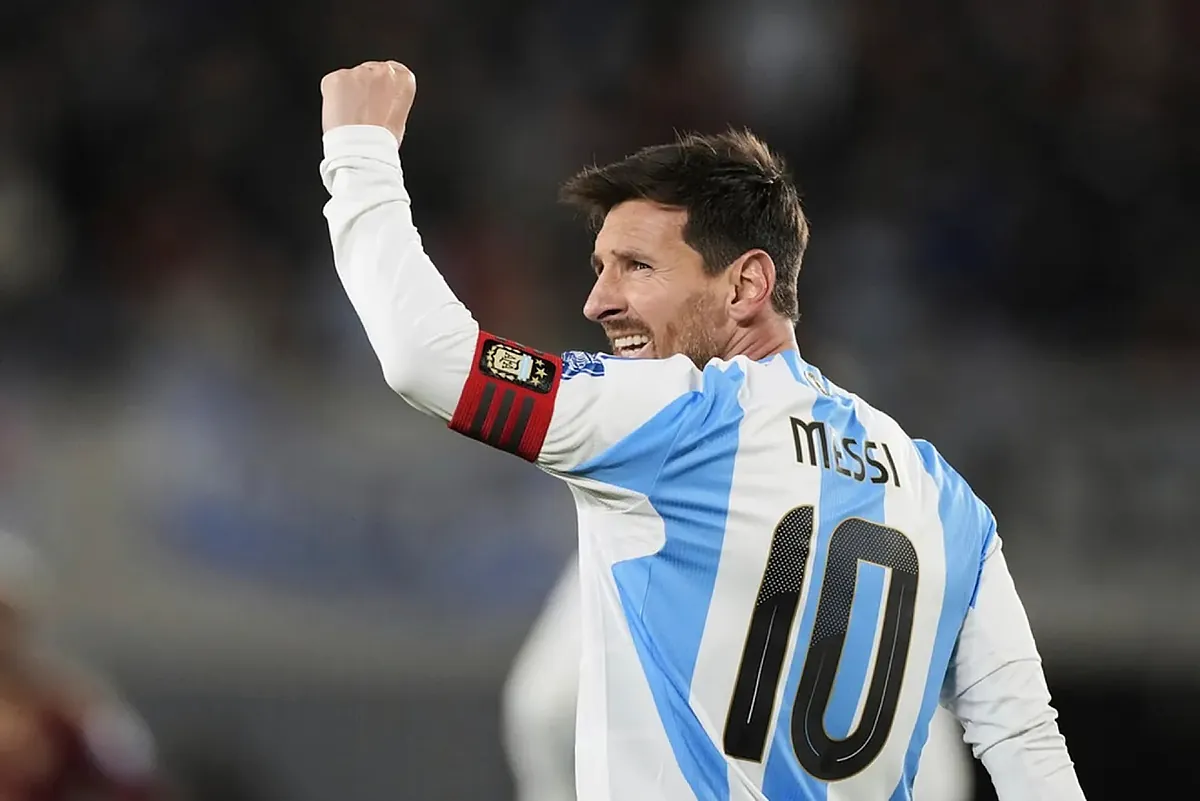
Like many Argentines, the writer is fortunate to have lived through the joy of seeing Diego Armando Maradona and Lionel Messi lift the cup that accredited them as world champions. He lives to tell what it means for a fan like him to witness two eras that gave him the joy of celebrating and savoring the glory of a World Cup title with two soccer players who are already part of history.
In an exclusive interview with MARCA USA in Spanish, Eduardo Sacheri talks about that special feeling that Maradona and Messi arouse in his passion for soccer.
Eduardo Sacheri, the dream of having seen Maradona and Messi as champions
MARCA USA IN ENGLISH: Diego Armando Maradona and Lionel Messi are two monsters in the history of soccer who were the best on the planet in their respective eras and contexts. For a fan and Argentine like you, what was it like to live those two stages with two Argentine geniuses who were world champions?
EDUARDO SACHERI: It’s a very special experience. I think what unites Maradona and Messi is that they are absolutely outstanding and unforgettable figures in the history of football, but it is true that their symbolic significance in Argentina was different
With Maradona, there was a widespread feeling of absolute admiration, of boundless gratitude, which had to do precisely, and above all, with the 1986 World Cup; with what that World Cup had meant, with what it had meant to play against England in that World Cup.
And with Messi, there was a more ambivalent feeling in my country. There were many people, myself included, who felt a deep admiration for Leo and that’s it. While others tended to compare him with Maradona and put him on a second level, because with the national team he had not had those achievements (before 2022).
I think the cycle of Leo’s last few years with the national team has worked the miracle of equating them. Well, I say equating them, although each one still has its different resonance, because the Argentina of 2022 is not the Argentina of the 1980s, but they are certainly on an equal footing that, I think, most Argentines are very happy about
MARCA USA IN SPANISH: Maradona was kicked a lot and seemed unbeatable, because he kept playing as if nothing had happened. With Messi, we ended up seeing the footballer he is when they started to kick him and he resisted those blows. Something changed in Messi with the rough play that ended up awakening the monster of his figure. Is this reading correct? Are we right or wrong with this appreciation?
EDUARDO SACHERI: I find this interpretation you give very suggestive, very interesting: to suffer, to suffer the violence of the rivals that could have awakened that monster. I don’t think our views are antithetical, but rather complementary. I think that Messi prepared himself for that last great opportunity, especially after the failure of the World Cup in Russia.
I think Leo did the math and said “there’s one last train”. Why do I say that? Hopefully the Argentine national team will do very well in the next World Cup, but for Leo’s performance, for the rigorous and demanding life of the great players… I think Leo said “my last great opportunity is Qatar” and I think that must have influenced a lot in the spirit with which he faced that World Cup.
I also think that generationally the Argentine national team, with Scaloni as coach, did a great job of learning: surrounding Messi with young talent, that is to say, most of the world champions in Qatar knew that they were helping Messi to become champion. It’s something very beautiful in its own way. This “we can collaborate with Messi in this last great challenge, in this last great dance” and I think that also had to do with it.
MARCA USA: What do you think of the phenomenon that is Messi playing with Inter Miami and that he has influenced a lot so that a nation that was not believed to be adept or close to soccer, namely the United States, is now very involved with this sport?
EDUARDO SACHERI: Leo belongs to an era in which global idols have enormous reach thanks to social networks and the circulation of information. Leo belongs to the mature stage of this possibility, because Maradona was a global phenomenon before globality.
I think one of the great things about Diego was that he anticipated the global in the sense that he was a global figure when the technological conditions for that globalization were not yet in place. However, Diego achieved it.
I believe that Leo, now, with the prestige and quality he has, added to these possibilities, generates what happens in the United States, this that a country looks a little sideways at this sport. Well, with the magnet that represents Messi, he feels even more attracted.
Read the full article here