





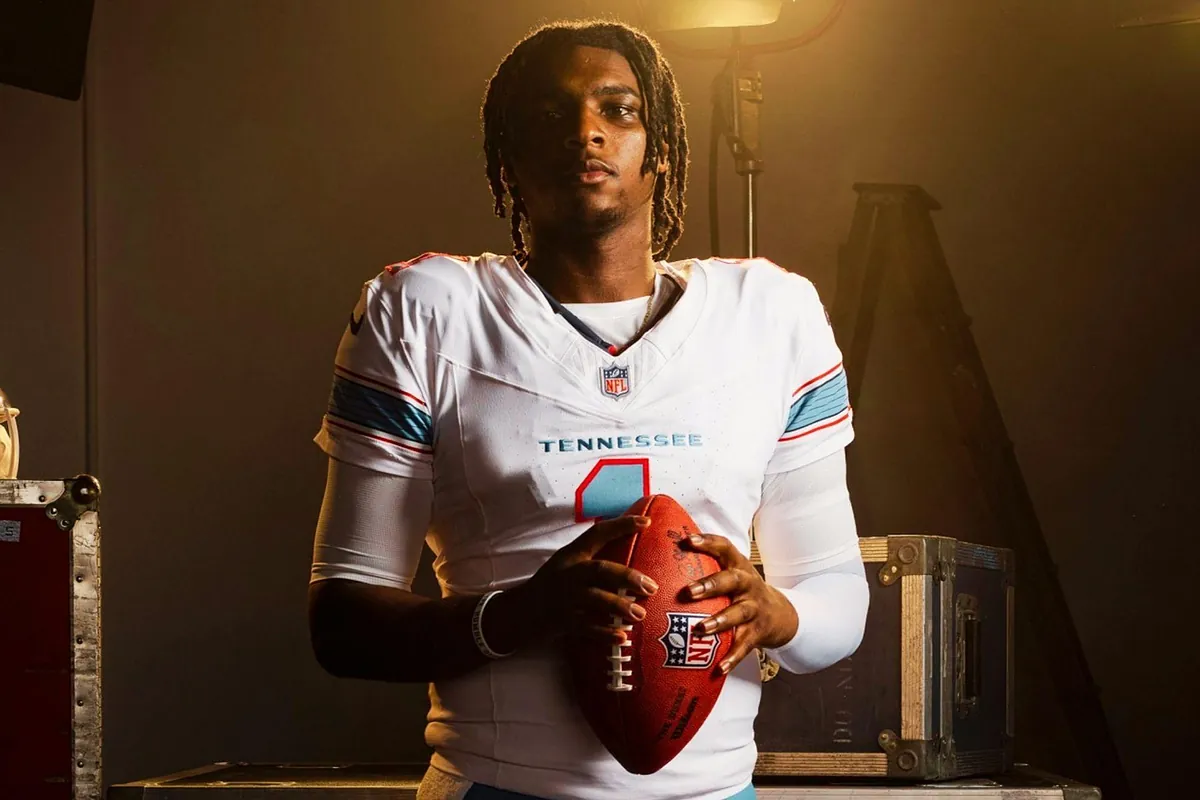
The Tennessee Titans are still searching for long-term stability at quarterback, and the question surrounding Cam Ward is already taking center stage: is he the franchise cornerstone the organization has been waiting for, or is there a risk he falls short of expectations?
Ward‘s rookie season did not provide a definitive answer, but it did offer enough evidence to keep the conversation open. On the surface, a 3-14 record raises concerns about the direction of the team and the effectiveness of its quarterback. But a deeper look shows a player who began to find his footing late in the year. Over a four-game stretch from Weeks 14 to 17, Ward threw multiple touchdown passes in each game while leading the Titans to a 2-2 record. It was a small sample, but it demonstrated growth in decision-making and confidence.
By the end of the season, Cam had compiled 3,169 passing yards with 15 touchdowns and seven interceptions. Those numbers are not overwhelming, but they reflect a level of efficiency that is encouraging for a first-year starter on a struggling team. He avoided major turnover issues and showed the ability to manage games while still making plays down the field.
Cam made a strong impression on new head coach
Off the field, Ward has already made a strong impression on new head coach Robert Saleh. Known for his defensive background and leadership style, Saleh has emphasized character and work ethic as foundational traits for building a winning culture. Ward has checked those boxes early.
Saleh noted that even without being able to discuss football during certain periods due to league rules, Cam‘s presence around the facility stood out. He has made a point to connect with everyone in the building, from support staff to trainers, showing a level of maturity that coaches value in a young quarterback. Saleh‘s belief is clear: he sees a player whose approach gives him a strong chance to succeed at the highest level.
That optimism is being paired with a significant change on the coaching staff. The addition of offensive coordinator Brian Daboll could prove to be one of the most important factors in Ward‘s development. Daboll has built a reputation for maximizing quarterback potential, most notably during his time with the Buffalo Bills, where he helped transform Josh Allen into one of the league’s elite players.
Tension and accountability are necessary for growth
The dynamic between Ward and Daboll could define the Titans’ future. Saleh has already embraced the idea of a competitive relationship between quarterback and coordinator, believing that tension and accountability are necessary for growth. For Ward, adapting to a new playbook and system will be a critical test heading into his second season.
There are still legitimate concerns. Ward suffered a right shoulder injury in the season finale, and while Saleh has said the quarterback is progressing well, any injury to a young passer invites caution. Durability and health will be key as he prepares for a full offseason program, which begins April 7 and includes minicamps and organized team activities in the following weeks.
Ultimately, the answer to whether Ward is the Titans‘ franchise quarterback is still unfolding. He has shown enough flashes to justify patience, and the organization has surrounded him with a coaching staff capable of accelerating his development. At the same time, the margin for error in the NFL is small, and second-year quarterbacks are often judged by how quickly they turn potential into consistent production.
Read the full article here